The Canidae family encompasses wolves, foxes, jackals, coyotes, and wild dogs. These intelligent and adaptable predators are found on every continent except Antarctica. Discover the full diversity of wild canids.
🐺 Animal Families
Dog Family (Canidae) — Wolves, Foxes & Wild Dogs
1
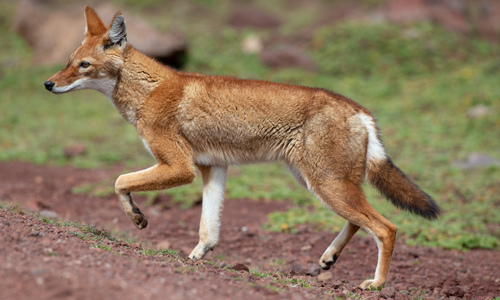
Canis simensis Rüppell, 1840, the Ethiopian wolf, is a high-altitude canid endemic to the Ethiopian highlands.
The Ethiopian wolf (Canis simensis Rüppell, 1840) matches the North American coyote in size and body build. It is larger than the black-backed jackal, side-striped jackal, and African wolf, and has comparatively longer legs. Its skull is very flat, with a long facial region that makes up 58% of the skull’s total length. The species’ ears are broad, pointed, and face forward. Its teeth, particularl...
View full details → 2
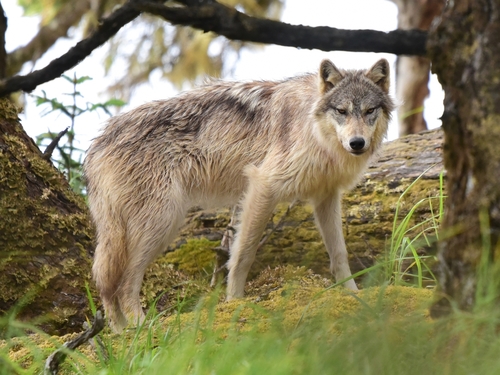
Canis lupus Linnaeus, 1758, the gray wolf, is the largest extant canid, found across Eurasia and North America with described physical traits, habitat, reproduction.
The wolf (Canis lupus Linnaeus, 1758) is the largest living member of the Canidae family. It can be distinguished from coyotes and jackals by a broader snout, shorter ears, a shorter torso, and a longer tail. It has a slender, powerful build with a large, deeply descending rib cage, a sloping back, and a heavily muscled neck. Its legs are moderately longer than those of other canids, which allows ...
View full details → 3
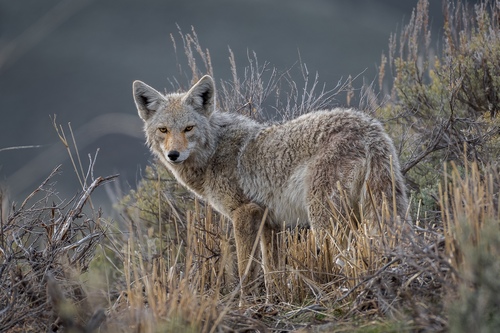
Canis latrans (coyote) is a North American canid with expanded range, and its fur and meat have human uses.
Scientific name: Canis latrans Say, 1823. Description: Male coyotes average 8 to 20 kg (18 to 44 lb) in weight, while females average 7 to 18 kg (15 to 40 lb). Size varies geographically: northern subspecies, which average 18 kg (40 lb), tend to grow larger than the southern Mexican subspecies, which average 11.5 kg (25 lb). Average total length ranges from 1.0 to 1.35 m (3 ft 3 in to 4 ft 5 in), ...
View full details → 4
Canis lupus rufus Audubon & Bachman, 1851
Canis lupus rufus Audubon & Bachman, 1851
🦋 Animalia Canidae
This is a detailed description of the physical traits, distribution, habitat, and reproduction of the wolf.
Canis lupus rufus Audubon & Bachman, 1851 (red wolf) is a subspecies of the gray wolf (Canis lupus). As a member of the Canidae family, the wolf is the largest living canid, and can be distinguished from coyotes and jackals by a broader snout, shorter ears, a shorter torso, and a longer tail. It has a slender, powerful build, with a large, deeply descending rib cage, a sloping back, and a heavily ...
View full details → 5
This is a detailed description of the wolf, covering its physical traits, distribution, habitat, and reproductive behavior.
The wolf is the largest living member of the canid family (Canidae). It can be distinguished from coyotes and jackals by a broader snout, shorter ears, a shorter torso, and a longer tail. It has a slender, powerfully built body with a large, deeply descending rib cage, a sloping back, and a heavily muscled neck. A wolf's legs are moderately longer than those of other canids, which lets the wolf mo...
View full details → 6
Canis lupaster Hemprich & Ehrenberg, 1833
Canis lupaster Hemprich & Ehrenberg, 1833
🦋 Animalia Canidae
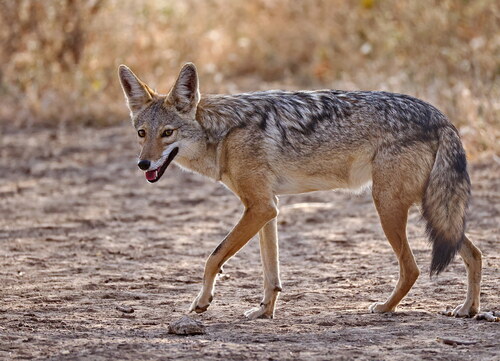
This is a description of the African wolf, covering its physical traits, distribution and occupied habitats across Africa.
The African wolf (Canis lupaster Hemprich & Ehrenberg, 1833) is intermediate in size between African jackals (Lupulella mesomelas and Lupulella adusta) and small gray wolf subspecies. Both sexes weigh 7–15 kg (15–33 lb), and stand 40 cm (16 in) tall. There is substantial geographic size variation: specimens from Western and Northern Africa are larger than those from East Africa. It has a relativel...
View full details → 7
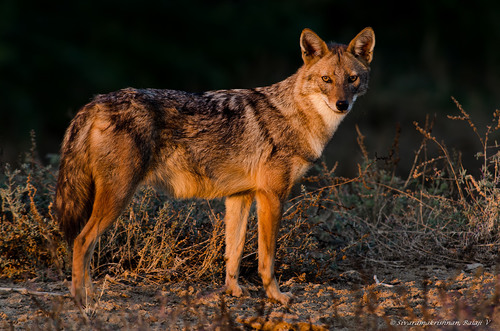
Canis aureus (golden jackal) is a canid species found across Eurasia, described for physical traits, ecology, reproduction, and fur use.
Canis aureus Linnaeus, 1758, commonly called the golden jackal, resembles the gray wolf, but differs in having a smaller body, lighter weight, more elongated torso, a less prominent forehead, shorter legs and tail, and a narrower, more pointed muzzle. Its legs are long relative to its body size, with slender feet and small foot pads. Males have a body length of 71–85 cm (28–33 in), while females m...
View full details → 8
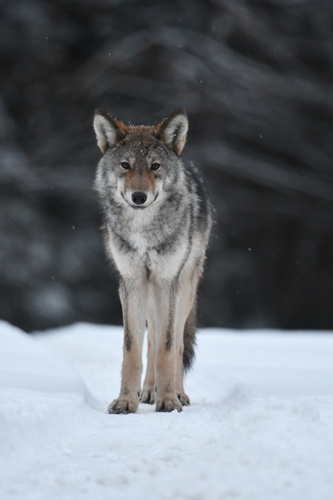
Eastern wolf (Canis lycaon) is a canid intermediate in size between coyotes and gray wolves, native to central North America.
Charles Darwin was informed that two types of wolf lived in the Catskill Mountains: one was a lightly built, greyhound-like animal that hunted deer, and the other was a bulkier, shorter-legged wolf. Eastern wolves typically have grizzled grayish-brown fur mixed with cinnamon. Their flanks and chest are rufous or creamy, while the nape, shoulders and tail are a mix of black and gray. Unlike gray wo...
View full details → 9
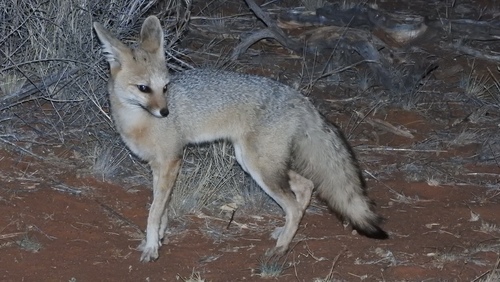
Vulpes chama (Cape fox) is a small southern African canid with well-documented physical traits, range, and reproduction.
Vulpes chama, also called the Cape fox, is a small canid. Excluding the tail, its body length is usually between 45 and 62 cm (17.5 to 24.5 in), while its tail measures 30 to 40 cm (12 to 15.5 in). It stands 30 to 35 cm (12 to 14 in) tall at the shoulder, and weighs between 2.5 and 4.5 kg (5.5 to 9.9 lb). Its skull is very similar to that of Vulpes bengalensis, though the cranium of V. chama is sl...
View full details → 10
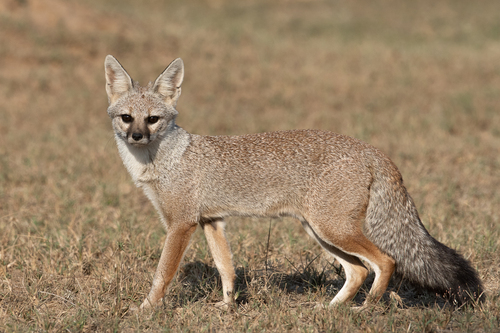
Vulpes bengalensis, the Bengal fox, is a small canid endemic to the Indian subcontinent with specific habitat preferences and social behavior.
The Bengal fox (scientific name Vulpes bengalensis (Shaw, 1800)) is a relatively small fox species with an elongated muzzle, long pointed ears, and a long bushy tail. Its fur (pelage) ranges in color from buff to silver-gray, creating an overall grizzled appearance; it is mostly grayish on the back (dorsally) and paler on the underside (ventrally). The legs are typically brownish or rufous, and th...
View full details → 11
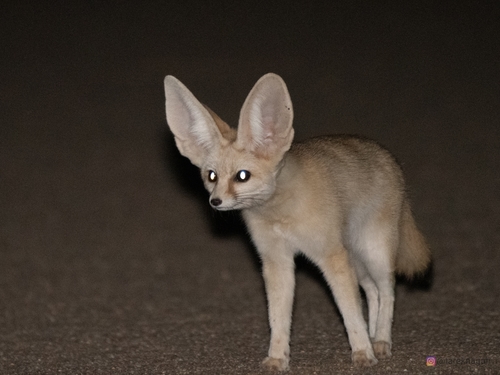
The fennec fox (Vulpes zerda) is the smallest canid, native to the Sahara desert, with distinctive large ears.
Vulpes zerda, the fennec fox, is the smallest canid species. Its fur is sand-colored, which reflects sunlight during the day and helps retain warmth at night. Fennec foxes have a black nose, and their tapering tails end in a black tip. They have long ears, which have the highest ratio of ear size to body size of any canid; this trait likely helps them dissipate heat and locate prey. The backs of t...
View full details → 12
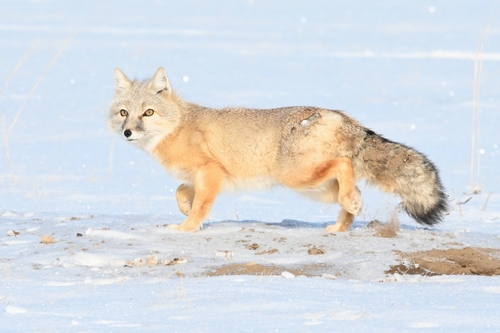
Vulpes corsac, the Corsac fox, is a medium-sized steppe-dwelling fox native to central and northeast Asia.
The Corsac fox (scientific name Vulpes corsac, first described by Linnaeus in 1768) is a medium-sized fox. Adults measure 45 to 65 cm in head-and-body length, have tails 19 to 35 cm long, and weigh between 1.6 and 3.2 kilograms. Most of its body fur ranges from grey to yellowish, with paler underparts and pale markings on the mouth, chin, and throat. In winter, its coat becomes much thicker and si...
View full details → 13
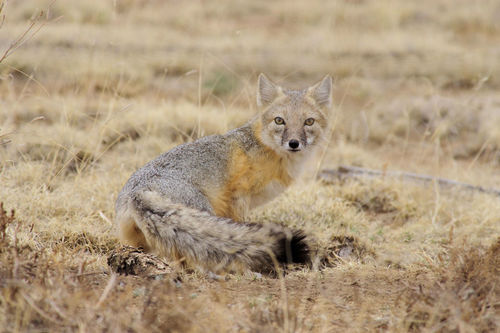
Vulpes velox, the swift fox, is a small North American prairie canid known for its speed and female-centered social structure.
The swift fox (Vulpes velox (Say, 1823)) has a dark, grayish tan base color that shifts to yellowish tan across its sides and legs. Its throat, chest, and belly range in color from pale yellow to white. The tip of its tail is black, and it has black patches on its muzzle. Its ears are noticeably large, similar to those of the kit fox, though they are positioned slightly farther apart on the head t...
View full details → 14
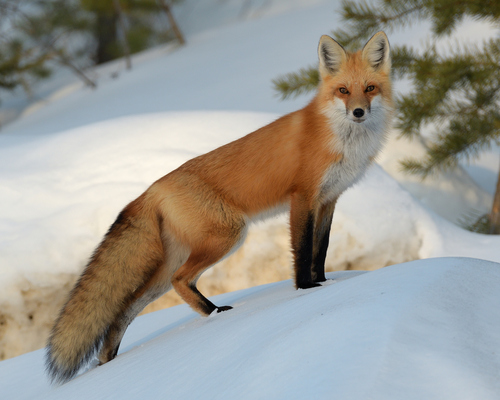
Vulpes vulpes (red fox) is the largest true fox, widely distributed across the Northern Hemisphere, hunted extensively for fur.
The red fox (Vulpes vulpes), formally described by Linnaeus in 1758, is the largest species of true foxes and one of the most widely distributed members of the order Carnivora. It occurs across the entire Northern Hemisphere, covering most of North America, Europe, and Asia, as well as parts of North Africa. Its range has expanded alongside human settlement, and the species was introduced to Austr...
View full details → 15
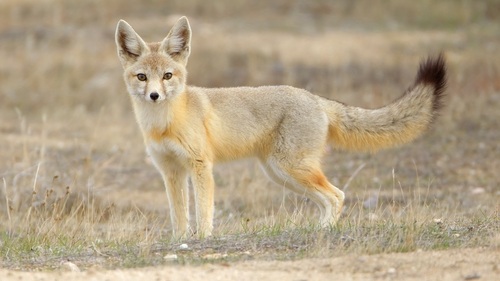
The kit fox (Vulpes macrotis) is a small North American fox native to arid regions of the southwestern US and Mexico.
The kit fox (Vulpes macrotis) is a fox species that lives in arid and semi-arid regions of the southwestern United States, as well as northern and central Mexico. It is the smallest of the four Vulpes species found in North America, and is among the smallest vulpines in the world. Due to its large ears, it has been called the North American counterpart of the fennec fox. The northernmost point of...
View full details → 16
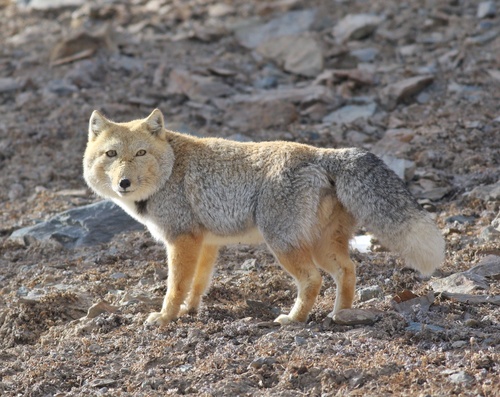
Vulpes ferrilata, the Tibetan fox, is a specialized carnivorous fox native to high elevations of the Tibetan Plateau and surrounding regions.
Vulpes ferrilata, commonly known as the Tibetan fox, has a soft, dense rufous coat that covers its crown, neck, back, and lower legs. It has a narrow muzzle; grey fur on its cheeks, flanks, upper legs, and rumps; and a bushy tail with a white tip. Its short ears are tan to greyish tan on the outer back, with white fur on the inner ear and underside. For adult Tibetan foxes, head-and-body length (e...
View full details → 17
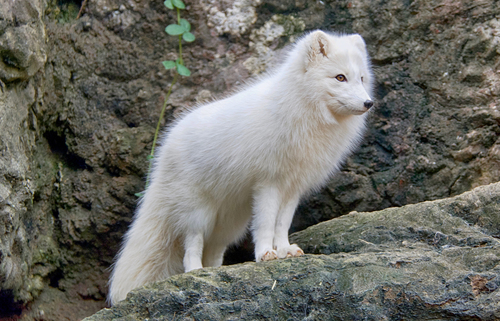
Vulpes lagopus, the Arctic fox, is a small cold-adapted fox native to Northern Hemisphere Arctic regions.
The Arctic fox (scientific name Vulpes lagopus), also called the white fox, polar fox, or snow fox, is a small fox species native to Arctic regions of the Northern Hemisphere, and common across the Arctic tundra biome. It is well adapted to cold environments, and is best known for its thick, warm fur that also serves as camouflage. It has a large, very fluffy tail. In the wild, most individuals do...
View full details → 18
Urocyon cinereoargenteus (Schreber, 1775)
Urocyon cinereoargenteus (Schreber, 1775)
🦋 Animalia Canidae
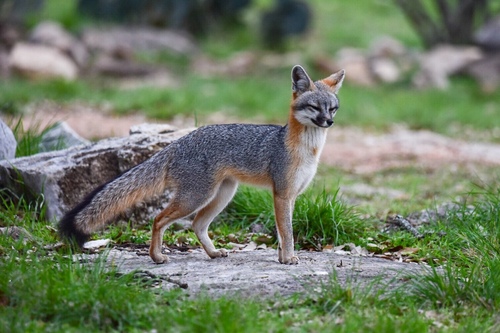
This is a detailed description of the physical traits, distribution, habitat, and reproduction of the gray fox, Urocyon cinereoargenteus.
Description: The gray fox (Urocyon cinereoargenteus) is mainly distinguished from most other canids by its grizzled upper parts, strong neck, black stripe running down the middle of its tail, and a black-tipped tail. Its skull can be easily told apart from all other North American canids by its widely separated temporal ridges that form a U-shape. Like other canids, the gray fox has angular, point...
View full details → 19
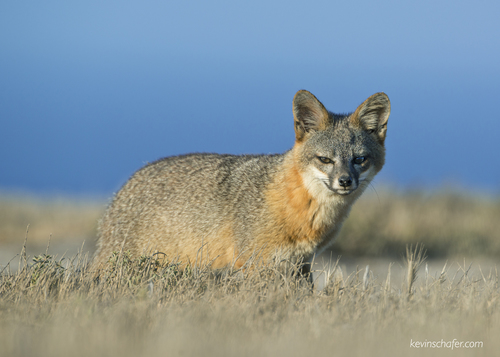
This is the species description of the island fox, Urocyon littoralis, the smallest North American fox, covering its traits, reproduction, ecology and behavior.
Urocyon littoralis, commonly known as the island fox, is the smallest fox species in North America. It has a head-and-body length of 48–50 cm (19–19.5 in), a shoulder height of 12–15 cm (4.5–6 in), and a tail that is 11–29 cm (4.5–11.5 in) long. Its tail is notably shorter than the 27–44 cm (10.5–17.5 in) tail of the gray fox, because the island fox generally has two fewer tail vertebrae than the ...
View full details → 20
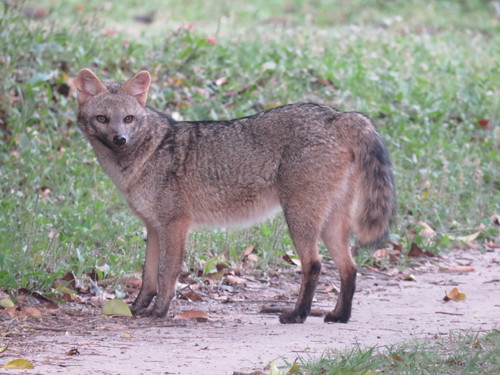
Crab-eating fox (Cerdocyon thous) is a South American canid with greyish-brown fur and specific habitat, behavior and reproductive traits.
Cerdocyon thous, commonly known as the crab-eating fox, is predominantly greyish-brown, with reddish areas on the face and legs, and black tips on its ears and tail. It has short, strong legs, a long, bushy tail, and a short, thick coat. Its coloration can range from grey to brown, yellowish, pale, and dark grey. There is a black streak along the back legs and a black stripe along the spine, with ...
View full details → 21
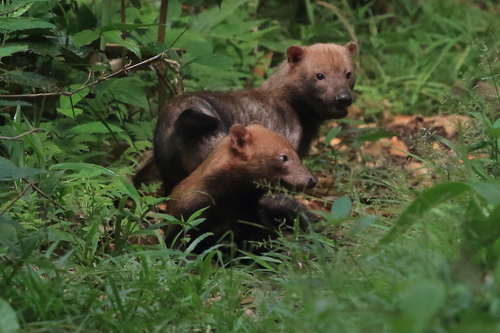
Speothos venaticus, the bush dog, is a small carnivorous canid found across Central and South America.
Description: Adult bush dogs have soft, long brownish-tan fur, with a lighter reddish tinge on the head, neck, and back, plus a bushy tail. The underside is dark, and sometimes features a lighter throat patch. Younger individuals, by contrast, have solid black fur across their entire bodies. Adults typically measure 57–75 cm (22–30 in) from head to body, with a tail that is 12.5–15 cm (5–6 in) lon...
View full details → 22
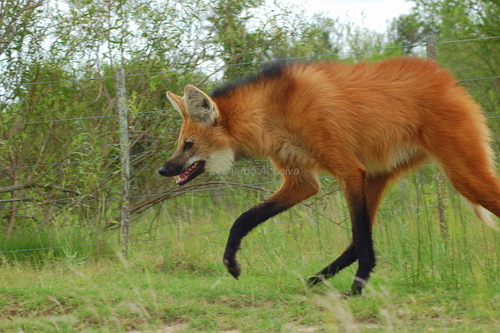
This is a full description of the taxonomy, physical traits, reproduction, and life cycle of the maned wolf Chrysocyon brachyurus.
Chrysocyon brachyurus, the maned wolf, was first described in 1815 by Johann Karl Wilhelm Illiger, under the initial name Canis brachyurus. Lorenz Oken later reclassified it as Vulpes cancosa, and it was not until 1839 that Charles Hamilton Smith established the separate genus Chrysocyon for this species. Additional authors later reclassified the species back into the genus Canis at different poin...
View full details → 23
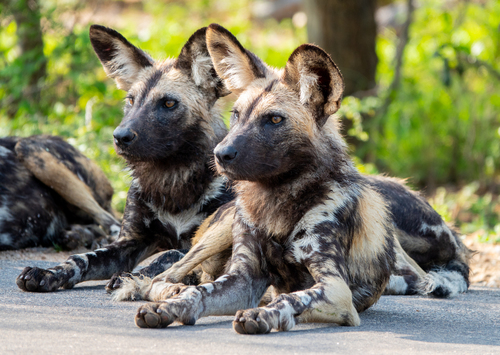
Lycaon pictus, the African wild dog, is a distinct African canid with a range mostly across Southern and East Africa.
The African wild dog (Lycaon pictus) is the bulkiest and most solidly built canid native to Africa. Adults stand 60 to 75 cm (24 to 30 in) at the shoulder, have a head-and-body length of 71 to 112 cm (28 to 44 in), and a tail between 29 and 41 cm (11 to 16 in) long. Adult body weight ranges from 18 to 36 kg (40 to 79 lb), with East African individuals typically weighing 20–25 kg (44–55 lb). Among ...
View full details → 24
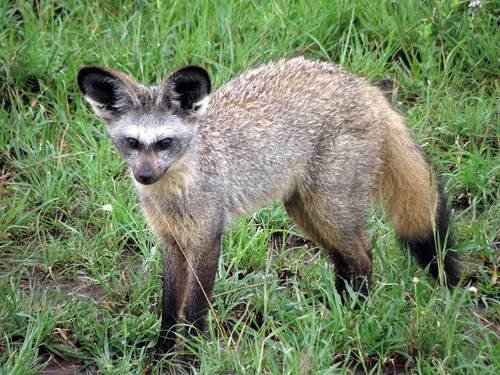
Bat-eared fox (Otocyon megalotis) is an African canid with large ears, adapted to arid and semi-arid environments.
Bat-eared fox (Otocyon megalotis, Desmarest, 1822) adults weigh between 3 and 5.3 kg (6.6 to 11.7 lb). Head and body length measures 46–66 cm (18–26 in), tail length measures 23–34 cm (9.1–13 in), shoulder height measures 30–40 cm (12–16 in), and their characteristic large ears are 11–13 cm (4.3–5.1 in) long. This species shows sexual dimorphism, with females generally being larger and heavier tha...
View full details → 25
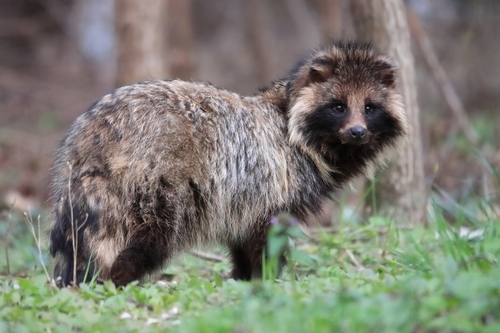
Nyctereutes procyonoides, the common raccoon dog, is an East Asian canid now invasive in Europe, farmed and hunted for its fur.
The scientific name of the common raccoon dog is Nyctereutes procyonoides (Gray, 1834). The skulls of common raccoon dogs strongly resemble those of South American foxes, especially crab-eating foxes, though genetic studies confirm the two groups are not closely related. Common raccoon dog skulls are small but sturdily built and moderately elongated, with narrow zygomatic arches. Skull projections...
View full details → 26
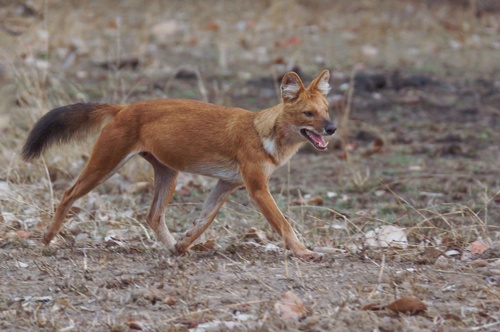
The dhole (Cuon alpinus) is a canid species with distinct physical traits, fragmented Asian range, and unique social and feeding behaviours.
Cuon alpinus (Pallas, 1811), commonly called the dhole, has characteristic fur with an overall reddish base tone, which is brightest during winter. In winter coat, the back is a deep rusty-red to reddish shade, with brownish highlights along the top of the head, neck, and shoulders. The throat, chest, flanks, belly, and upper limbs are paler, with a more yellowish tone. The lower limbs are whitish...
View full details → 27
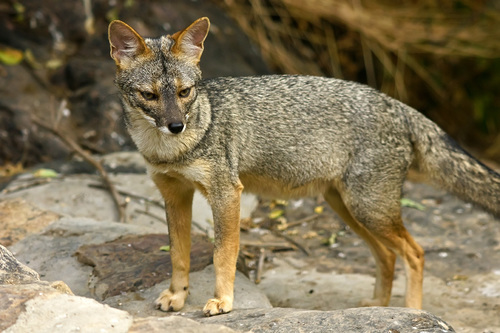
The Sechuran fox (Lycalopex sechurae) is a small, versatile canid native to arid habitats of western South America.
Lycalopex sechurae, commonly known as the Sechuran fox, is a small canid species. Adults weigh between 2.6 and 4.2 kg (5.7 to 9.3 lb), with a head-and-body length of 50 to 78 cm (20 to 31 in) and a tail length of 27 to 34 cm (11 to 13 in). Most of its body has gray agouti fur, which fades to white or cream on the underparts. It has reddish-brown markings on the back of the ears, around the eyes, a...
View full details → 28
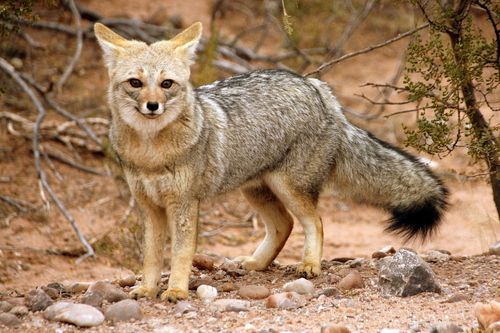
Lycalopex gymnocercus, the Pampas fox, is a South American canid with recognized subspecies, described in appearance, range, and reproduction.
Lycalopex gymnocercus, commonly known as the Pampas fox, resembles the culpeo or Andean fox in size and general appearance. It can be distinguished by a proportionately wider snout, reddish fur on the head and neck, and a black marking on the muzzle. Most of its body is covered in short, dense grey fur, with a black stripe running down its back and onto the tail, while its underparts are pale, nea...
View full details → 29
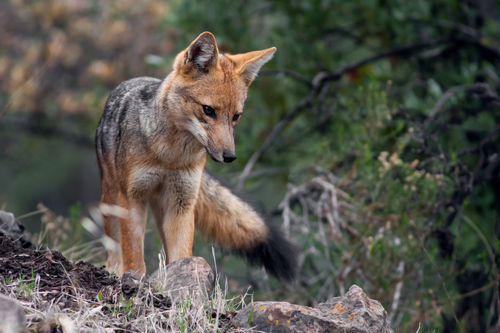
Lycalopex culpaeus, the culpeo, is a medium-sized South American canid found across a wide range of habitats from the Andes to Patagonia.
The culpeo (Lycalopex culpaeus) is a canid that falls between a red fox and a coyote in size. It is the second-largest native canid in South America, with the maned wolf being the only larger native canid on the continent. In appearance, the culpeo shares many similarities with the well-known red fox. Its fur is a mix of grey and reddish tones, with a white chin, reddish legs, and a faint, often b...
View full details → 30
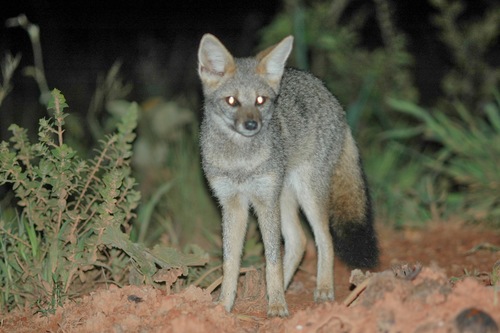
Lycalopex vetulus, the hoary fox, is a small endemic Brazilian canid with distinct physical traits and shared parental care.
Lycalopex vetulus, commonly called the hoary fox, has a short muzzle, small teeth, a short coat, and slender limbs. Its upper body is grey, while its underside is cream or fawn. The tip of its tail is black, with a distinct dark stripe running along the upper surface of the tail; in males, this stripe may extend all the way up the back to the nape of the neck. The hoary fox's ears and the outer po...
View full details →Frequently Asked Questions
How many species are in the Canidae family?
This guide features 30 representative species from the Canidae family. The full family contains many more species worldwide — explore them all on iNature.
How to identify Canidae species?
Canidae species share common features in their flowers, leaves, and growth patterns. This guide provides photos and descriptions for 30 species. For instant field identification, use the iNature app.
Sources: GBIF, iNaturalist, Wikipedia · Disclaimer
Identify any species instantly — even offline
iNature uses on-device AI to identify plants, animals, fungi and more. No internet needed.
Download iNature — FreeStart Exploring Nature Today
Download iNature for free. 10 identifications on us. No account needed. No credit card required.
Download Free on App Store
