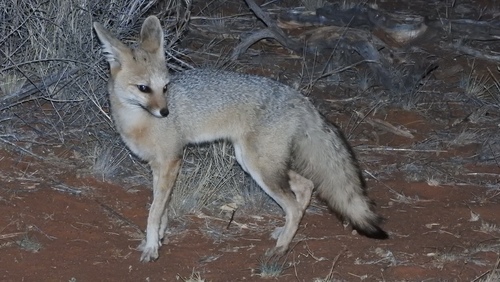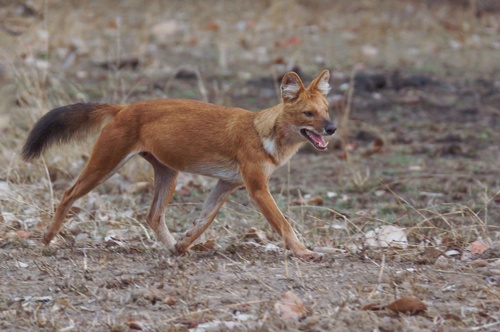
About Cuon alpinus (Pallas, 1811)
Species Naming
Cuon alpinus (Pallas, 1811), commonly called the dhole, has characteristic fur with an overall reddish base tone, which is brightest during winter.
Winter Coat Coloration
In winter coat, the back is a deep rusty-red to reddish shade, with brownish highlights along the top of the head, neck, and shoulders. The throat, chest, flanks, belly, and upper limbs are paler, with a more yellowish tone. The lower limbs are whitish, with dark brown bands on the front sides of the forelimbs.
Head & Tail Coloration
The muzzle and forehead are greyish-reddish. The tail is very full and fluffy, primarily reddish-ochre with a dark brown tip.
Summer Coat & Guard Hairs
The summer coat is shorter, coarser, and darker. Adult dorsal and lateral guard hairs measure 20–30 mm (0.79–1.18 in) long.
Moulting Pattern
Dholes held at the Moscow Zoo moult once per year between March and May. One melanistic dhole individual has been recorded in the northern Coimbatore Forest Division of Tamil Nadu.
Skull Morphology
The dhole has a wide, massive skull with a well-developed sagittal crest, and highly developed masseter muscles compared to other canid species, which gives its face an almost hyena-like look. Its rostrum is shorter than that of domestic dogs and most other canids.
Dental Structure
It has six lower molars, rather than the seven seen in most canids. Its upper molars are weak, measuring one third to one half the size of a wolf’s upper molars, and only have one cusp, unlike the two to four cusps typical for canids.
Dental Adaptation Function
This tooth structure is thought to be an adaptation that improves shearing ability and speeds up prey consumption, which may help dholes compete more successfully against kleptoparasites.
Body Size Measurements
In terms of body size, dholes have an average head-body length of 88–113 cm (35–44 in), not counting their 41–50 cm (16–20 in) long tail, and stand 42–50 cm (17–20 in) tall at the shoulder.
Adult Weight
Adult females weigh 10–17 kg (22–37 lb), while slightly larger males weigh 15–21 kg (33–46 lb). The average weight of adult dholes from three small study samples was 15.1 kg (33 lb).
Overall Build
Dholes have been described as combining physical traits of gray wolves and red foxes, and as having a "cat-like" build due to their long backbone and slender limbs.
Historical Extirpation Range
Historically, dholes lived in Singapore and across Central Asia, including Afghanistan, Kyrgyzstan, Kazakhstan, Mongolia, Tajikistan, and Uzbekistan, but they are now regionally extinct in all these areas. Historical records from the Veritable Records of the Joseon Dynasty show dholes once lived in Yangju, Gyeonggi Province, South Korea, but the species is now extinct in South Korea; the last known captures were reported in 1909 and 1921 from Yeoncheon, Gyeonggi Province.
Uncertain Current Range
The current presence of dholes in North Korea and Pakistan is considered uncertain. Dholes once inhabited the alpine steppes stretching from Kashmir into the Ladakh area, and have disappeared from 60% of their historic range in India over the past century.
Habitat Preference
In India, Myanmar, Indochina, Indonesia, and China, dholes prefer forested areas in alpine zones, and are occasionally seen in plains regions.
Central Asia Recent Records
Genetic samples collected in 2019 from Bek-Tosot Conservancy, southern Kyrgyzstan, indicated dholes are likely present there; this was the first record of dholes in the country in almost 30 years. Dholes may still occur in Tunkinsky National Park, located in extreme southern Siberia near Lake Baikal.
Russian Range Status
They may also still live in Primorsky Krai, far eastern Russia, where they were classified as a rare endangered species in 2004, with unconfirmed reports from the Pikthsa-Tigrovy Dom protected forest area; no confirmed sightings have been reported from other areas of the region since the late 1970s. Currently, there are no other confirmed recent reports of dholes in Russia, so the IUCN classifies them as extinct in Russia.
Russian Possible Occurrences
However, dholes may be present in the eastern Sayan Mountains and the Transbaikal region; they have been sighted in Tofalaria (Irkutsk Oblast), the Republic of Buryatia, and Zabaykalsky Krai. One dhole pack was sighted in the Qilian Mountains in 2006.
Xinjiang Dhole Records
From 2011 to 2013, local government officials and herders reported several dhole packs living at elevations of 2,000 to 3,500 m (6,600 to 11,500 ft) near Taxkorgan Nature Reserve in China’s Xinjiang Autonomous Region. Camera traps also recorded several packs and an adult female with pups at elevations of roughly 2,500 to 4,000 m (8,200 to 13,100 ft) in Yanchiwan National Nature Reserve, northern Gansu Province, China, between 2013 and 2014.
Chinese Mountain Records
Dholes have also been reported in the Altyn-Tagh Mountains. In China’s Yunnan Province, dholes were recorded in Baima Xueshan Nature Reserve between 2010 and 2011.
Confirmed Chinese Range
Dhole samples were collected in Jiangxi Province in 2013. Since 2008, camera traps have confirmed dhole presence in southern and western Gansu province, southern Shaanxi province, southern Qinghai province, southern and western Yunnan province, western Sichuan province, southern Xinjiang Autonomous Region, and the Southeastern Tibet Autonomous Region of China.
Hainan Extinction
Historical records of dholes on China’s Hainan Island date from 1521 to 1935, but the species is no longer present there and is estimated to have gone extinct around 1942.
Indian Mainland Range
Dholes occur across most of India south of the Ganges, particularly in the Central Indian Highlands and the Western and Eastern Ghats. They are also present in Arunachal Pradesh, Assam, Meghalaya, West Bengal, and the Terai region of the Indo-Gangetic Plain.
Indian Population Status
Dhole populations in the Himalayas and northwest India are fragmented. Camera traps recorded dhole packs in Chitwan National Park in 2011.
Nepal & Gujarat Records
Their presence was confirmed in the Kanchenjunga Conservation Area in 2011 via camera traps. In February 2020, dholes were sighted in Vansda National Park, India, and camera traps confirmed the presence of two individuals in May of that year; this was the first confirmed dhole sighting in Gujarat since 1970.
Bhutan & Bangladesh Range
In Bhutan, dholes are present in Jigme Dorji National Park. In Bangladesh, dholes inhabit forest reserves in the Sylhet area and the Chittagong Hill Tracts in the southeast.
Bangladesh Population Viability
2016 camera trap photos from Chittagong confirmed dholes continue to live there. These areas likely do not support a viable dhole population, as mostly small groups or solitary individuals have been sighted.
Myanmar Range
In Myanmar, dholes are present in multiple protected areas. In 2015, camera traps recorded dholes and tigers for the first time in the hill forests of Karen State, Myanmar.
Southeast Asian Range Status
Dhole range is highly fragmented in the Malaysian Peninsula, Sumatra, Java, Vietnam, and Thailand; the Vietnamese population is considered possibly extinct. In 2014, camera trap videos from montane tropical forests at 2,000 m (6,600 ft) in Sumatra’s Kerinci Seblat National Park confirmed dholes continue to occur there.
Thailand & Laos Records
A camera trapping survey conducted in Thailand’s Khao Ang Rue Nai Wildlife Sanctuary from January 2008 to February 2010 documented one healthy dhole pack. In northern Laos, dholes have been studied in Nam Et-Phou Louey National Protected Area, and camera trap surveys from 2012 to 2017 recorded dholes in this same protected area.
Vietnam Records
In Vietnam, dholes were only sighted in Pu Mat National Park in 1999, Yok Don National Park in 2003 and 2004, and Ninh Thuan Province in 2014.
Unverified Caucasus Reports
A separate disjunct dhole population was reported in the Trabzon and Rize area of northeastern Turkey near the Georgian border in the 1990s; this report is not considered reliable. A single dhole individual was claimed to have been shot in 2013 in the nearby Kabardino-Balkaria Republic of Russia, in the central Caucasus.
Caucasus Report Verification
A biologist from Kabardino-Balkarian State University analyzed the remains in May 2015, and concluded the skull belonged to a dhole. In August 2015, researchers from the National Museum of Natural History and Karadeniz Technical University launched an expedition to track and document a possible Turkish dhole population.
Caucasus Report Conclusion
In October 2015, they concluded two skins claimed to be from dholes in Turkey most likely belonged to dogs, pending further DNA analysis of skin samples. After analyzing photos of the claimed dhole skull from Kabardino-Balkaria Republic, Russia, they concluded it was actually a gray wolf skull.
Vocalization Types
In terms of ecology and behaviour, dholes produce whistles that resemble the calls of red foxes, sometimes described as coo-coo. It is unknown how this sound is produced, but it is thought to help packs coordinate when moving through thick brush.
Prey Attack Vocalizations
When attacking prey, dholes emit screaming KaKaKaKAA sounds. Other sounds dholes make include whines (used when soliciting food), growls (used as a warning), screams, chatterings (both screams and chatterings function as alarm calls), and yapping cries.
Vocalization Differences From Wolves
Unlike wolves, dholes do not howl or bark. Dholes have complex body language.
Friendly Body Language
Friendly or submissive greetings involve horizontal lip retraction, lowering the tail, and licking. Playful dholes open their mouths with retracted lips, hold their tails vertically, and perform a play bow.
Aggressive & Fearful Body Language
Aggressive or threatening dholes push their lips forward into a snarl, raise the hairs on their backs, and hold their tails horizontally or vertically. When afraid, dholes pull their lips back horizontally, tuck their tails, and flatten their ears against their skull.
Mating Season
In India, the dhole mating season falls between mid-October and January, while captive dholes at the Moscow Zoo mostly breed in February. Unlike wolf packs, dhole clans can include more than one breeding female.
Denning Behaviour
Multiple female dholes may share a den and raise their litters together in the same space. During mating, the female assumes a crouched, cat-like position.
Mating Process
There is no copulatory tie typical of other canids after the male dismounts; instead, the pair lie on their sides facing each other in a semicircular shape. The gestation period lasts 60–63 days, and litter sizes average four to six pups.
Captive Breeding Hormones
A study of hormone metabolites from five male and three female captive dholes in Thai zoos found breeding males have increased testosterone levels from October to January. Captive females have increased oestrogen levels for roughly two weeks in January, followed by increased progesterone, and display sexual behaviours during the oestrogen peak.
Pup Rearing
Pups are suckled for at least 58 days. During this period, the pack brings food to the mother at the den site.
Den Care Behaviour
Unlike wolves, dholes do not use rendezvous sites to meet their pups; instead, one or more adults stay with the pups at the den while the rest of the pack hunts. Once weaning begins, adult clan members regurgitate food for the pups until the pups are old enough to join hunts.
Pup Development
Pups remain at the den site for 70–80 days. By six months of age, pups accompany adults on hunts, and can assist in killing large prey such as sambar by eight months of age.
Lifespan
The maximum recorded longevity of captive dholes is 15–16 years.
Indian Prey Base
In terms of feeding ecology, dhole prey in India includes chital, sambar deer, muntjac, mouse deer, barasingha, wild boar, gaur, water buffaloes, banteng, cattle, nilgai, goats, Indian hares, Himalayan field rats, and langurs. There is one recorded case of a dhole pack killing an Indian elephant calf in Assam, despite a desperate defensive effort from the mother that caused numerous injuries to pack members.
Regional Prey Variation
In Kashmir, dholes prey on markhor; in Myanmar they prey on thamin; in Sumatra and the Malay Peninsula they prey on Malayan tapir and Sumatran serow; and in Java they prey on Javan rusa. In the Tian Shan and Tarbagatai Mountains, dholes prey on Siberian ibexes, arkhar, roe deer, Caspian red deer, and wild boar.
Northern Prey Base
In the Altai and Sayan Mountains, they prey on musk deer and reindeer. In eastern Siberia, they prey on roe deer, Manchurian wapiti, wild pig, musk deer, and reindeer, while in Primorye they feed on sika deer and goral.
Mongolian Prey & Human Interaction
In Mongolia, they prey on argali and rarely on Siberian ibex. Like African wild dogs, but unlike wolves, dholes are not known to actively hunt humans.
Non-prey Food Items
Dholes are known to eat insects and lizards. They eat fruit and plant matter more readily than other canids.
Captive Plant Consumption
In captivity, dholes eat various kinds of grasses, herbs, and leaves, apparently for pleasure rather than only when ill. In summer in the Tian Shan Mountains, dholes eat large amounts of mountain rhubarb.
Livestock Predation Pattern
Although dholes are opportunistic hunters, they appear to avoid hunting cattle and their calves. Livestock predation by dholes has been a problem in Bhutan since the late 1990s, because domestic animals are often left to graze unsupervised in the forest for weeks at a time.
Livestock Predation Risk Factors
Livestock that are stall-fed at night and graze near human homes are never attacked. Oxen are killed more often than cows, likely because oxen receive less protection.