About Lycaon pictus (Temminck, 1820)
General Build
The African wild dog (Lycaon pictus) is the bulkiest and most solidly built canid native to Africa.
Standard Body Measurements
Adults stand 60 to 75 cm (24 to 30 in) at the shoulder, have a head-and-body length of 71 to 112 cm (28 to 44 in), and a tail between 29 and 41 cm (11 to 16 in) long.
Body Weight
Adult body weight ranges from 18 to 36 kg (40 to 79 lb), with East African individuals typically weighing 20–25 kg (44–55 lb).
Size Comparison to Other Canids
Among living canids, only the wolf species complex is larger than the African wild dog by body mass. Females are usually 3–7% smaller than males.
External Morphology
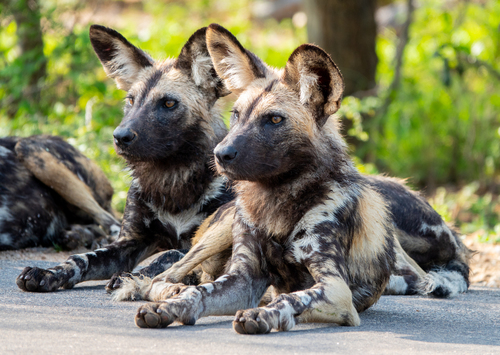
Compared to canids in the genus Canis, the African wild dog is lean and tall, has unusually large ears, lacks dewclaws, and usually has fused middle two toepads.
Dentition Characteristics
Its dentition differs from Canis in that the last lower molar is degenerate, the canines are narrow, and the premolars are proportionately large. These premolars are the largest relative to body size of any carnivore aside from hyenas.
Carnassial Tooth Adaptation
The heel of the lower carnassial M1 has a single blade-like cusp forming a crest, which boosts the teeth's shearing ability and lets the species consume prey faster. This trait, called a "trenchant heel", is shared with two other canids: the Asian dhole and the South American bush dog.
Skull Structure
The African wild dog's skull is relatively shorter and broader than the skulls of other canids.
Fur Composition
The species' fur differs notably from that of other canids: it is made up entirely of stiff bristle hairs, with no underfur.
Individual Fur Variation
Fur color varies extremely between individuals, and this variation likely helps with visual identification, since African wild dogs can recognize each other at distances of 50–100 m (160–330 ft).
Geographic Coat Variation
There is some geographic variation in coat color: individuals from northeastern Africa are mostly black with small white and yellow patches, while those from southern Africa have brighter, mixed coats of brown, black, and white.
Trunk and Leg Patterning
Most coat patterning is found on the trunk and legs.
Facial Markings
Facial markings vary little: the muzzle is black, and the color fades gradually to brown across the cheeks and forehead. A black stripe runs up the forehead and becomes blackish-brown on the back of the ears. A small number of individuals have a brown, teardrop-shaped marking below the eyes.
Head and Neck Markings
The back of the head and neck are either brown or yellow.
Chest and Leg Markings
A white patch sometimes appears behind the fore legs, and some individuals have entirely white fore legs, chests, and throats.
Tail Markings
The tail is typically white at the tip, black in the middle section, and brown at the base. Some individuals have no white tip at all, or may have black fur under the white tip.
Asymmetrical Patterning
Coat patterns can be asymmetrical, with each side of the body often bearing different markings from the other.
Core Distribution
The African wild dog is primarily found in Southern and East Africa.
West African Distribution
It is rare in North Africa, and mostly absent from West Africa, with the only potentially viable West African population located in Senegal's Niokolo-Koba National Park. The species is occasionally sighted in other parts of Senegal, Guinea, and Mali, and has a patchy distribution across East Africa.
Primary Habitat Preference
It mostly lives in savannas and arid zones, and generally avoids forested areas. This habitat preference is probably connected to the species' hunting habits, which require open areas that do not block vision or get in the way of pursuing prey.
Non-typical Habitat Use
African wild dogs will travel through scrubland, woodland, and montane areas when chasing prey. One forest-dwelling population has been found in the Harenna Forest, a wet montane forest reaching up to 2,400 m (7,900 ft) in elevation in Ethiopia's Bale Mountains.
Elevation Records (East Africa)
There is at least one confirmed sighting of a pack on the summit of Mount Kilimanjaro. The species has been recorded at 1,800 m (5,900 ft) in elevation in Zimbabwe.
Elevation Records (Ethiopia)
In Ethiopia, several packs have been sighted at elevations from 1,900 to 2,800 m (6,200 to 9,200 ft), and a dead individual was found in June 1995 at 4,050 m (13,290 ft) on the Sanetti Plateau.
Kruger National Park Population
A stable population of more than 370 African wild dogs lives in Kruger National Park.