About Chrysocyon brachyurus (Illiger, 1815)
Initial Taxonomic Description
Chrysocyon brachyurus, the maned wolf, was first described in 1815 by Johann Karl Wilhelm Illiger, under the initial name Canis brachyurus. Lorenz Oken later reclassified it as Vulpes cancosa, and it was not until 1839 that Charles Hamilton Smith established the separate genus Chrysocyon for this species. Additional authors later reclassified the species back into the genus Canis at different points after this.
Fossil Discovery Details
Fossils of the genus Chrysocyon, dated to the Late Pleistocene and Holocene epochs, were collected during one of Peter Wilheim Lund’s expeditions to Lagoa Santa, Minas Gerais, Brazil. This fossil specimen is currently held in the South American Collection of the Zoologisk Museum in Denmark (archived 2017-08-03 at the Wayback Machine).
Evolutionary Origin Hypothesis
Since no other Chrysocyon fossils have been found in any other region, it is suggested that the species evolved in this geographic area.
Comparison to Red Fox
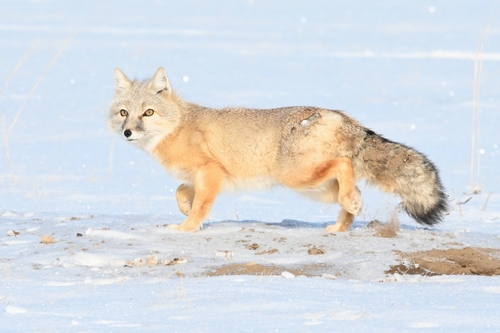
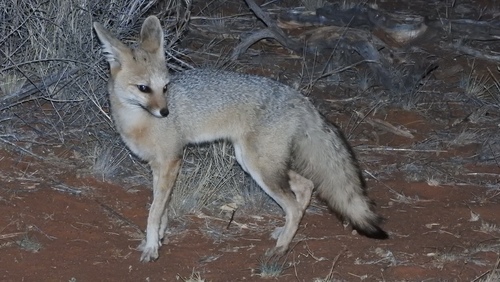
The maned wolf shares only minor similarities with the red fox, despite belonging to a completely different genus; it is also considerably larger than the red fox, with a different body structure.
General Size Measurements
The average adult maned wolf weighs 23 kg (51 lb), stands up to 110 cm (43 in) tall at the shoulder, has a head-body length of 100 cm (39 in), and an additional tail length of 45 cm (18 in). Its ears are large and long, measuring 18 cm (7.1 in).
Leg Adaptation
The maned wolf is the tallest species of wild canid, and its long legs are likely an evolutionary adaptation to the tall grasslands of its native habitat.
Body Fur Coloration
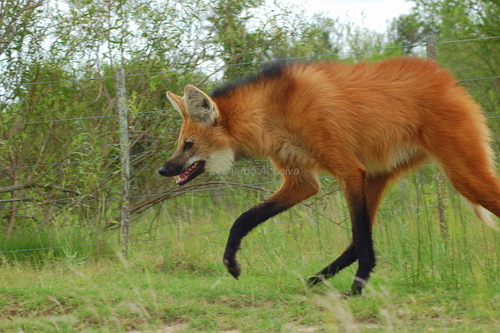
The fur of a maned wolf ranges from reddish-brown to golden orange on its sides, with long, black legs and a distinctive black mane along the neck. The coat also has a whitish tuft at the tip of the tail and a white "bib" marking beneath the throat.
Mane Function
The mane is erectile, and is typically used to make the wolf’s body profile appear larger when the animal is threatened or displaying aggression.
Melanistic Morph
Melanistic (all-black) maned wolves do exist, but they are very rare. The first photograph of an adult black maned wolf was captured by a camera trap in northern Minas Gerais, Brazil, in 2013.
Skull Dental Features
The maned wolf skull can be identified by its reduced carnassial teeth, small upper incisors, and long canine teeth. Like all other canids, it has a total of 42 teeth, with a dental formula of (3.1.4.2 / 3.1.4.3) × 2 = 42.
Additional Skull Traits
The maned wolf’s rhinarium extends all the way to the upper lip, a trait similar to the bush dog, but its vibrissae are longer than that species. The maned wolf skull also has a prominent sagittal crest.
Footprint Pad Comparison
The footprints of a maned wolf are similar to those of domestic dogs, but have disproportionately small plantar pads compared to their clearly separated, well-opened digit marks. Domestic dogs have plantar pads up to three times larger than those of the maned wolf.
Footprint Shape and Size
These maned wolf plantar pads have a triangular shape. Front footprints measure 7–9 cm (2.8–3.5 in) long and 5.5–7 cm (2.2–2.8 in) wide, while hind footprints measure 6.5–9 cm (2.6–3.5 in) long and 6.5–8.5 cm (2.6–3.3 in) wide.
Unique Footprint Feature
One feature that sets maned wolf footprints apart from those of other South American canids is the proximal union of the third and fourth digits.
Territorial Marking Odor
The maned wolf is also known for its distinctive cannabis-like odor that it uses to mark territory, which has earned it the nickname "skunk wolf".
Mating Season and Gestation
The maned wolf’s mating season, overall, ranges from November to April. Gestation lasts 60 to 65 days, and a litter may have between two and six black-furred pups, each weighing approximately 450 g (16 oz).
Pup First Year Development
Pups are fully grown by the time they reach one year old, and rely on their parents for food throughout this first year.
Reproductive Cycle Data Source
Most available data on the maned wolf’s estrus and reproductive cycle comes from studies of captive animals, particularly data related to breeding endocrinology. Hormonal changes in wild maned wolves follow the same variation pattern seen in captive individuals.
Estrus Induction
Females ovulate spontaneously, but some authors suggest that the presence of a male is important to induce estrus.
Hemisphere Breeding Difference
Captive maned wolves in the Northern Hemisphere breed between October and February, while those in the Southern Hemisphere breed between August and October. This shift indicates that photoperiod plays an important role in maned wolf reproduction, mainly through its impact on semen production.
Estrus Cycle Frequency
Generally, maned wolves have only one estrus cycle per year.
Sperm Production
The total amount of sperm produced by maned wolves is lower compared to other canid species.
Copulation Details
Copulation occurs during the four-day estrus period, and can last up to 15 minutes.
Courtship Behavior
Courtship behavior is similar to that of other canids, characterized by frequent approaches between the pair and anogenital investigation.
Litter Size
A litter typically has two to six pups, though one litter of seven pups has been recorded.
Birthing Period
Birthing in the wild was observed in May in the Canastra Mountains, but data from captive animals suggests that most births occur between June and September.
Wild Reproduction Challenges
Maned wolves reproduce with difficulty in the wild, and have a high rate of infant mortality. Females can go up to two years without breeding.
Captive Reproduction Challenges
Breeding is even more difficult in captivity, especially in temperate regions of the Northern Hemisphere.
Newborn Pup Traits
Pups are born weighing between 340 and 430 grams. They are born with black fur, which changes to red after 10 weeks. Their eyes open at approximately 9 days of age.
Pup Nursing and Weaning
Pups are nursed until they are 4 months old. After weaning, they are fed by their parents via regurgitation; this regurgitation feeding starts when pups are three weeks old and lasts until they are 10 months old.
Pup Foraging Behavior
Three-month-old pups begin accompanying their mother when she forages for food.
Parental Care Patterns
Both male and female maned wolves take part in parental care, though the majority of care is provided by the female. Most data on male parental care has been collected from captive animals, and little is known about how frequently males provide care in wild populations.
Sexual Maturity
Maned wolves reach sexual maturity at one year of age, at which point they leave their birth territory.
Longevity
The longevity of wild maned wolves is unknown, but captive individuals are estimated to live between 12 and 15 years. One report exists of an individual maned wolf at the São Paulo Zoo that lived to be 22 years old.