About Cerdocyon thous (Linnaeus, 1766)
Common Name & Base Coloration
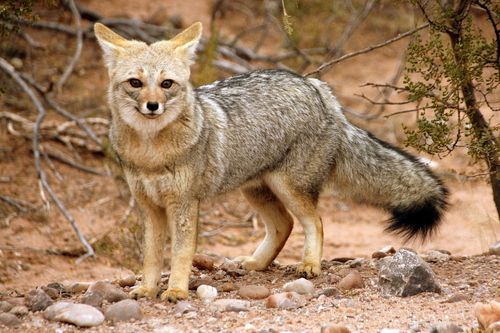
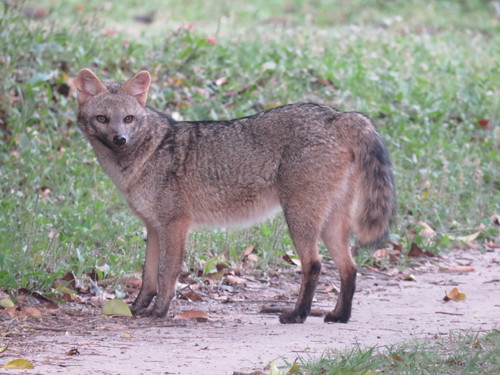
Cerdocyon thous, commonly known as the crab-eating fox, is predominantly greyish-brown, with reddish areas on the face and legs, and black tips on its ears and tail.
Limb & Coat Structure
It has short, strong legs, a long, bushy tail, and a short, thick coat.
Color Variation Range
Its coloration can range from grey to brown, yellowish, pale, and dark grey.
Markings on Torso & Limbs
There is a black streak along the back legs and a black stripe along the spine, with more reddish fur on the muzzle, ears and paws.
Extremity Coloration
The tail, legs and ear tips are black.
Head & Torso Shape
It has wide, round ears, and a somewhat narrow torso.
Tail Behavior
The dense, hairy tail stays upright when the animal is excited.
Population Color Variation
There is significant color variation between populations, ranging from very dark to light grey-yellow.
Size & Weight Measurements
The average head and body length is 64.3 centimetres (25.3 in), the average tail length is 28.5 centimetres (11.2 in), and adult weight ranges between 10 and 17 pounds (4.5 and 7.7 kg).
Genetic Karyotype
Genetically, this species has 74 diploid chromosomes, arranged as 36 pairs.
Native Continent
The crab-eating fox is a canid native to South America.
Core Geographic Range
Its range extends from Colombia and southern Venezuela in the north, south to Paraguay, Uruguay and northern Argentina.
Extralimital Sightings
It has also been sighted in Panama since the 1990s.
Preferred Habitats
It occupies savannas, woodlands, subtropical forests, prickly shrubby thickets, tropical savannas including caatinga, plains and campo, and wooded riverbanks such as riparian forest.
Avoided Habitats
It avoids rainforests, high mountains, and open grassy savannas.
Seasonal Range Shifts
During the rainy season, the crab-eating fox’s range shifts uphill; during drier periods, it moves to lower ground.
Local Population Threats
In some parts of its range, local populations are threatened with extirpation.
Hunting & Reproductive Grouping
For hunting, crab-eating foxes form monogamous pairs, and groups of multiple monogamous pairs may gather during the reproductive season.
Population Density Estimates
Population density estimates range from one individual per 4 km² in Venezuela to 0.0003 individuals/km² in Argentinian wetlands.
Seasonal Territoriality
The species shows territorial behavior during the dry season, and pays less attention to territory boundaries in the rainy season when food is more abundant.
Den Location Characteristics
Hideouts and dens are most often found in bushes and thick grass, and most dens have multiple entrance holes.
Den Construction Behavior
While crab-eating foxes are capable of digging their own tunnels, they prefer to take over burrows built by other animals.
Vocalization Types & Context
They make several distinct vocalizations, including barking, whirring and howling, which occur most often when paired individuals lose contact with each other.
Activity Pattern
This is a nocturnal species, with activity peaks around midnight and early morning.
Sexual Maturity Age
Crab-eating foxes reach sexual maturity at 9 to 10 months old.
Annual Litter Frequency
Adult females produce one or two litters per year, depending on climate and food availability.
Reproductive Period Timing
The reproductive period most often begins in November or December, with a second period starting in July.
Gestation & Birth Timing
Gestation lasts approximately 56 days, and birth typically occurs in January, February, or sometimes March for the first litter, and between September and October for the second.
Single Litter Birth Timing
If a female only produces one litter per year, it is typically born in early spring.
Parental Care Behavior
Breeding pairs are monogamous, and both parents raise the pups together.
Pup Weaning & Independence
Pups are weaned at around three months old, and become independent from their parents between 5 and 8 months old.