About Vulpes zerda (Zimmermann, 1780)
Taxonomic Classification
Vulpes zerda, the fennec fox, is the smallest canid species.
Fur Coloration
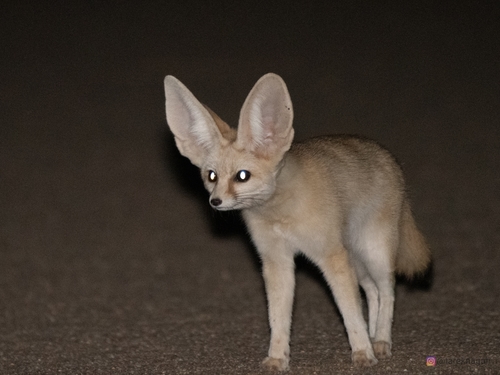
Its fur is sand-colored, which reflects sunlight during the day and helps retain warmth at night. Fennec foxes have a black nose, and their tapering tails end in a black tip.
Ear Morphology
They have long ears, which have the highest ratio of ear size to body size of any canid; this trait likely helps them dissipate heat and locate prey. The backs of the ears carry longitudinal reddish stripes, and their inner surfaces are so densely furred that the external auditory meatus is not visible. The edges of the ears are whitish, while the back of the ears is darker.
Facial Features
Dark streaks run from the inner corner of each eye to either side of their slender muzzle, and their large eyes are dark.
Dental Structure
Fennec foxes have a dental formula of 3.1.4.2 / 3.1.4.3 multiplied by 2, giving a total of 42 teeth, with small, narrow canines.
Paw Adaptations
The pads of their paws are covered in dense fur, which makes walking on hot, sandy soil easier.
Kidney Adaptations
Their kidneys are large and dense, with a somewhat compact medulla, an adaptation that helps them store water during periods of water scarcity.
Female Size Measurements
Females measure 34.5 to 39.5 cm (13.6 to 15.6 in) from head to body, have tails 23–25 cm (9.1–9.8 in) long, ears 9–9.5 cm (3.5–3.7 in) long, and weigh between 1 and 1.9 kg (2.2–4.2 lb).
Male Size Measurements
Males are slightly larger: they are 39 to 39.5 cm (15.4 to 15.6 in) long from head to body, have tails 23–25 cm (9.1–9.8 in) long, ears 10 cm (3.9 in) long, and weigh at least 1.3 kg (2.9 lb).
Geographic Range
The fennec fox is found throughout the Sahara, ranging from Morocco and Mauritania east through Egypt and the Sinai Peninsula to northern Sudan.
Habitat Characteristics
It inhabits small dunes and large expanses of treeless sand with sparse vegetation including grasses, sedges, and small shrubs. In the northern part of its range, annual rainfall is less than 100 mm, while the southern part receives up to 300 mm of rain per year.
Burrowing Behavior
Fennec foxes build burrows in grainier soil, and their range overlaps with that of other canids such as the golden jackal and Rüppell's fox; compared to these species, the fennec fox occupies areas with more extreme climates, and this burrowing adaptation gives it an advantage over competitors.
Mating System
Fennec foxes are monogamous and mate for life.
Reproductive Maturity
Captive fennec foxes reach sexual maturity around nine months old, and mating occurs between January and April. Females enter estrus for an average of 24 hours, and usually breed once per year.
Mating Behavior
The copulation tie during mating can last up to two hours and 45 minutes.
Gestation Period
Gestation typically lasts 50 to 52 days, though it may occasionally extend to 63 days.
Parental Behavior Pre-Birth
After mating, males become aggressive to protect the female, and provide her with food during pregnancy and lactation.
Pup Birth Details
Females give birth between March and June to litters of one to four pups.
Pup Development
Pups open their eyes 8 to 11 days after birth, and are weaned at 61 to 70 days old. Both parents care for the pups, and pups remain part of the family group even after a new litter is born. Adults care for pups until they are 16 to 17 weeks old.
Vocal Communication
Fennec foxes communicate using barks, purrs, yaps, and squeaks.
Lifespan
The average lifespan of a fennec fox in the wild is 10 years. The oldest recorded captive male fennec fox lived to 14 years old, while the oldest recorded captive female lived to 13 years old.