About Vulpes vulpes (Linnaeus, 1758)
Taxonomic Description
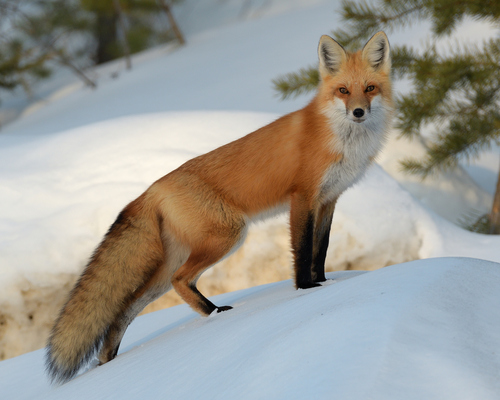
The red fox (Vulpes vulpes), formally described by Linnaeus in 1758, is the largest species of true foxes and one of the most widely distributed members of the order Carnivora.
Native Distribution
It occurs across the entire Northern Hemisphere, covering most of North America, Europe, and Asia, as well as parts of North Africa.
Introduced Range
Its range has expanded alongside human settlement, and the species was introduced to Australia, where it preys on native small and medium-sized rodents and marsupials.
Conservation Status
The red fox is listed as Least Concern on the IUCN Red List, but due to its negative impacts on native species, it is also included on the list of the world's 100 worst invasive species.
Evolutionary History
The red fox originated in Eurasia during the Middle Pleistocene at least 400,000 years ago, and later colonized North America sometime before 130,000 years ago.
Evolutionary Traits
Among true foxes, the red fox is a more evolutionarily advanced form adapted toward greater carnivory.
Distinguishing Characteristics
In addition to its large size, the red fox can be distinguished from other fox species by its ability to adapt quickly to new environments.
Coat Coloration
Despite its common name, this species often includes individuals with other coat colorations, including leucistic and melanistic forms.
Subspecies Classification
Forty-five subspecies are currently recognized, split into two groups: the large northern foxes, and the small, basal southern grey desert foxes of Asia and North Africa.
Social Group Structure
Red foxes are usually found in pairs or in small family groups. These groups may consist of a mated pair and their offspring, or a male with multiple related females. Offspring from previous litters stay with their parents to help care for new kits.
Primary Diet
The species feeds primarily on small rodents, though it may also prey on rabbits, squirrels, game birds, reptiles, invertebrates, and young ungulates. It also occasionally eats fruit and vegetable matter.
Predator-Prey Relationships
Although red foxes tend to kill smaller predators, including other fox species, they are vulnerable to attacks from larger predators such as wolves, coyotes, golden jackals, large predatory birds like golden eagles and Eurasian eagle-owls, and medium- to large-sized felids.
Human Association History
This species has a long history of association with humans. It has been extensively hunted for centuries as a pest and for its fur, and appears widely in human folklore and mythology.
Fur Trade Role
Due to its widespread distribution and large population, the red fox is one of the most important fur-bearing animals harvested for the global fur trade.
Urban Colonization
It is too small to pose a significant threat to humans, has benefited greatly from human habitation, and has successfully colonized many suburban and urban areas.
Domestication Research
Domestication of the red fox is an ongoing project in Russia, which has produced the domesticated silver fox.
Global Range Size
The red fox is an extremely widespread species. Its total range covers nearly 70,000,000 km² (27,000,000 sq mi), and extends as far north as the Arctic Circle.
Continental Distribution
It is found throughout Europe, in Africa north of the Sahara Desert, across most of Asia excluding extreme Southeast Asia, and across North America excluding most of the southwestern United States and Mexico.
Absent Regions
It is absent from Arctic islands, the northernmost parts of central Siberia, and extreme deserts.
New Zealand Regulation
It is not present in New Zealand, where it is classed as a prohibited new organism under the 1996 Hazardous Substances and New Organisms Act, which bans its import.
Urban Habitat Colonization
Red foxes have been very successful at colonizing built-up environments, especially lower-density suburbs, though they have also been observed in densely populated urban areas far from rural landscapes.
Global Urban Colonization Timeline
Throughout the 20th century, they established populations in many Australian, European, Japanese, and North American cities. The species first colonized British cities in the 1930s, entering Bristol and London in the 1940s, and later establishing populations in Cambridge and Norwich.
Regional Urban Records
In Ireland, they are now common in suburban Dublin. In Australia, red foxes were recorded in Melbourne as early as the 1930s, while they only began appearing in Zurich, Switzerland in the 1980s.
Urban Habitat Preference
Urban red foxes are most common in residential suburbs made up of privately owned, low-density housing. They are rare in areas dominated by industry, commerce, or council-rented housing.
Urban Home Range Size
In these less residential areas, average population density is lower because foxes rely less on human resources; home ranges in these areas average 80–90 ha (0.80–0.90 km²; 200–220 acres), while home ranges in more residential areas average 25–40 ha (0.25–0.40 km²; 62–99 acres).
UK Urban Population Trend
In the UK, the estimated urban fox population increased from 33,000 in 1995 to 150,000 in 2017.
Urban vs Rural Diet
City-dwelling red foxes may scavenge food from litter bins and bin bags; 2025 research found that human-generated food makes up 35% of the diet of urban foxes, compared to just 6% for rural foxes.
Urban vs Rural Morphology
As a result of this dietary difference between urban and rural populations, city-dwelling red foxes tend to grow larger than rural individuals. Urban foxes also tend to have shorter and wider muzzles, smaller braincases, and reduced sexual dimorphism compared to rural individuals, a difference thought to stem from differing biomechanical demands of feeding and cognition between the two habitats.
Reproductive Cycle Timing
Red foxes reproduce once a year in spring. Two months before oestrus (usually December), the reproductive organs of female vixens change in shape and size.
Female Reproductive Changes
By the time vixens enter oestrus, their uterine horns double in size, and their ovaries grow 1.5–2 times larger.
Male Reproductive Changes
Sperm formation in males begins in August to September, with the testicles reaching their greatest weight between December and February.
Mating Behavior
A vixen's oestrus period lasts three weeks, during which male dog-foxes mate with vixens for several days, often in burrows. The male's bulbus glandis enlarges during copulation, forming a copulatory tie that may last for more than an hour.
Gestation Period
The gestation period lasts 49–58 days.
Mating System Dynamics
Though foxes are largely monogamous, DNA evidence from one population shows high levels of polygyny, incest, and litters with mixed paternity. Subordinate vixens may become pregnant, but usually do not successfully give birth, or have their kits killed after birth by the dominant female or other subordinates.
Litter Size
The average litter size is four to six kits, though litters as large as 13 kits have been recorded. Large litters are typical in areas where fox mortality is high.
Newborn Kit Characteristics
Kits are born blind, deaf, toothless, and covered in dark brown fluffy fur. At birth, they weigh 56–110 g (2.0–3.9 oz), with a body length of 14.5 cm (5.7 in) and a tail length of 7.5 cm (3.0 in). Newborn kits are short-legged, large-headed, and have broad chests.
Neonatal Care
Mothers stay with their kits for 2–3 weeks, as the young cannot regulate their body temperature in this period. During this time, fathers or barren vixens provide food for the mother.
Parental Protection Behavior
Vixens are very protective of their kits, and have been recorded fighting off terriers to defend them. If the mother dies before the kits become independent, the father takes over as their provider.
Early Development Milestones
The kits' eyes open after 13–15 days; during this same period, their ear canals open and their upper teeth erupt, with lower teeth emerging 3–4 days later. Their eyes are blue at birth, changing to amber at 4–5 weeks of age.
Juvenile Coat Development
Their coat begins to change color at three weeks old, when a black streak appears around the eyes. By one month of age, red and white patches appear on their faces. During this time, their ears become erect and their muzzles elongate.
Weaning Process
Kits begin to leave their dens and try solid food brought by their parents at 3–4 weeks old. The lactation period lasts 6–7 weeks. Their woolly juvenile coats begin to be overlaid with shiny guard hairs after 8 weeks.
Juvenile Growth Timeline
By 3–4 months of age, kits are long-legged, narrow-chested, and sinewy. They reach adult body proportions at 6–7 months old.
Sexual Maturity and Lifespan
Some vixens may reach sexual maturity at 9–10 months old, producing their first litters when they are one year old. In captivity, red foxes can live as long as 15 years, though wild individuals typically do not survive past 5 years of age.
Fur Trade Uses
Red foxes are among the most important fur-bearing animals harvested by the global fur trade. Their pelts are used for trimmings, scarves, muffs, jackets, and coats. They are primarily used as trimming for both cloth coats and fur garments, including evening wraps.
Pelt Use by Morph
The pelts of silver foxes are popular for capes, while cross fox pelts are mostly used for scarves and only rarely used for trimming. The number of sold fox scarves is higher than the total number of scarves made from other fur-bearing animals. However, this total is smaller than the total number of red fox pelts used for trimming purposes.
Pelt Value by Morph
Silver color morphs are the most valuable to furriers, followed by cross color morphs, then red color morphs.
Historical Fur Trade Volumes
In the early 1900s, over 1,000 American red fox skins were imported to Great Britain annually, while 500,000 were exported annually from Germany and Russia. The total worldwide trade of wild red fox pelts in 1985–1986 was 1,543,995 pelts.
US Fur Trade Statistics
Red fox pelts made up 45% of U.S. wild-caught pelts, with a total value of $50 million.
Recent Pelt Price Trends
Pelt prices have increased; 2012 North American wholesale auction prices averaged $39, and 2013 prices averaged $65.78.
North American Pelt Quality
North American red foxes, particularly those from northern Alaska, are highly valued for their fur. Their guard hairs have a silky texture that allows unrestricted mobility after dressing.
Alaskan Pelt Quality Variation
However, red foxes living in southern Alaska's coastal areas and the Aleutian Islands are an exception, as their pelts are extremely coarse and rarely sell for more than one-third of the price of pelts from northern Alaska.
European Pelt Quality
Most European red fox pelts have coarser-textured fur than North American varieties. The only exceptions are pelts from Nordic regions and the Far East of Russia, which are still less silky than North American pelts.