About Urocyon littoralis (Baird, 1858)
Common Name and Classification
Urocyon littoralis, commonly known as the island fox, is the smallest fox species in North America.
Body Measurements
It has a head-and-body length of 48–50 cm (19–19.5 in), a shoulder height of 12–15 cm (4.5–6 in), and a tail that is 11–29 cm (4.5–11.5 in) long. Its tail is notably shorter than the 27–44 cm (10.5–17.5 in) tail of the gray fox, because the island fox generally has two fewer tail vertebrae than the gray fox.
Size Comparisons
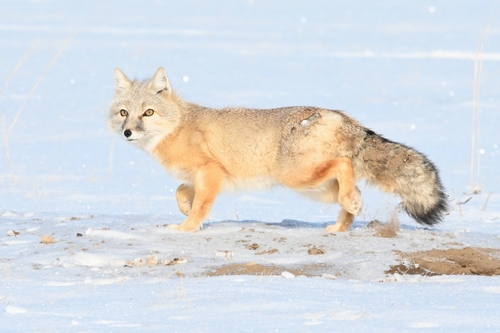
The island fox is slightly smaller than swift foxes (Vulpes velox) and kit foxes (Vulpes macrotis), and it has a similar body length but shorter shoulder height compared to domesticated cats (Felis catus). The island fox weighs between 1 and 2.8 kg (2.2 and 6.2 lb).
Sexual Dimorphism
This species displays sexual dimorphism, with males always being larger than females.
Subspecies Size Variation
The largest subspecies are found on Santa Catalina Island, while the smallest are found on Santa Cruz Island.
Fur Coloration
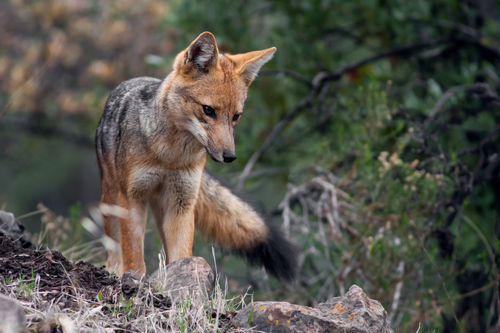
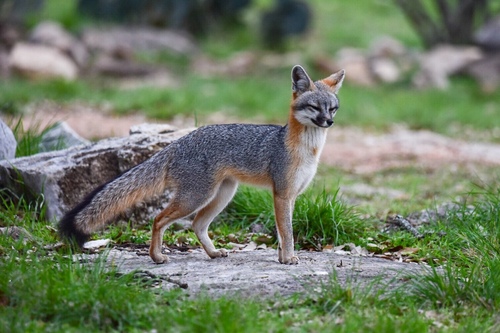
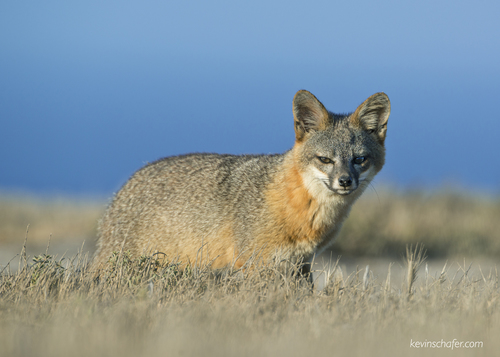
The island fox has gray fur on its head, ruddy red coloring on its sides, white fur on its belly, throat, and the lower half of its face, and a black stripe on the upper (dorsal) surface of its tail. Overall, its coat is darker and duller in color than the coat of the gray fox.
Molting Pattern
Island foxes molt once a year between August and November. Before their first molt, pups have a wooly, generally darker coat than adult foxes.
Brown Color Phase
A brown color phase, where the body's usual gray and black fur is replaced by sandy brown and deeper brown, can occur in populations on San Clemente Island and San Nicolas Island. It is still unclear whether this is a true genetic color phase, an age-related coat change, or a change caused by embedded Opuntia cactus spines in the pelt.
Breeding Pairs
Island foxes typically form monogamous breeding pairs. Pairs are frequently seen together starting in January and continuing through the breeding season, which runs from late February to early March.
Gestation and Litter Size
The gestation period is 50–63 days. Females give birth to their litter in a den. A typical litter holds one to five pups, with an average of two or three.
Pup Development
Pups are born in spring and emerge from the den in early summer. The mother lactates for 7–9 weeks.
Sexual Maturity and Lifespan
Island foxes reach sexual maturity at 10 months of age, and females usually breed within their first year. In the wild, island foxes live 4–6 years; they can live up to 8 years in captivity.
Habitat Preferences
The island fox prefers habitats with layered, complex vegetation that has a high density of woody, perennially fruiting shrubs. It lives in all island biomes, including temperate forest, temperate grassland, and chaparral.
Population Size
No single island supports more than 1,000 island foxes.
Diet Composition
The island fox's diet includes fruits, insects, birds, eggs, land snails, crabs, lizards, amphibians, small mammals such as deer mice (Peromyscus sp.), human refuse, and it is known to scavenge for food along coastal beaches.
Social Behavior
The island fox tends to move alone rather than in packs.
Interaction with Humans
It is not intimidated by humans, though it may act aggressive when first encountering people. It is generally docile and quite easy to tame.
Activity Patterns
While the species is generally considered nocturnal, it has activity peaks at dawn and dusk. Activity patterns also change with the seasons: island foxes are more active during the day in summer than in winter.
Human Impact on Activity
Recent behavioral studies confirm that island foxes adjust their activity patterns in response to human presence and island development. On Santa Catalina Island, which has heavy tourism, island foxes have shifted to become more diurnal, and are often seen rummaging for food at campsites. By contrast, island fox populations on less populated, more deserted islands remain mostly nocturnal.
Behavioral Adaptability Benefit
Researchers believe this behavioral adaptability helped the species maintain stable populations and avoid continued endangerment.
Communication Methods
Island foxes communicate using a combination of auditory, olfactory, and visual signals. Dominant foxes use vocalizations, staring, and ear flattening to make other foxes submit. Dominance and submission are communicated through visual signals including facial expressions and body posture.
Vocalizations
The main vocalizations of the island fox are barking and growling.
Territory Marking
The species marks its territory with urine and feces.