About Vulpes velox (Say, 1823)
Base and Side Coloration
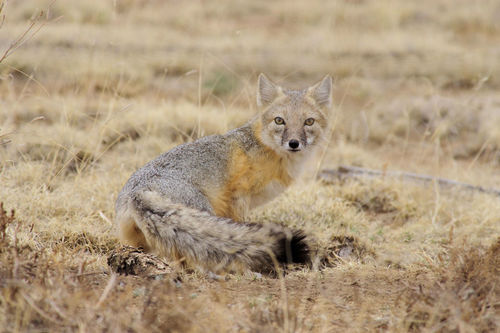
The swift fox (Vulpes velox (Say, 1823)) has a dark, grayish tan base color that shifts to yellowish tan across its sides and legs. Its throat, chest, and belly range in color from pale yellow to white.
Distinctive Markings
The tip of its tail is black, and it has black patches on its muzzle.
Ear Characteristics
Its ears are noticeably large, similar to those of the kit fox, though they are positioned slightly farther apart on the head than the kit fox's ears.
Body Size
The swift fox stands around 12 inches (30 cm) tall, and measures 31 inches (79 cm) long from head to the tip of the tail, making it roughly the size of a domestic cat. Its weight ranges from approximately five to seven pounds.
Sexual Dimorphism
Males and females look very similar, though males are slightly larger than females.
General Habitat
The swift fox inhabits short-grass prairies and western grasslands. It builds dens in sandy soil on open prairies, in plowed fields, or along fences.
Geographic Range
It is native to the Great Plains region of North America; its range extends north to southern Alberta and Saskatchewan, Canada, and south to Texas, reaching from western Iowa to Colorado, Kansas, Wyoming, Nebraska, and Montana.
Lifespan
In the wild, the swift fox typically lives 3 to 6 years, though it can live up to 14 years in captivity.
Activity Patterns
It is primarily nocturnal, and only stays above ground during evenings and nighttime in the summer. It usually stays in its den during daytime, but it has been observed above ground during warm midday periods in winter.
Winter Mortality
Higher mortality rates occur in the harsh winter conditions that the swift fox lives in.
Den Usage
Compared to most North American canids, the swift fox relies more heavily on its den for shelter from predators. These dens are usually burrows 2 to 4 meters in length.
Running Speed
The swift fox is known to run very fast, reaching speeds of over 50 km/h (30 mph), and up to 60 km/h (40 mph).
Main Predator
The coyote is the swift fox's main predator, but coyotes often do not eat the swift fox they kill; they kill it more often as competition than as prey.
Additional Predators
Additional predators of the swift fox include the American badger, golden eagle, and bobcat.
Anthropogenic Threats
The swift fox is also at risk from trapping, poisoning, and vehicle collisions on highways.
Mating System
Swift foxes are a socially monogamous species, though multiple breeding strategies have been observed. The breeding season for adult swift foxes varies by location.
Southern Breeding Timeline
In the southern United States, mating occurs between December and February, and pups are born in March and early April.
Canadian Breeding Timeline
In Canada, the breeding season begins in March, and pups are born in mid-May.
Sexual Maturity
Male swift foxes reach sexual maturity and may mate at one year old, while females usually wait until their second year to breed.
Pair Bonding
Adult swift foxes live in pairs; some pairs mate for life, while others choose different partners each year.
Reproduction Basics
Gestation lasts around 51 days, and litters of four to five kits are born. Swift foxes produce only one litter per year, but an individual may use up to thirteen different dens in one year, moving when prey becomes scarce or when skin parasites build up in the current den.
Burrow Acquisition
The swift fox can dig its own burrow, but it sometimes takes over burrows built by other larger animals.
Pup Early Development
Pups are born in the den and typically stay there for approximately one month. A newborn pup's eyes and ears stay closed for 10 to 15 days, so during this time it depends entirely on its mother for food and protection.
Pup Post-Weaning
Pups are usually weaned around six or seven weeks old, and stay with their parents until fall.
Social Organization
Recent research shows that the swift fox's social organization is unusual among canids, as it is centered on females. Females maintain territories year-round, and males will emigrate if the resident female is killed or removed.