About Canis lycaon Schreber, 1775
Historical Wolf Accounts in Catskills
Charles Darwin was informed that two types of wolf lived in the Catskill Mountains: one was a lightly built, greyhound-like animal that hunted deer, and the other was a bulkier, shorter-legged wolf.
Fur Coloration
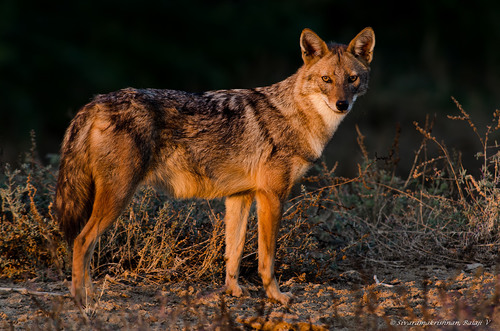
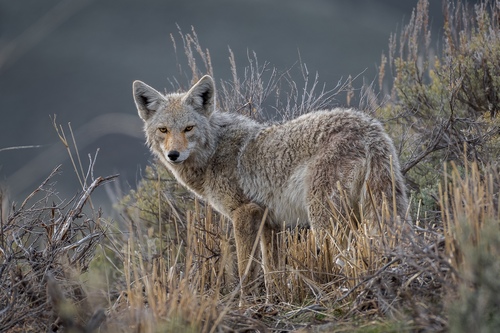
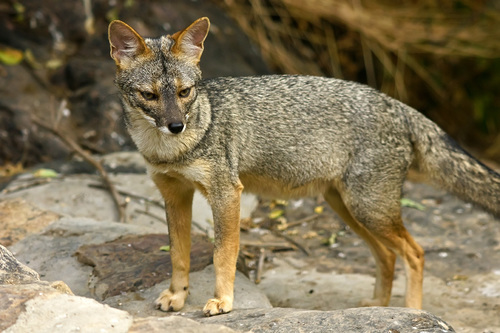
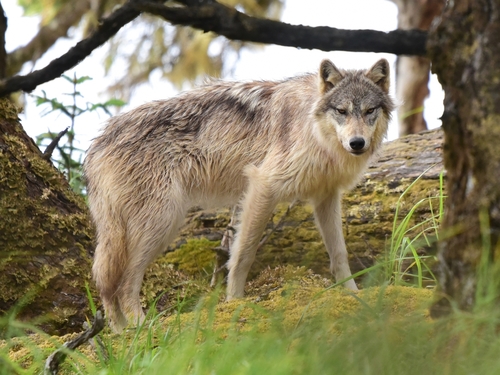
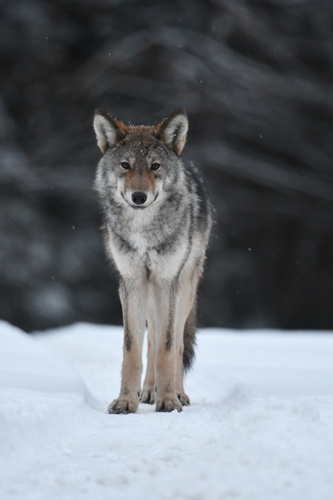
Eastern wolves typically have grizzled grayish-brown fur mixed with cinnamon. Their flanks and chest are rufous or creamy, while the nape, shoulders and tail are a mix of black and gray.
Melanism Occurrence
Unlike gray wolves, eastern wolves rarely produce melanistic individuals; the first recorded all-black eastern wolf was confirmed to be an eastern wolf and gray wolf hybrid.
Size and Weight
Like red wolves, eastern wolves are intermediate in size between coyotes and gray wolves: females weigh an average of 23.9 kilograms (53 lb), and males weigh an average of 30.3 kilograms (67 lb).
Lifespan
Their average lifespan matches that of gray wolves, at 3–4 years, with a maximum lifespan of 15 years.
Intermediate Size Adaptation
Researchers believe their intermediate size between gray wolves and coyotes stems more from adaptation to an environment dominated by medium-sized prey, similar to the Mexican wolf of the southwestern United States, rather than from their close relationship to red wolves and coyotes.
Historical Range
Historically, the eastern wolf’s range covered southern Quebec, most of Ontario, the Great Lakes states, New York State, and New England.
Current Great Lakes Population Distribution
Today, the Great Lakes wolf population is generally found in the northern halves of Minnesota and Wisconsin, the Upper Peninsula of Michigan (where it coexists with the Great Plains wolf), southeastern Manitoba, and northern Ontario.
Algonquin Wolf Core Distribution
The Algonquin wolf population occupies central and eastern Ontario, as well as southwestern Quebec north of the St. Lawrence River. Algonquin wolves are particularly concentrated in Algonquin Provincial Park and nearby protected areas including Killarney Provincial Park, Kawartha Highlands Provincial Park, and Queen Elizabeth II Wildlands Provincial Park.
Recent Algonquin Wolf Range Extent
Recent surveys have also found small numbers of Algonquin wolves in southern areas of northeastern Ontario, northwestern Ontario as far west as Lake of the Woods near the Manitoba border (where some mixing with Great Lakes wolves occurs), and southcentral Ontario (where some mixing with eastern coyotes occurs).
Eastern Wolf Sightings Outside Core Range
There are reports of eastern wolf sightings and wolves shot by hunters in Quebec south of the St. Lawrence River, New Brunswick, New York State, northern Vermont, and Maine.
2021 New York Wolf DNA Analysis
For example, DNA testing of a canid killed near Cherry Valley, New York, in 2021 initially indicated it was an eastern coyote, but a recent statement from the New York State Department of Environmental Conservation (DEC) confirms the animal was a wolf, with most of its ancestry matching Michigan wolves; the DEC has neither confirmed nor denied the existence of an established breeding population in the state.
Wolf Recolonization Claims
Some proponents of wolf recolonization argue that wolves are already established in New York and New England, having naturally dispersed from Canada by crossing the frozen St. Lawrence River.
Primary Prey Species
In terms of ecology and behaviour, the eastern wolf primarily preys on small to medium-sized animals such as white-tailed deer and beavers. This differs from gray wolves, which can successfully hunt large ungulates including caribou, elk, moose, and bison.
Omnivorous Feeding Behavior
Though eastern wolves are carnivores, packs in Voyageurs National Park forage for blueberries for much of July and August, when the berries are in season.
Pack Territoriality
Eastern wolf packs carefully avoid one another; only lone wolves sometimes enter the territories of other packs. The average territory size for an eastern wolf pack ranges from 118–185 km² (46–71 sq mi).
Dispersal Age
Young eastern wolves can disperse as early as 15 weeks old, which is much earlier than young gray wolves disperse.