The Lamiaceae (mint family) includes many of the world's most popular herbs — mint, basil, rosemary, lavender, thyme, and sage. Learn to identify these aromatic plants in the wild and garden.
🌱 Plant Families
Mint Family (Lamiaceae) — Herb & Plant Guide
1
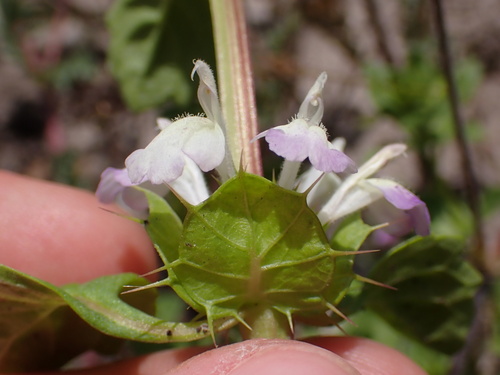
San Diego thornmint (Acanthomintha ilicifolia) is a small annual herb native to Southern California and Baja California, currently threatened by habitat loss.
Scientific name: Acanthomintha ilicifolia A.Gray, commonly called San Diego thornmint Description: Acanthomintha ilicifolia is a small annual herb that reaches a maximum height of approximately 15 centimeters (6 inches). It bears rounded to oval, serrated leaves that grow up to 1.5 cm (5⁄8 inch) long. The inflorescence forms a cluster of flowers, accompanied by oval bracts nearly 1 centimeter lon...
⚠️ Toxicity: Insufficient toxicity evidence; avoid direct contact and ingestion.
View full details →
2
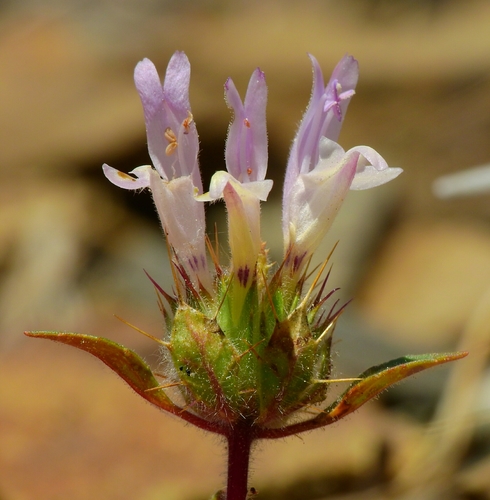
Acanthomintha lanceolata Curran is a small, scented, spiny annual herb that grows in shale or serpentine scree.
Acanthomintha lanceolata Curran is a small, hairy annual herb that reaches a maximum height of around 30 centimeters. Its entire surface is covered in glandular hairs, and it produces an unpleasant scent. Its oval-shaped, toothed leaves measure 1 to 2 centimeters long, and have spiny, glandular surfaces. The inflorescence features bracts that bear 1-centimeter-long spines, and produces glandular, ...
⚠️ Toxicity: Insufficient toxicity evidence; avoid direct contact and ingestion.
View full details →
3
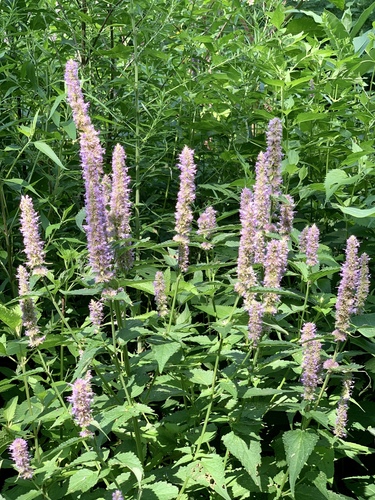
Agastache foeniculum is a North American perennial prairie plant widely valued as top-tier forage for pollinators with traditional and culinary uses.
Agastache foeniculum (Pursh) Kuntze is a perennial plant that grows from a taproot, reaching 0.6–1.2 metres (2–4 feet) in height with an upright, clump-forming growth habit. Its leaves are oval with toothed edges and have a white tint on the underside. This plant blooms from June to September, producing bright lavender flowers that become more intensely colored near the tip. A single plant can pro...
⚠️ Toxicity: Insufficient toxicity evidence; avoid direct contact and ingestion.
View full details →
4
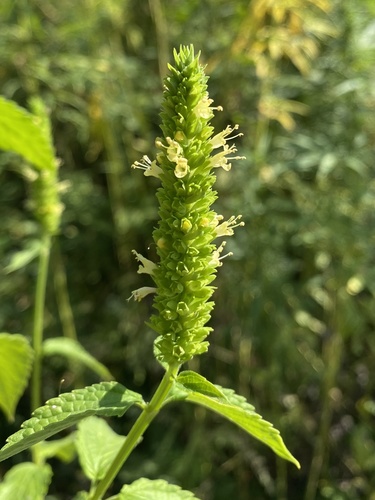
Agastache nepetoides is a large, unscented mint species native to eastern North America that blooms late summer, attracting many bees.
Agastache nepetoides, or yellow giant hyssop, is a large mint-family plant that grows as an erect, sparsely branched stem reaching 1.2 to 2.1 meters (4 to 7 feet) in height. Like other members of the mint family, its central stem is four-sided rather than round; it is also hairless (glabrous) and has winged edges. Its leaves are thin, shaped either ovate or ovate-lanceolate, measuring 5 to 15 cm (...
⚠️ Toxicity: Insufficient toxicity evidence; avoid direct contact and ingestion.
View full details →
5
Agastache scrophulariifolia (Willd.) Kuntze
Agastache scrophulariifolia (Willd.) Kuntze
🌿 Plantae Lamiaceae
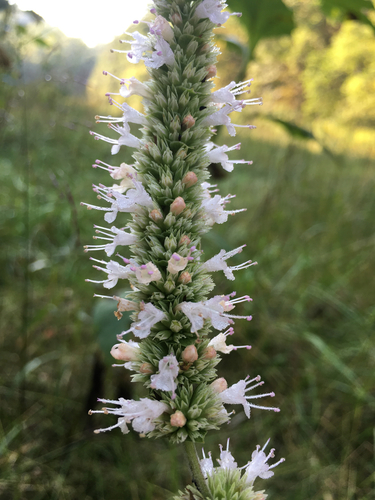
Agastache scrophulariifolia is a declining perennial herb in the mint family with documented traditional medicinal use by the Meskwaki.
Agastache scrophulariifolia (Willd.) Kuntze is a perennial herb in the mint family. Mature individuals of this species can grow up to six feet tall, and it is classed as a late-flowering species. This species typically produces several spiked inflorescences. Its flowers do not all bloom at the same time, and their color ranges from lavender to pink. The fruit it produces is a dark brown nutlet. Hi...
⚠️ Toxicity: Insufficient toxicity evidence; avoid direct contact and ingestion.
View full details →
6
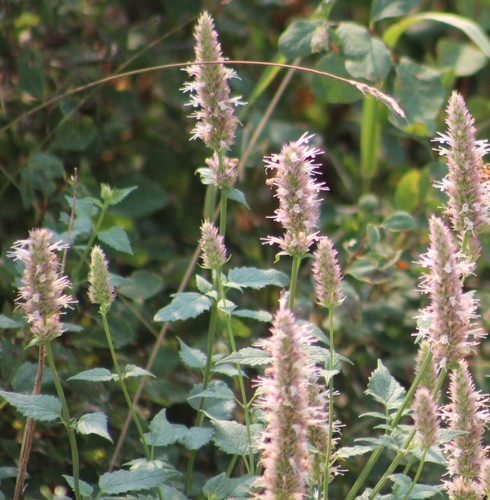
Agastache urticifolia is an aromatic North American perennial herb used for tea and traditional Native American medicine.
Agastache urticifolia (Benth.) Kuntze is an aromatic perennial herb that produces an erect stem with widely spaced leaves. Each leaf is lance-shaped to nearly triangular, toothed, and can grow up to 8 centimeters long and 7 centimeters wide. Its inflorescence is a dense spike made up of many flowers. Each individual flower has long sepals tipped with bright purple, and tubular corollas in shades o...
⚠️ Toxicity: Insufficient toxicity evidence; avoid direct contact and ingestion.
View full details →
7
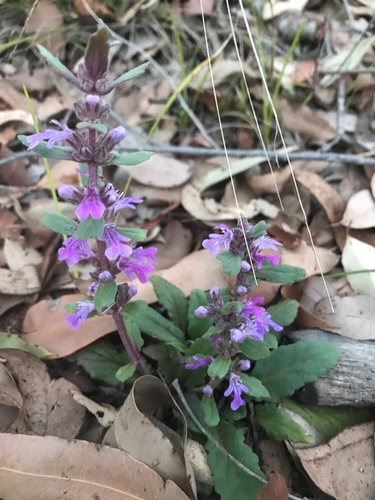
Ajuga australis R.Br. is a short-lived herbaceous Australian shrub with purple flowers that can be grown in gardens.
Ajuga australis R.Br. grows as a herbaceous shrub. Flowering stems emerge from a loose rosette of leaves. Each leaf is obovate or elliptic with a wedge-shaped base, measuring 3–12 cm in length and 0.8–3.5 cm in width. Leaves are covered in fine hairs, which are more prominent along the midrib. Its purple flowers predominantly bloom in spring, but may appear at any time of year. This species typica...
⚠️ Toxicity: Insufficient toxicity evidence; avoid direct contact and ingestion.
View full details →
8
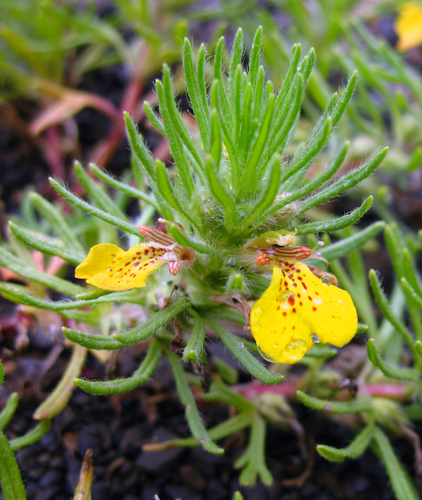
Ajuga chamaepitys, or ground pine, is a small herb with traditional herbal uses for gout and rheumatism.
Ajuga chamaepitys, also commonly called ground pine, is a small herbaceous perennial plant, growing 10 to 40 centimeters tall. It has a four-cornered, hairy stem that is reddish purple, and at first glance, the plant resembles a tiny pine tree. Its leaves are arranged oppositely along the stem, can grow up to 4 centimeters long, and are divided into three linear lobes; when crushed, the leaves rel...
⚠️ Toxicity: Insufficient toxicity evidence; avoid direct contact and ingestion.
View full details →
9
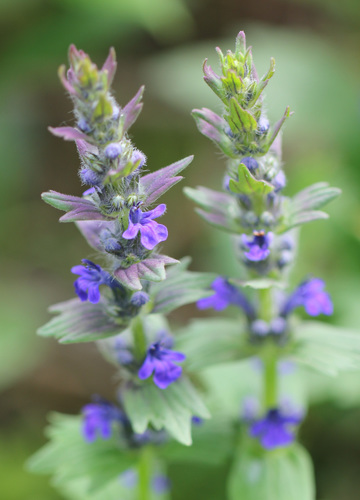
Ajuga genevensis L. is an evergreen perennial ornamental herb native to Europe, Turkey and the Caucasus, also used in traditional Austrian medicine.
Ajuga genevensis L. is an evergreen perennial plant that flowers between April and July, and grows to a height of 10 to 30 cm. It has long-stalked, obovate basal leaves that are shallowly lobed or toothed. It produces an upright stem, with flowers arranged in dense, terminal, spike-like inflorescences. The flowers are most often violet-blue, but can also be pink or white; the uppermost flowers are...
⚠️ Toxicity: Insufficient toxicity evidence; avoid direct contact and ingestion.
View full details →
10
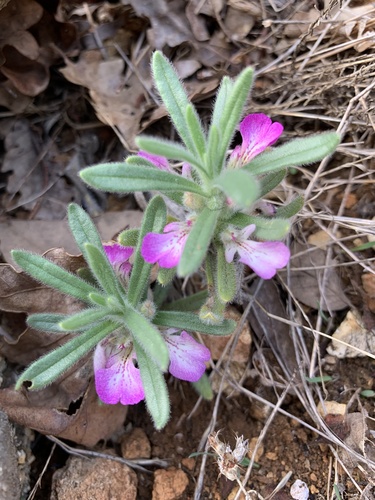
Southern bugle, Ajuga iva, is a 5-cm-tall self-supporting perennial herb in the Lamiaceae family with two known subspecies.
Ajuga iva, commonly known as southern bugle, is a species of perennial herb belonging to the family Lamiaceae. This species has a self-supporting growth form and produces simple, broad leaves. Mature individuals of Ajuga iva can reach a height of 5 cm. Two subspecies are recognized for this species: Ajuga iva subsp. iva and Ajuga iva subsp. pseudoiva.
⚠️ Toxicity: Insufficient toxicity evidence; avoid direct contact and ingestion.
View full details →
11
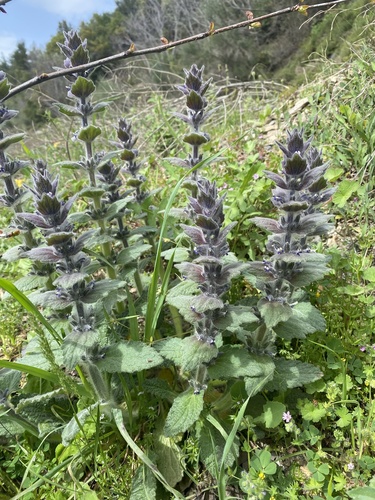
Ajuga orientalis L. is a flowering plant used for its claimed medicinal properties in traditional Turkish medicine.
Ajuga orientalis L. is a plant that reaches a mature height and width of 0.45 meters (1 foot 6 inches) after 2 to 5 years of growth. It produces flower stems 6 to 30 centimeters (2.4 to 11.8 inches) long during spring and summer. Each stem holds 4 to 12 tube-shaped flowers that measure 10 to 12 millimeters (0.39 to 0.47 inches) long, with a mixed cream and violet coloration. The flower calyx is 6 ...
⚠️ Toxicity: Insufficient toxicity evidence; avoid direct contact and ingestion.
View full details →
12
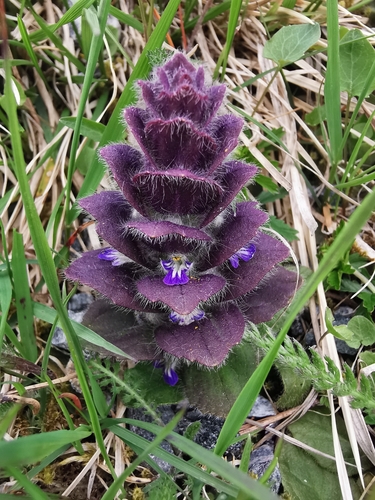
Ajuga pyramidalis L., pyramidal bugle, is a perennial herb with purplish-tinted bracted purple flowers, claimed to have medicinal uses.
Ajuga pyramidalis L., commonly called pyramidal bugle, is a perennial herbaceous plant that reaches a height of about 5 to 20 cm (2 to 8 in). It forms a basal rosette of stalked leaves, which are noticeably larger than the leaves growing along the stem. The stiff, upright, hairy stem is square-shaped, and bears simple leaves arranged in opposite pairs. These leaves are ovate, hairy on both their u...
⚠️ Toxicity: Insufficient toxicity evidence; avoid direct contact and ingestion.
View full details →
13
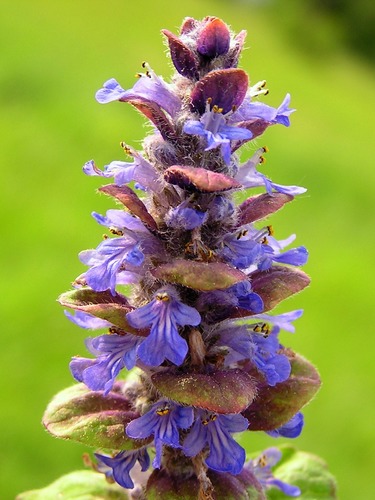
Ajuga reptans is an evergreen perennial herb grown as garden groundcover, with edible leaves and ecological and traditional uses.
Ajuga reptans, commonly known as bugle or bugleweed, is a sprawling perennial herb that grows 10 to 35 cm (4 to 14 in) tall with erect flowering stems. Its stems are square in cross-section, with hairs growing on two sides, and the plant produces runners that spread across the ground surface. Its purplish-green stalked leaves grow in opposite pairs; the hairless leaf blades are usually elliptical ...
⚠️ Toxicity: Insufficient toxicity evidence; avoid direct contact and ingestion.
View full details →
14
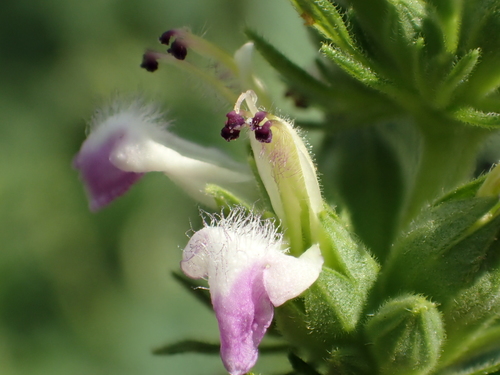
Anisomeles indica is a herbaceous plant species native to eastern Asia and naturalized on some Pacific islands.
Anisomeles indica (L.) Kuntze, commonly called catmint, is a herbaceous plant species. It is native to eastern Asia, and has become naturalized on some Pacific islands.
⚠️ Toxicity: Insufficient toxicity evidence; avoid direct contact and ingestion.
View full details →
15
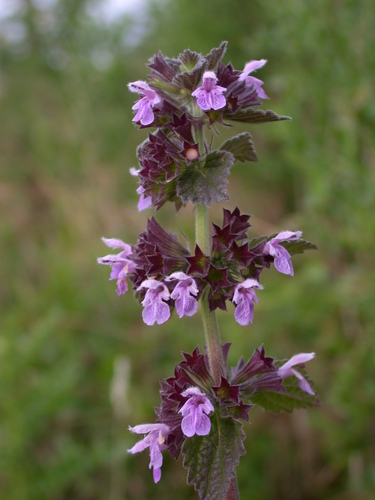
Ballota nigra L. is a nitrophilous flowering plant that has a distinct moldy scent and is harvested for use in products like syrups.
Ballota nigra L. produces a very strong, characteristic odor that resembles mould or damp soil. It can be identified by its clusters of hairy, reddish-purple flowers. This plant can grow up to 1 meter (3 feet 3 inches) tall. Ballota nigra is a nitrophilous plant. It grows in ruins, fallow fields, and hedgerows, at elevations up to 1,300 meters (4,300 feet). It prefers loose, calcareous (alkaline) ...
⚠️ Toxicity: Insufficient toxicity evidence; avoid direct contact and ingestion.
View full details →
16
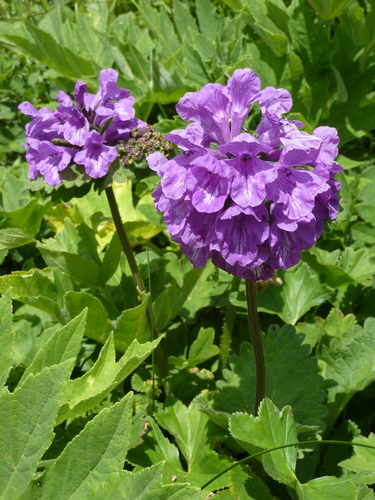
Big betony (Betonica macrantha) is a herbaceous perennial flowering plant in the mint family native to parts of Western Asia.
Betonica macrantha, formerly classified under the name Stachys macrantha and commonly called big betony, is a species of flowering plant belonging to the mint family, Lamiaceae. It is native to the Caucasus, northeastern Turkey, and northwestern Iran. This plant is an erect herbaceous perennial that grows to 60 cm (24 in) tall and 30 cm (12 in) wide, with scalloped cordate leaves. Through the whol...
⚠️ Toxicity: Insufficient toxicity evidence; avoid direct contact and ingestion.
View full details →
17
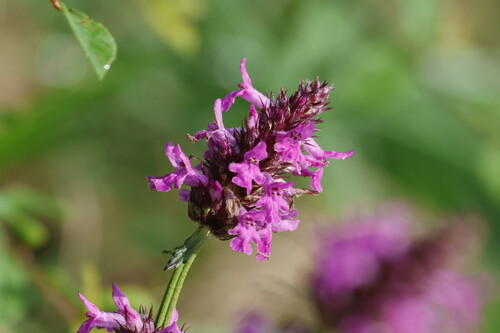
Betonica officinalis (common betony) is a perennial herb with a long history of traditional medicinal uses across Europe and beyond.
Betonica officinalis L. is a rhizotomous, patch-forming herbaceous perennial that grows in grasslands, reaching 30–60 cm (12–24 in) tall. It bears stalked, narrowly oval leaves with heart-shaped bases, a somewhat wrinkled texture, and toothed margins on upright stems. Its calyx measures 5–7 mm long, has 5 teeth, and is edged with bristles. The corolla is 1–1.5 cm long, with a flat upper lip that i...
⚠️ Toxicity: Insufficient toxicity evidence; avoid direct contact and ingestion.
View full details →
18
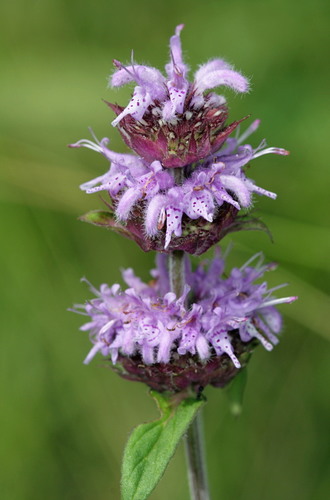
Blephilia ciliata is a perennial mint-family herb native to eastern North America, traditionally used by the Cherokee for headache treatment.
Blephilia ciliata (L.) Raf. ex Benth. is a perennial herb that grows 40 to 80 cm (15.5 to 31.5 in) tall. Like many other mint family plants, it has a 4-angled square stem. The central stem is typically unbranched; side stems only form if the plant is damaged. Leaves are arranged oppositely along the stem. They are sessile, lightly toothed, broadly ovate to lanceolate, and give off a mild fragrance...
⚠️ Toxicity: Insufficient toxicity evidence; avoid direct contact and ingestion.
View full details →
19
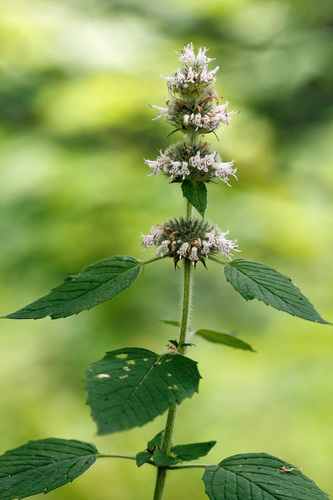
Blephilia hirsuta, or hairy wood mint, is a fragrant perennial mint native to eastern North American hardwood forests.
Blephilia hirsuta, commonly known as hairy wood mint, is a perennial herb. It typically grows between 30 and 120 cm (12 to 47 inches) tall, spreading from a rhizome system with fibrous roots. Its central stem is covered in long white hairs, and leaves are arranged oppositely along this stem. The leaves are long and thin, wider near the base; they have a pleasant fragrance, and their 1 to 3 cm (1⁄2...
⚠️ Toxicity: Insufficient toxicity evidence; avoid direct contact and ingestion.
View full details →
20
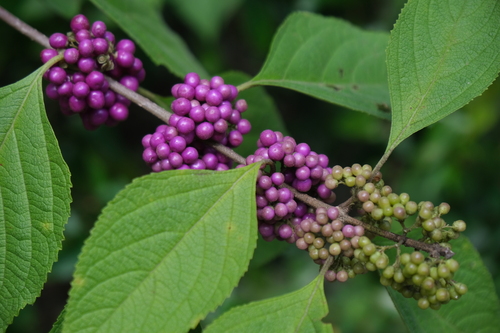
Callicarpa americana L., American beautyberry, is a low-maintenance North American shrub grown ornamentally for its colorful berry clusters.
Callicarpa americana L. is a shrub that grows to approximately 3 meters in height. Its young stems are densely covered in stellate, scurfy hairs, which sometimes create a tomentose texture; these hairs are shed once stems become woody. Leaves are arranged oppositely, or very rarely in whorls of three, with petioles 0.5 to 3.5 centimeters long. Leaf blades are ovate to elliptic, 8 to 23 centimeters...
⚠️ Toxicity: Insufficient toxicity evidence; avoid direct contact and ingestion.
View full details →
21
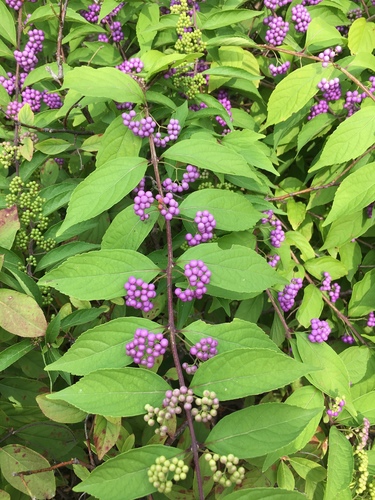
Callicarpa dichotoma, purple beautyberry, is an edible fruiting Lamiaceae shrub grown in gardens, found in East Asia.
Callicarpa dichotoma (Lour.) K.Koch is a species of flowering plant that belongs to the Lamiaceae family. It is commonly known by two common names: purple beautyberry and early amethyst. This plant is cultivated as a garden shrub. Its flowers range in color from pink to white. It produces small purple drupes, which are its berries. The fruits grow in large, dense clusters. These fruits serve as a ...
⚠️ Toxicity: Insufficient toxicity evidence; avoid direct contact and ingestion.
View full details →
22
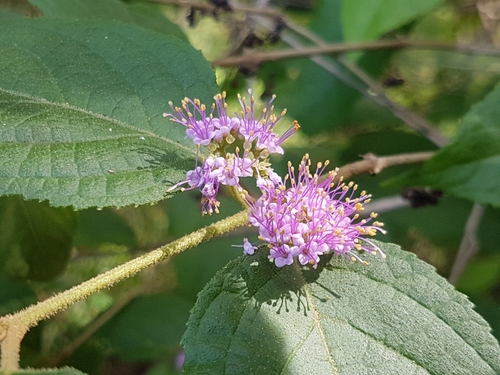
Callicarpa pedunculata is an up to 4m tall shrub grown as an ornamental, with inedible astringent acidic fruit.
Callicarpa pedunculata R.Br. is a shrub that can reach up to 4 meters in height. Its twigs, leaf petioles, and the underside of leaf blades are covered in stalked stellate hairs. The upper surface of leaves is covered in a mix of stellate and simple hairs, which grow sparser as the leaf ages. Leaf blades measure roughly 6–18 cm long by 3–6 cm wide, and bear small pale yellow glands on their unders...
⚠️ Toxicity: Insufficient toxicity evidence; avoid direct contact and ingestion.
View full details →
23
Cantinoa mutabilis (Rich.) Harley & J.F.B.Pastore
Cantinoa mutabilis (Rich.) Harley & J.F.B.Pastore
🌿 Plantae Lamiaceae
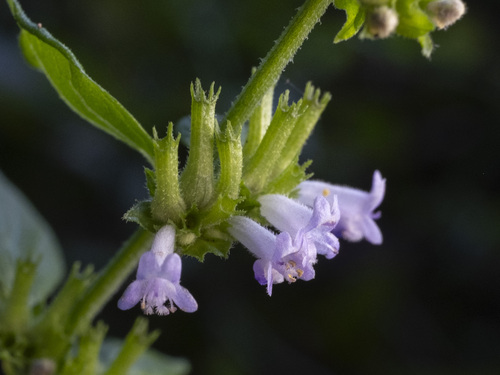
Cantinoa mutabilis is an aromatic Lamiaceae herb or subshrub native to tropical and subtropical regions of the Americas.
Cantinoa mutabilis is an aromatic herb or subshrub belonging to the Lamiaceae family. Like other Lamiaceae species, it has opposite leaves and square stems. Its flowers are bilaterally symmetrical, grow in axillary clusters, and have a tubular corolla that is adapted for insect pollination. Modern taxonomic treatments emphasize features of the inflorescence, calyx, and corolla as the key morpholog...
⚠️ Toxicity: Insufficient toxicity evidence; avoid direct contact and ingestion.
View full details →
24
Caryopteris incana (Thunb. ex Houtt.) Miq.
Caryopteris incana (Thunb. ex Houtt.) Miq.
🌿 Plantae Lamiaceae
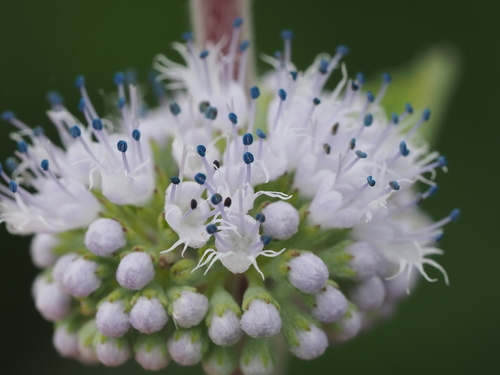
Caryopteris incana is a 2 - m - long deciduous vine with tuberous roots, alternate palmately - divided leaves, pale - yellow bisexual flowers in panicles, round spotted fruits, flowering from late June to early August and fruiting from late August to mid - October, distributed in central - southern China and some Korean provinces.
Caryopteris incana is a deciduous vine, reaching up to 2 m in length and having tuberous roots. Its leaves are alternate, palmately divided into 5 segments. The marginal segments are the smallest and further divided into 3, while other leaflets are palmately or pinnately divided. The leaf margins have sparse serrations. The leaf axis and nodes have wings and are glabrous. The petiole is 1 - 6 cm l...
View full details → 25
Cedronella canariensis (L.) Webb & Berthel.
Cedronella canariensis (L.) Webb & Berthel.
🌿 Plantae Lamiaceae
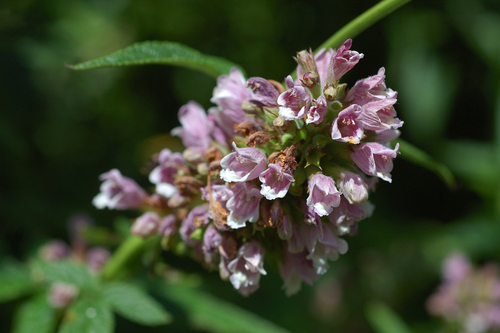
Cedronella canariensis is the only species in the Cedronella genus, a Lamiaceae perennial native to the Macaronesian archipelagoes.
Cedronella is a genus of flowering plants in the tribe Mentheae of the family Lamiaceae that contains only one species: Cedronella canariensis. This species is native to the Canary Islands, the Azores, and Madeira, and has become naturalized in South Africa, St. Helena, New Zealand, and California. Its common names are Canary Islands-balm, Canary balm, and Balm-of-Gilead. It is a perennial herbace...
⚠️ Toxicity: Insufficient toxicity evidence; avoid direct contact and ingestion.
View full details →
26
Chaiturus marrubiastrum (L.) Ehrh. ex Rchb.
Chaiturus marrubiastrum (L.) Ehrh. ex Rchb.
🌿 Plantae Lamiaceae
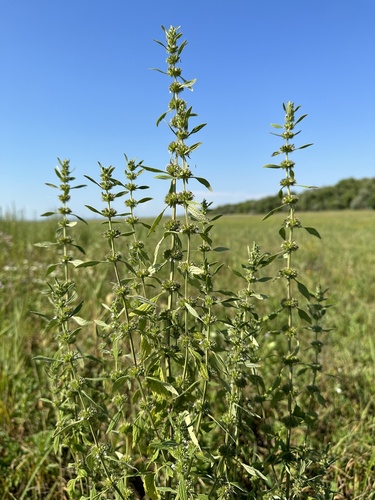
Chaiturus is a monotypic Lamiaceae plant genus, whose only species is native to parts of Europe, Asia, and Turkey.
Chaiturus is a genus of flowering plants in the family Lamiaceae that was first formally described in 1787. The genus contains only one recognized species: Chaiturus marrubiastrum, which has the common name false motherwort. This species is native to central and southern Europe (including locations such as Germany, Poland, Spain, Italy, the Balkans, and Ukraine), Russia, Turkey, the Caucasus, and ...
⚠️ Toxicity: Insufficient toxicity evidence; avoid direct contact and ingestion.
View full details →
27
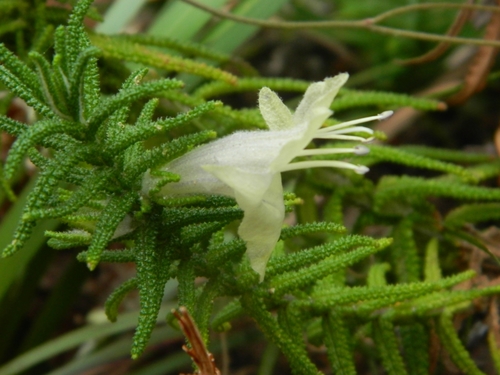
Chloanthes stoechadis is a small flowering undershrub native to eastern and southwestern Australia.
Chloanthes stoechadis, formally Chloanthes stoechadis R.Br., is a small, branched undershrub that typically reaches 30–90 cm (12–35 in) in height, with stems covered in a white woolly layer. Its leaves are arranged oppositely and are roughly linear in shape, usually between 0.5–5 cm (0.20–1.97 in) long. They are dull green, with a roughly wrinkled texture on the upper surface, a white woolly textu...
⚠️ Toxicity: Insufficient toxicity evidence; avoid direct contact and ingestion.
View full details →
28
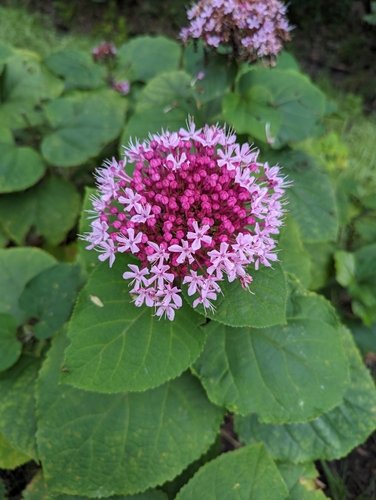
Clerodendrum bungei is a deciduous flowering shrub native to East Asia, widely cultivated as an ornamental plant.
Clerodendrum bungei is a deciduous shrub that grows up to 2 meters tall. Its leaves are heart-shaped (cordate), 10–20 cm long, slightly narrower than they are long, and have coarsely toothed edges. Flowers bloom in late summer, in shades of rose, crimson, or pink. They are arranged in a noticeable, rounded terminal inflorescence called a corymb, which can reach up to 10 cm in diameter. Like other ...
⚠️ Toxicity: Insufficient toxicity evidence; avoid direct contact and ingestion.
View full details →
29
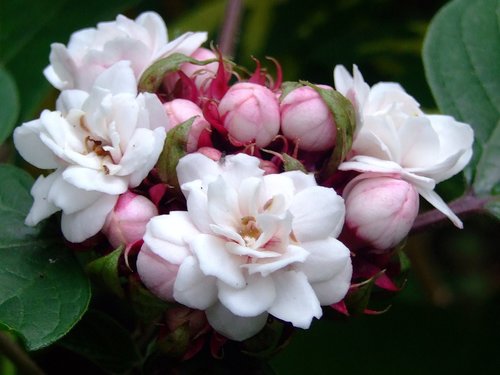
Clerodendrum chinense (glory bower) is a popular perennial garden shrub native to South and East Asia and widely introduced elsewhere.
Clerodendrum chinense, commonly known as glory bower, is a flowering plant species that belongs to the genus Clerodendrum. This species is native to Nepal, the eastern Himalayas, Assam, the Andaman and Nicobar Islands, south-central and southeast China, Southeast Asia, and Malesia. It is a perennial shrub that can grow up to 3 meters (10 feet) tall. It is a popular garden plant, and has been widel...
⚠️ Toxicity: Insufficient toxicity evidence; avoid direct contact and ingestion.
View full details →
30
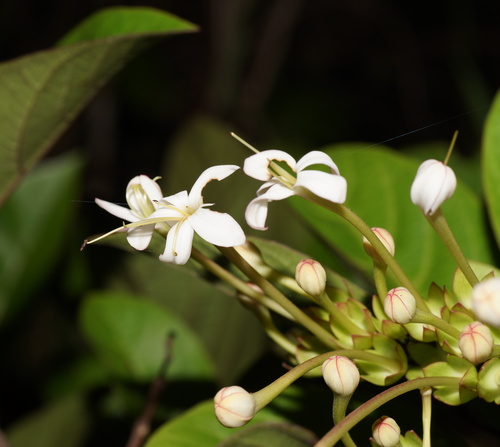
Clerodendrum floribundum, commonly called lolly bush, is an Australian tree with glossy succulent fruit, grown easily from seed or cuttings.
The scientific name of this plant is Clerodendrum floribundum R.Br. Its leaves are variable in shape, tapering to a blunt tip, a small prickle, or a sharp tip, and are usually 4 to 15 cm long and 2 to 6 cm wide. Young leaves of this species are less hairy than the leaves of the related species Clerodendrum tomentosum, also called downy chance. The generic name Clerodendrum comes from Greek, and tr...
⚠️ Toxicity: Insufficient toxicity evidence; avoid direct contact and ingestion.
View full details →
Frequently Asked Questions
How many species are in the Lamiaceae family?
This guide features 30 representative species from the Lamiaceae family. The full family contains many more species worldwide — explore them all on iNature.
How to identify Lamiaceae species?
Lamiaceae species share common features in their flowers, leaves, and growth patterns. This guide provides photos and descriptions for 30 species. For instant field identification, use the iNature app.
Sources: GBIF, iNaturalist, Wikipedia · Disclaimer
Identify any species instantly — even offline
iNature uses on-device AI to identify plants, animals, fungi and more. No internet needed.
Download iNature — FreeStart Exploring Nature Today
Download iNature for free. 10 identifications on us. No account needed. No credit card required.
Download Free on App Store
