About Agastache nepetoides (L.) Kuntze
Species Naming & Growth Form
Agastache nepetoides, or yellow giant hyssop, is a large mint-family plant that grows as an erect, sparsely branched stem reaching 1.2 to 2.1 meters (4 to 7 feet) in height.
Stem Characteristics
Like other members of the mint family, its central stem is four-sided rather than round; it is also hairless (glabrous) and has winged edges.
Leaf Shape & Size
Its leaves are thin, shaped either ovate or ovate-lanceolate, measuring 5 to 15 cm (2 to 6 inches) long and 3 to 7 cm (1 to 3 inches) across.
Leaf Arrangement & Properties
Leaves are arranged oppositely along the stem and have coarse teeth along their edges, and they lack the strong fragrance typical of many other mint family members.
Flower Inflorescence Type
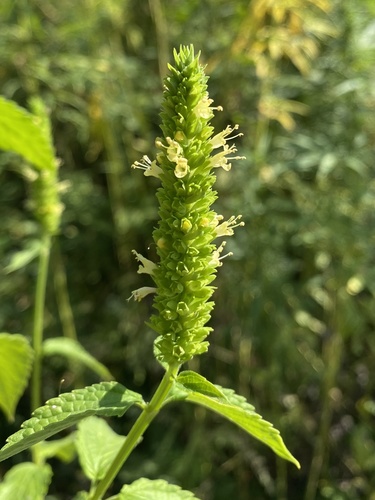
The plant produces greenish-yellow flowers that grow in individual spikes at the tips of the central stem and major secondary stems.
Flower Spike Features
Each flower spike measures 10 to 41 cm (4 to 16 inches) long, and only a small number of its densely packed flowers are open at the same time.
Native Distribution Overview
This species is native to central and eastern North America.
US Native Range
In the United States, its native range extends west to Nebraska, south to Georgia, east to Massachusetts, and north to the Canadian border.
Canadian Native Range
In Canada, it is native to Quebec and Ontario.
Natural Habitat
Its natural habitats include meadows, lowland woods and thickets, and upland deciduous woods.
Flowering & Pollinator Appeal
Its flowers bloom in late summer and are strongly attractive to bees.