About Callicarpa americana L.
Species and Growth Form
Callicarpa americana L. is a shrub that grows to approximately 3 meters in height.
Young Stem Indumentum
Its young stems are densely covered in stellate, scurfy hairs, which sometimes create a tomentose texture; these hairs are shed once stems become woody.
Leaf Arrangement and Petioles
Leaves are arranged oppositely, or very rarely in whorls of three, with petioles 0.5 to 3.5 centimeters long.
Leaf Blade Morphology
Leaf blades are ovate to elliptic, 8 to 23 centimeters long and 3.5 to 13 centimeters wide, with coarsely toothed margins.
Leaf Indumentum
Young leaves are densely covered in stellate scurfy hairs, and the upper leaf surface becomes nearly hairless as leaves mature.
Inflorescence Structure
Inflorescences are compact, many-flowered cymes that are typically shorter than the leaf petiole.
Calyx Characteristics
The calyx is 1.6 to 1.8 millimeters long, with four very short teeth.
Corolla Characteristics
The corolla varies in color from bluish to pinkish, and is sometimes white; its tube measures 2.6 to 3 millimeters long, and its blunt lobes are 1.3 to 1.5 millimeters long.
Ripe Fruit Appearance
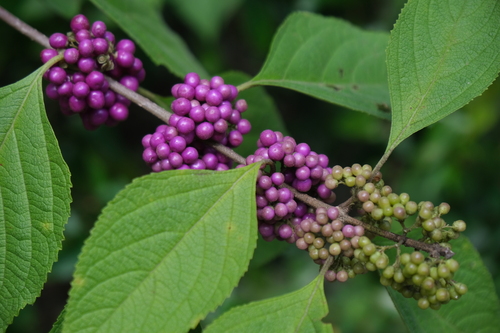
When ripe, the fruit is rose-pink to purple, 3 to 6 millimeters across, and grows in dense clusters.
Fruit Tissue Coloration
Only the fruit skin has color, while the fruit interior is white.
White-berried Cultivar Status
White-berried plants are cultivated under the name Callicarpa americana var. lactea, though not all botanical authorities recognize this grouping as a distinct botanical variety, the rank below subspecies.
Propagation Methods
This species can be propagated in three ways: through traditional cuttings, through germinating fully ripened purple seeds in pots or growing flats, or through scattering seeds on bare ground in a suitable area, then lightly covering the seeds or stepping on them to gently press them into the soil.
Native Range
The native range of C. americana stretches from Maryland to Florida, west to Texas and Arkansas, and also includes Mexico, Bermuda, the Bahamas and Cuba.
Raw Berry Edibility
Raw berries of this species are palatably sweet, but are only suitable for human consumption in small amounts due to their astringent properties.
Raw Berry Adverse Effects
Some people have experienced mild stomach cramps after eating the berries.
Processed Berry Uses
The berries are also processed into jellies and wine.
Root Use
The roots are used to make herbal tea.
Traditional Insect Repellent Use
As a folk remedy, it has been claimed that fresh, crushed leaves of American beautyberry help repel biting insects from animals like horses and mules.
Mosquito Repellent Compound
Callicarpenal, a chemical compound isolated from this plant, was proven effective as a mosquito repellent in a laboratory experiment that used a simulated skin model.
Berry Ripening Period and Wildlife Use
The berries ripen between September and October, and are a favorite food source for many wild bird species including cardinals, mockingbirds, finches and woodpeckers.
Wildlife Landscaping Use
Beautyberry is commonly planted in landscape designs to attract wildlife, because its berries provide food and the shrub itself provides cover for animals.
Ornamental Use
It is also popular for ornamental use, as it requires very little maintenance.