About Kobus kob (Erxleben, 1777)
Species Identification
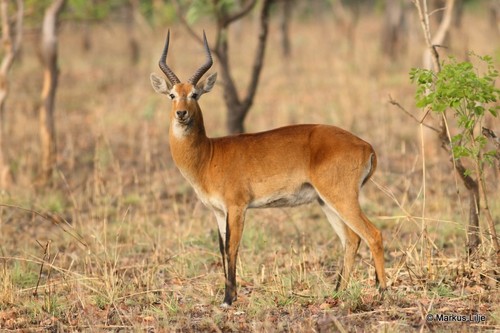
Kobus kob, or the kob, is an antelope that resembles the impala but has a heavier build. Males are more robust than females and possess horns.
Male Physical Measurements
Male kobs have shoulder heights between 90 and 100 cm (3.0–3.3 ft), and an average weight of 94 kg (207 lb).
Female Physical Measurements
Female kobs have shoulder heights between 82 and 92 cm (2.69–3.02 ft), and an average weight of 63 kg (139 lb).
General Pelage Characteristics
The kob's overall fur (pelage) is typically golden to reddish-brown, with white markings on the throat patch, eye ring, and inner ear, and black coloration on the front of the forelegs. Older male kobs become darker in color.
White-eared Kob Subspecies Traits
The subspecies white-eared kob (K. k. leucotis), found in the Sudd region (the easternmost part of the kob's total range), differs noticeably from other kob: it has an overall dark coat, similar to a male Nile lechwe, but with a white throat and no pale patch extending from the nape to the shoulder.
Gland Characteristics
Both sexes of kob have well-developed inguinal glands that secrete a yellow, waxy substance, alongside preorbital glands.
Current Geographical Range
Currently, the kob is found across Benin, Burkina Faso, Cameroon, the Central African Republic, Chad, Ivory Coast, the Democratic Republic of the Congo, Ethiopia, Ghana, Guinea, Guinea Bissau, Mali, Mauritania, Niger, Nigeria, Senegal, South Sudan, Togo, and Uganda.
Extirpated Historical Range
It was historically also present in Gambia, Kenya, Sierra Leone, Morocco, and Tanzania, but is now extinct in those areas.
Distribution Pattern
The kob's distribution, from western Africa to central East Africa, is patchy.
Habitat Preferences
It lives on flat ground and in open country near permanent water, in regions with a consistent climate.
Water and Grazing Requirements
The kob drinks daily and needs access to fresh grazing. During the rainy season, kobs use areas with short grasses and keep these grasses cropped short.
Arid Area Limitation
Because the kob depends on regular access to water, it does not travel far into arid areas.
Seasonal Herd Movement
Kob herds gather on pastures and move between them following seasonal changes. In flooded regions, kobs may travel hundreds of kilometers, and dry-season trips to reach water can cover 10 km (6.2 mi) or more.
Preferred Grass Species
Grasses preferred by kobs include Hyparrhenia species, Brachiaria brizantha, Setaria gayanus, Chloris gayana, and species in the Echinochloa and Digitaria genera.