About Capra ibex Linnaeus, 1758
Common and Scientific Names
The Alpine ibex, with the scientific name Capra ibex Linnaeus, 1758, is also commonly called the steinbock.
Taxonomy and Closest Relatives
It is a European goat species that resides in the Alps, one of ten species classified in the genus Capra, with the Iberian ibex as its closest living relative.
Sexual Dimorphism
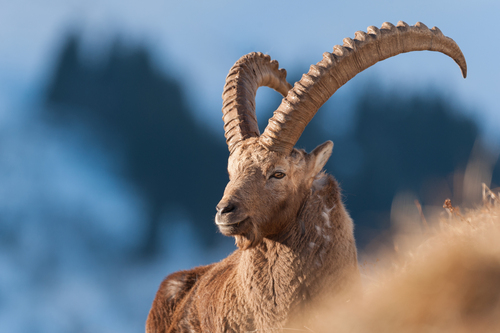
This species is sexually dimorphic: males are larger than females and grow longer horns.
Coat Color
Its coat is brownish-grey.
Typical Habitat and Elevation Range
Alpine ibexes typically inhabit steep, rough terrain and open alpine meadows, and can be found at elevations as high as 3,300 m (10,800 ft).
Climbing Adaptations
Their sharp hooves let them climb the steep slopes and cliffs of their mountain habitat.
Diet and Year-Round Activity
They primarily eat grass and remain active year-round.
Social Structure Outside Breeding Season
Though they are social animals, adult males and females stay separated for most of the year, only gathering to mate.
Breeding Season Male Competition
During the breeding season, males use their long horns to fight to gain access to females.
Natural Threats
Alpine ibexes have few natural predators, but are vulnerable to parasites and diseases.
19th Century Population Bottleneck
By the 19th century, the species had been extirpated from most of its original range and went through a population bottleneck with fewer than 100 individuals during its near-extinction event.
Genetic Diversity Impacts
This bottleneck resulted in very low genetic diversity across all modern populations.
Reintroduction History
The species has since been successfully reintroduced to parts of its historical range, and all living individuals today descend from the original population found in Italy's Gran Paradiso National Park.
IUCN Conservation Status
As of 2020, the IUCN Red List classifies the Alpine ibex as a species of least concern.
Current Native Range
The Alpine ibex is native to the Alps of central Europe, with a current range covering France, Switzerland, Liechtenstein, Italy, Germany, and Austria.
Fossil Record and Prehistoric Extirpation
Fossils of the species have been discovered as far south as Greece, where the species became locally extinct around 7,500 years ago due to human hunting.
Early Modern Hunting Impacts
Between the 16th and 18th centuries, hunting eliminated the species from most of its range, leaving only one surviving population in and around Gran Paradiso, Italy by the 19th century.
Modern Reintroduction Locations
Since that time, the species has been reintroduced into parts of its former range, as well as new areas including Slovenia and Bulgaria.
General Elevation Habitat
It is an excellent climber that occupies steep, rough terrain at elevations between 1,800 and 3,300 m (5,900 to 10,800 ft).
Woodland Habitat Use
It prefers open areas, but when snow cover is low and depending on population density, adult males may gather in larch and mixed larch-spruce woodland.
Sex-Separated Habitat Preferences
Outside of the breeding season, males and females occupy separate habitats: females are more often found on steep slopes, while males prefer more level ground.
Seasonal Elevation Movements
In spring, males inhabit lowland meadows where fresh grass grows, and climb to alpine meadows during summer.
Winter Habitat Selection
In early winter, both sexes move to steep, rocky slopes to avoid deep snow accumulations.
Slope Preference and Shelter Sites
Alpine ibexes prefer slopes with a 30–45° incline, and take shelter in small caves and rock overhangs.
Feeding Guild
The Alpine ibex is strictly herbivorous.
Primary Diet Components
Its diet is mostly made up of grass, which it prefers year-round.
Seasonal Diet Variation
In summer, ibexes add herbs to their diet, while in autumn and winter they also eat dwarf shrubs and conifer shoots.
Common Grass Genera Eaten
The most commonly eaten grass genera are Agrostis, Avena, Calamagrostis, Festuca, Phleum, Poa, Sesleria, and Trisetum.
Spring Feeding Time Allocation
In spring, individuals of both sexes spend roughly the same amount of time feeding each day.
Summer Feeding Time Differences Between Sexes
In summer, females — especially lactating females — spend more time feeding than males.
Male Summer Feeding Adaptations
Large adult males experience heat stress at high temperatures, which reduces their feeding time, but they can avoid this issue by feeding at night.
Home Range Size Variation
In the original Gran Paradiso population, home ranges of Alpine ibex can exceed 700 ha (1,700 acres); in reintroduced populations, home ranges may reach close to 3,000 ha (7,400 acres).
Home Range Seasonal Variation
Home range size depends on resource availability and time of year: it is largest during summer and autumn, smallest in winter, and intermediate in spring.
Sex-Based Home Range Differences
Females' home ranges are usually smaller than those of males.
Winter Thermoregulation and Metabolism
Alpine ibexes do not hibernate in winter; they shelter on cold winter nights and bask in sunlight in the mornings, and also reduce their heart rate and metabolism.
Interspecific Resource Competition
The species may compete for resources with chamois and red deer, and the presence of these species can force Alpine ibexes to occupy higher elevations.
Dam Climbing Behavior
The species' climbing ability is notable enough that it has been observed scaling the 57-degree slopes of the Cingino Dam in Piedmont, Italy, to lick mineral salts.
Dam Climbing Demographics
Only lighter females and kids, which have shorter legs than adult males, climb this steep dam.
Kid Dam Climbing Observations
Kids have been observed ascending 49 m (161 ft) along a zig-zag path, and descending along a straight path.
Mating Season Timing
The mating season for Alpine ibex starts in December and generally lasts around six weeks.
Breeding Season Male Herd Behavior
During this period, male herds break up into smaller groups that search for females.
Rut Phases
The rut occurs in two phases: in the first phase, males interact with females as a group; in the second phase, one male separates from his group to follow a female that is in oestrus.
Dominant Male Mating Behavior
Dominant males between nine and twelve years old follow a female and guard her from competing males.
Subordinate Male Mating Tactics
Subordinate younger males between two and six years old attempt to sneak past the guarding dominant male when he is distracted.
Response to Fleeing Females
If a female flees, both dominant and subordinate males will follow her.
Courtship Displays
During courtship, the male stretches his neck, flicks his tongue, curls his upper lip, urinates, and sniffs the female.
Post-Copulation Male Behavior
After copulation, the male returns to his group and restarts the first phase of the rut.
Environmental Impacts on Courtship
Environmental conditions can impact courtship; for example, snow can limit males' ability to follow and mate with females.
Oestrus and Gestation
A female is in oestrus for around 20 days, and gestation averages around five months, usually resulting in the birth of one kid, and sometimes two.
Birthing Site Selection
Females give birth away from their social groups on rocky slopes that are relatively safe from predators.
Kid Development After Birth
After a few days, kids are able to move on their own.
Nursery Group Behavior
Mothers and kids gather into nursery groups, where young are nursed for up to five months.
Nursery Group Composition
Nursery groups can also include non-lactating females.
Sexual Maturity and Growth Period
Alpine ibexes reach sexual maturity at 18 months old, but continue growing until females are five to six years old and males are nine to eleven years old.
Lifelong Horn Growth
Their horns grow throughout the animals' entire lives.
Newborn Horn Development
Newborns are born without horns; small horn tips become visible at one month old, and reach 20–25 mm (0.8–1.0 in) by the second month.
Male Early Horn Growth Rate
In males, horns grow around 8 cm (3.1 in) per year for the first five and a half years.
Adult Male Horn Growth Rate
Once males reach 10 years of age, horn growth slows to half this rate.
Horn Growth and Aging
This slowing of horn growth in males corresponds with aging.
Age Determination From Horns
The age of an Alpine ibex can be determined from the annual growth rings on its horns, which stop growing during winter.