About Syncerus caffer (Sparrman, 1779)
Taxonomic Identification
The African buffalo (Syncerus caffer) is a very robust bovid species.
Body Dimensions
Shoulder height ranges from 1.0 to 1.7 m (3 ft 3 in to 5 ft 7 in), head-and-body length ranges from 1.7 to 3.4 m (5 ft 7 in to 11 ft 2 in), and tail length is 70 to 110 cm (2 ft 4 in to 3 ft 7 in).
Compared to other large bovids, it has a long but stocky body (body length can exceed that of the heavier, taller wild water buffalo) and short thickset legs, leading to a relatively short standing height.
Weight by Subspecies
Cape buffalo weigh 425 to 870 kg (937 to 1,918 lb), with males averaging around 100 kg (220 lb) heavier than females.
African forest buffalo are only half this size, weighing 250 to 450 kg (600 to 1,000 lb).
Body Posture
The species carries its head low, with the top of the head sitting below the backline.
Hoof Adaptation
Front hooves are wider than rear hooves, an adaptation to support the heavier, more powerful front half of the body.
Coat Coloration (Savannah Type)
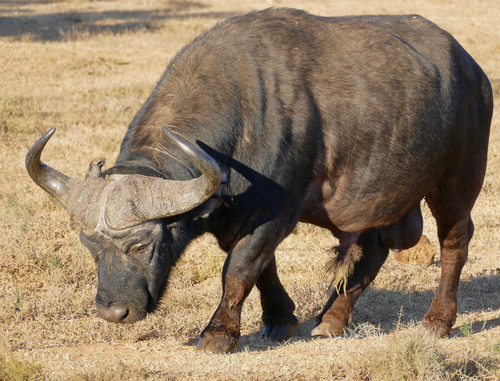
Savannah-type buffalo develop black or dark brown coats as they age; old bulls often have whitish circles around their eyes and face, while females tend to have more reddish coats.
Coat Coloration (Forest Type)
Forest-type buffalo are 30–40% smaller than savannah-type, are reddish brown, have more hair growth around the ears, and have horns that curve back and slightly upward.
Calf Coat Coloration
Calves of both types have red coats.
Male Savannah Buffalo Horn Structure
A key characteristic of the horns of adult male African buffalo from southern and eastern populations is that the horn bases lie very close together, forming a fused shield called a "boss".
From the base, the horns diverge downward, then curve smoothly upwards and outwards, and in some cases inwards or backwards.
Horn Span Records
In large bulls, the distance between the tips of the horns can reach over one metre, with a record of 164 cm (5 ft 5 in).
Horn Maturation Timing
Horns are fully formed when the animal reaches 5 or 6 years old, but the bosses do not harden until the animal is 8 to 9 years old.
Female Horn Characteristics
On average, female horns are 10–20% smaller than male horns, and females do not develop a boss.
Forest Type Buffalo Horn Characteristics
Forest-type buffalo horns are smaller than those of Southern and East African savannah-type buffalo, usually measuring less than 40 cm (16 in), and are almost never fused.
Chromosome Count and Hybridization Potential
Unlike most other large bovines, African buffalo have 52 chromosomes (for comparison, American bison and domestic cattle have 60), so they cannot produce hybrid offspring with domestic cattle or bison.
Feeding Habit Overview
The African buffalo is one of the most successful grazers in Africa.
Habitat Range
It inhabits savannas, swamps, floodplains, mopane grasslands, and the forests of Africa's major mountains.
Habitat Preferences
It prefers habitats with dense cover such as reeds and thickets, but can also be found in open woodland.
Water Requirements
While not particularly demanding of habitat types, it requires daily access to water, so it depends on perennial water sources.
Grazing Adaptations
Like the plains zebra, African buffalo can survive on tall, coarse grasses.
Herds of buffalo graze down grasses, creating openings for more selective grazers.
Feeding Mechanism
When feeding, the buffalo uses its tongue and wide incisor row to eat grass more quickly than most other African herbivores, and does not stay long on trampled or depleted grazing areas.
Predator Overview
Other than humans, African buffalo have few predators, and are capable of defending themselves against — and even killing — lions.
Lion Predation Dynamics
Lions regularly kill and eat buffalo, and in some regions buffalo are the lions' primary prey.
It usually takes multiple lions to bring down a single adult buffalo, and an entire pride may join the hunt, though lone adult male lions have been reported successfully killing adult buffalo in several incidents.
White Rhino Interactions
On very rare occasions, buffalo and white rhinos will fight over territory; due to the rhino's larger size and greater strength advantage, the rhino typically wins, and the buffalo may die from injuries sustained in the encounter.
Rhinos are solitary, while buffalo (excluding solitary adult bulls) are primarily social, so the two species do not usually recognize each other as threats.
Hippopotamus Interactions
Hippopotamuses and buffalo also do not normally interact, but fights can break out if a buffalo provokes a hippo or makes it feel threatened, though this is also rare.
African Elephant Interactions
Adolescent bull African elephants may harass or kill Cape buffalo, either out of territorial aggression or while in musth.
When this occurs, calves are most likely to be killed, as they are defenseless against an elephant alone, while adult buffalo will attempt to fight back and may survive (or die later from injuries).
Nile Crocodile Predation
The average-sized Nile crocodile typically only attacks old solitary buffalo and young calves, though they are capable of killing healthy adults.
Exceptionally large, old male crocodiles may become semi-habitual buffalo predators.
Smaller Predator Threats
Cheetahs, leopards, African wild dogs, and spotted hyenas normally only pose a threat to newborn calves.
However, larger spotted hyena clans have been recorded killing cows (mostly pregnant individuals) and, on rare occasions, full-grown bulls.
African Wild Dog Predation
Large packs of African wild dogs have been observed hunting calves and sick adults.
Sexual Maturity Timing
Female African buffalo reach sexual maturity around five years of age, while males reach sexual maturity between four and six years of age.
Breeding Seasonality
African buffalo only mate and give birth during the rainy season.
Birth peaks occur early in the rainy season, while mating peaks later.
Mating Guarding Behavior
A bull will closely guard a cow that has entered estrus, keeping other bulls away.
This is challenging, as cows are evasive and attract many males.
By the time a cow is in full estrus, only the most dominant bull in the herd or subherd remains with her.
Gestation and First Birth
Cows give birth for the first time at five years of age, after a gestation period of 11.5 months.
Calf Rearing Early Stage
For the first few weeks after birth, newborn calves remain hidden in vegetation, nursed occasionally by their mother, before joining the main herd.
Calf Herd Protection
Older calves are kept in the center of the herd for safety.
Maternal Bond Duration
The maternal bond between mother and calf lasts longer than in most bovids.
The bond ends when a new calf is born, and the mother will drive her previous offspring away with horn jabs.
Yearling Behavior
Even so, yearlings will follow their mother for another year or so.
Male Dispersal
Males leave their mothers when they are two years old to join bachelor groups.
Suckling Behavior
Unusually for bovids, young calves suckle from behind their mother, pushing their heads between the mother's legs.
Wild Lifespan
In the wild, African buffalo have an average lifespan of 11 years, with individuals recorded reaching 22 years of age.
Captive Lifespan
In captivity, they have a maximum recorded lifespan of 29.5 years, with an average lifespan of 16 years.