About Cephalophus silvicultor (Afzelius, 1815)
Physical Characteristics
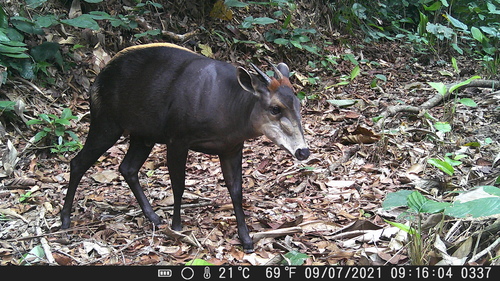
Yellow-backed duikers (Cephalophus silvicultor) have a convex body shape, with the rump standing taller than the shoulders. They possess very short horns, ranging from 8.5 to 21 cm (3.3 to 8.3 in) in length, which are cylindrical and ribbed at the base. An orange crest of hair sits between their horns.
Size and Coloration
The species gets its common name from a characteristic patch of yellow hairs on the rump, which stands up when the duiker is alarmed or threatened. Females often grow slightly larger than males; overall coloration is very similar between sexes, so there is very little sexual dimorphism. Head-and-body length ranges from 115 to 145 cm (45 to 57 in), with a short tail measuring 11 to 18 cm (4.3 to 7.1 in). Adult yellow-backed duikers weigh about 60–80 kg (130–180 lb), making this species the largest in its genus. It has a large mouth, throat, and developed jaw musculature.
Habitat and Adaptation
Yellow-backed duikers are primarily forest-dwelling, and inhabit semi-deciduous forests, rainforests, riparian forests, and montane forests. They can also be found in open bush, isolated forest fragments, and savanna clearings. Their convex body shape is well adapted for life in forests, allowing quick movement through dense forest and thick bush.
Behavior and Stress
This shape is typical of ungulates that regularly dive quickly into underbrush for cover; the word "duiker" is Afrikaans for "diver". Duikers are very skittish and easily stressed. When frightened or pursued, they will run almost blindly away from threats. At the Los Angeles Zoo, startled duikers have been recorded running headfirst into the glass of their enclosures. In captivity, duikers are known to develop stress-induced jaw abscesses.
Activity and Social Life
Yellow-backed duikers are active at all hours of the day and night. They live mainly alone or in pairs, and rarely gather even in small herds. Their elusive behavior means far less is known about their ecology and demography than for most other ungulates. Yellow-backed duikers can breed year-round, and many individuals breed twice per year.
Reproduction and Lifespan
The female gives birth to one (rarely two) offspring after a gestation period of 4 to 7 months. The calf stays hidden for the first week of life, and is weaned 3 to 5 months after birth. Males reach sexual maturity at 12 to 18 months old, while females reach sexual maturity at 9 to 12 months old. Their lifespan is 10 to 12 years in the wild, and up to 22.5 years in captivity.