About Ovis ammon (Linnaeus, 1758)
Etymology and Species Classification
The common name 'argali' comes from the Mongolian term for wild sheep, and Ovis ammon, the argali, is the largest wild sheep species.
Shoulder Height and Body Length
Argali stand 85 to 135 cm (3 to 4 ft) high at the shoulder, and measure 136 to 200 cm (4 to 7 ft) long from the head to the base of the tail.
Sexual Size Dimorphism Overview
Females (called ewes) are considerably smaller than males (called rams), and sometimes weigh less than half as much as a male.
Body Mass Ranges
Ewes weigh 43.2 to 100 kg (95 to 220 lb), while rams typically weigh 97 to 328 kg (214 to 723 lb), with a maximum recorded mass of 356 kg (785 lb).
Marco Polo Sheep Subspecies
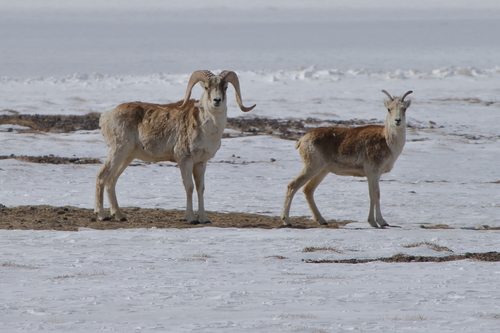
The Pamir argali, also called Marco Polo sheep (named for the traveler who first described this subspecies) with the scientific name O. a. polii, is the largest subspecies on average. It regularly reaches over 180 cm (5 ft 11 in) in length excluding the tail, and has less body mass sexual dimorphism than most other argali subspecies.
Tail Length
The argali has a relatively shorter tail than any other wild goat-antelope or sheep, with recorded tail lengths from 9.5 to 17 cm (3.7–6.7 in).
General Coat Color Variation
Individual argali have varied general coloration, ranging from light yellow to reddish-brown to dark grey-brown. Himalayan argali, also called nyan, are usually relatively dark, while argali from Russian ranges are often relatively pale. In summer, the coat often shows faint salt-and-pepper spotting.
Regional Color Gradients
The argali's back is darker than its sides, which gradually lighten toward the belly. The face, tail, and buttocks are yellowish-white.
Sex-Linked Color Features
Males have a whitish neck ruff and a dorsal crest, and are usually slightly darker in color than females.
Male Horn Characteristics
Males have two large corkscrew-shaped horns that can reach 190 cm (6 ft 3 in) in total length and weigh up to 23 kg (51 lb); males use these horns to compete with each other.
Female Horn Characteristics
Females also have horns, but they are much smaller, usually measuring less than 60 cm (24 in) in total length.
Geographical Range
Argali range from central Kazakhstan in the west to China's Shanxi Province in the east, and from the Altai Mountains in the north to the Himalayas in the south.
Elevation Range
They inhabit mountainous areas, living at elevations from 300 to 5,800 m (980 to 19,030 ft).
Protected Area Habitat Preferences
Within protected areas, the species generally prefers gently sloping terrain with soft broken ground, though ewes with lambs often live in steeper, more rugged areas with canyons and jagged rock.
Hunted Area Habitat Use
In heavily hunted areas such as Kazakhstan, argali are more likely to be found in forested areas.
Livestock Competition Habitat Shifts
In parts of China and Russia where argali compete for resources with large numbers of domestic livestock, they more often live in steep, jagged terrain.
Winter Habitat Selection
In winter, argali seek out mountain areas with low snow cover, following winds that clear snow from the ground. Rams are generally found at higher elevations more consistently than females, and stay at higher elevations longer into the winter.
Herd Size and Sex Segregation
Argalis live in herds that usually number between 2 and 150 individuals, and herds are segregated by sex outside of the breeding season. In most local populations, adult females make up more than half of the total population, while adult males account for around 20% and young argali make up the remaining 20%.
Male Herd Structure
Some rams are solitary, but most are seen in small herds of 3 to 30 individuals.
Female Herd Structure
Females and their young live in larger groups, regularly up to 92 individuals and exceptionally reaching 200 animals.
Migration Occurrence
Migratory herds, especially male herds, have been recorded.
Migration Triggers
Most migration is tied to seasonal reductions in food sources, but movements can also be triggered by an overabundance of biting insects (particularly horseflies), severe drought or fire, human poaching, or large numbers of domestic livestock.
Movement Capability
Thanks to their long legs, argali herds can travel quickly between locations. Argali tend to occupy higher elevations during the summer.
Breeding Maturity Age
Argali reach breeding maturity at two to three years of age.
Rutting Period Timing
Rutting can occur from October to mid-January, and generally lasts longer at lower elevations.
Rutting Dominance Establishment
In rutting herds, both rams and ewes attack other members of their own sex, establishing dominance by ramming each other with their horns. While these groups may engage in playful behavior similar to lambs, combat between two mature rams is serious.
Male Combat Behavior
Rams slam into each other with their forelegs raised, and the impact of their collisions can be heard from up to 800 m (2,600 ft) away. Older males (over six years of age), which are usually also the largest, most often end up as dominant individuals, and younger males are chased away once ewes enter estrus.
Mating Courtship Behavior
After dominance is established, top-ranking rams approach ewes and smell their urine to check if the ewe is receptive to mating. The ram then repeatedly approaches the ewe and forcibly mounts her.
Mating Timeline
Mating begins two to three weeks after the start of the rutting period. Rams may stay with ewes for up to two months after the rutting period ends.
Gestation Period
The gestation period lasts a little over 165 days.
Birth Timing and Litter Size
Births take place in late March or April, and a variable number of females do not produce young. Most subspecies give birth to a single lamb, though twins are not uncommon in some races, and even litters of five have been recorded.
Newborn Lamb Weight
Newborn lambs weigh 2.7 to 4.6 kg (6.0 to 10.1 lb).
Post-Birth Behavior
The newborn lamb and its mother stay near the birth site overnight, and typically walk together the next day. Lambs often play in groups, jumping together, and are sometimes joined by their mothers.
Lamb Growth Rate
Lambs gain weight quite quickly, and can reach 10 times their birth weight by their first birthday. Females usually reach their maximum mass by two years of age, but males continue growing larger and heavier during their third and fourth years.
Tooth Development
Milk teeth emerge around three months of age, and a full set of permanent teeth develops by around six months.
Nursing Period
By the time their full set of teeth develops, lambs are able to graze on their own, but ewes continue nursing them from August until May of the next year.
Lifespan
Most wild argali live five to 10 years, but can live up to 13 years in the wild.
Daily Food Intake
Adult argali eat 16 to 19 kg (35 to 42 lb) of food per day. The vegetation they prefer varies by elevation and region.
High Elevation Diet
At higher elevations, argali predominantly eat grasses, sedges, and forbs.
Mid-Elevation Diet
In mid-elevation habitats, they more often feed on bushes and mesophyte grasses.
Low Elevation Diet
In the lowest elevation ranges and desert spurs, grasses and sedges again make up most of the diet, though these are often different species than the sedges and grasses eaten at high elevation.
Regional Diet Variation
In north-central Kazakhstan, sprouts, leaves, flowers, and fruits are a significant part of the argali's diet year-round, while these plant parts only act as an occasional rare supplement across the rest of the argali's range.
Water Requirements
Argali require water, which is rarely a problem for animals at high elevation where melting snow and small waterways are common. In drier climates, argali may travel several kilometers to find water.
Saline Soil Consumption
When available, argali will readily eat saline soil.