About Caprimulgus jotaka Temminck & Schlegel, 1845
Species Identity and Morphology Overview
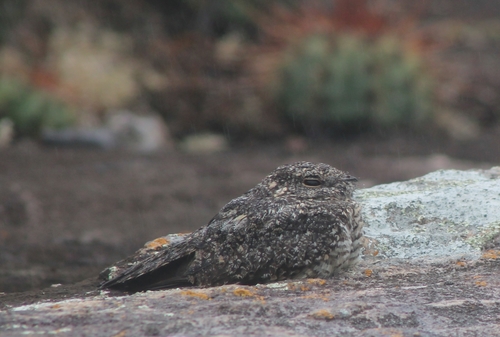
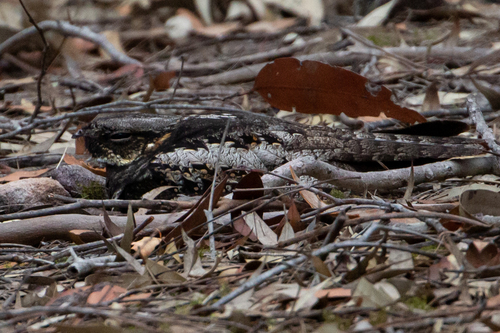
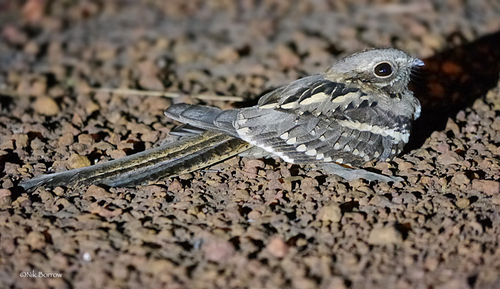
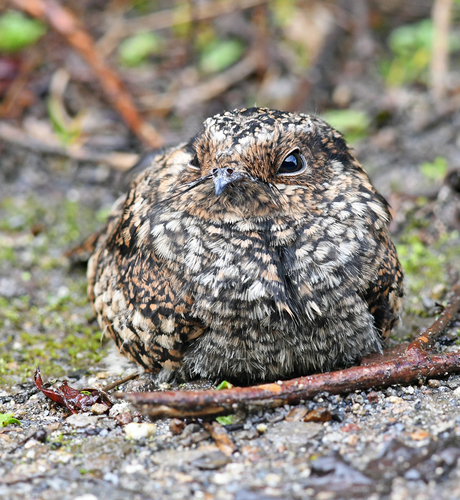
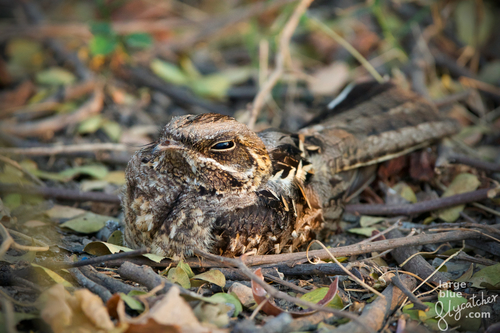
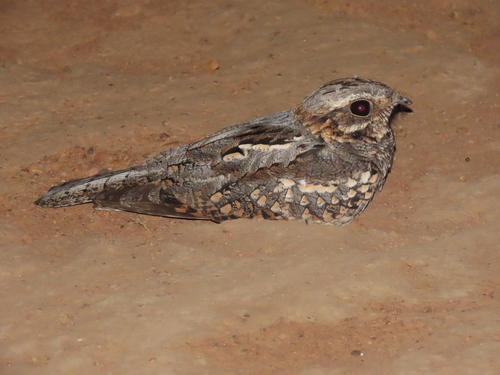
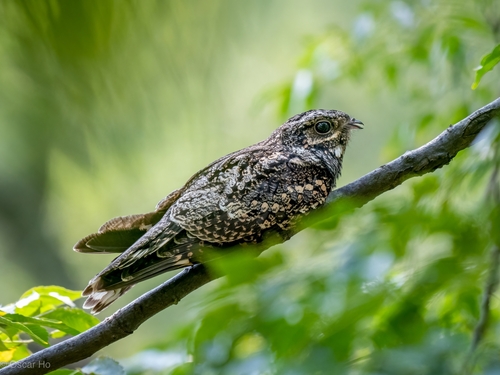
The grey nightjar (Caprimulgus jotaka Temminck & Schlegel, 1845) is a medium-sized nightjar with a large head, large eye, long tail, weak bill, and short legs. Its plumage is mottled and very similar to the Himalayan subspecies of the jungle nightjar (C. indicus harzarae).
Head Plumage Patterns
The forehead, crown, and nape are covered in small, intricate grayish-white and dark brown vermiculated patterns mixed with black longitudinal streaks; the central black stripe on the crown is particularly prominent. Nape feather tips have pale brown spots.
Upper Body Plumage
The upper back through the upper tail coverts matches the crown’s coloration, but has more dark brown horizontal bars. Scapulars are black with brownish-yellow spots, and their outer webs often have brownish-yellow patches.
Wing Coverts and Remiges
Wing coverts and remiges are dark brown, with round brownish-yellow spots on the tips of wing coverts. Inner flight feathers are grayish-white with black shaft streaks and vermiculated patterns.
Primary and Secondary Feathers
Primaries and secondaries are edged with reddish-brown serrated markings. The first primary feather has a white circular patch near the center of its inner web, while the second to fourth primaries have white horizontal bars.
Tail Feather Markings
Central tail feathers are gray-brown with dense dark brown vermiculated markings and 6 or 7 black wavy horizontal bands. Outer tail feathers are mostly dark brown with prominent white subterminal patches.
Facial and Throat Plumage
The lores, supercilium, cheeks, chin, and throat are dark brown with yellowish-brown spots on feather tips. Ear-coverts are yellowish-brown with black streaks.
Underpart Plumage
The throat has a conspicuous white patch. The chest is dark brown with pale brown horizontal bars, while the rest of the underparts are pale brownish-yellow, densely covered with dark brown horizontal stripes.
Sexual Dimorphism
Female plumage is similar to that of males but slightly paler; the white throat patch is smaller and often tinged with brown, females have no white spots in the middle of the flight feathers, and no white subterminal patch on the tail feathers.
Soft Parts Coloration
Irises are dark brown, the beak is black, tarsus and toes are horny brown, and claws are black.
Global Extent of Occurrence
Grey nightjars range across South Asia to southeastern Russia, and east to Japan, with an estimated extent of occurrence of 17,700,000 km² (6,834,008 mi²).
Resident Populations Range
Resident populations occur in Bangladesh, Bhutan, China, Hong Kong, India, Malaysia, Myanmar, Nepal, Pakistan, and Singapore.
Breeding Populations Range
Some sedentary populations breed within this resident range, while other migratory populations also breed in Japan, North Korea, South Korea, Mongolia, and Vietnam.
Non-Breeding Range
Non-breeding individuals have been recorded in Brunei, Cambodia, Indonesia, Laos, Philippines, eastern Russian Federation, and Thailand.
Vagrant Records
Vagrants have been sighted in southern Alaska, United States.
General Habitat and Altitude
This species can be found at altitudes up to 3,300 m (10,827 ft), and occupies forest, shrubland, cliffs or mountain rocks, and anthropogenic constructions.
Forest Habitat Preferences
It primarily inhabits broadleaf forests and mixed broadleaf-coniferous forests, and can sometimes be found in coniferous forests below 1,400 m (4,593 ft) in altitude.
Southern China Altitude Range
Populations in southern China occur at altitudes between 700 and 2,500 m (2,297 to 8,202 ft).