About Caprimulgus climacurus Vieillot, 1824
Taxonomy and Naming
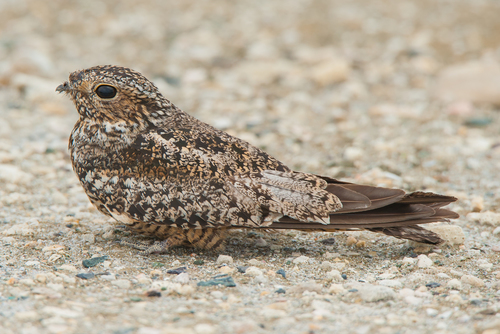
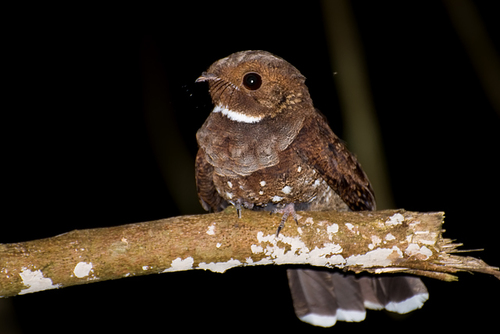
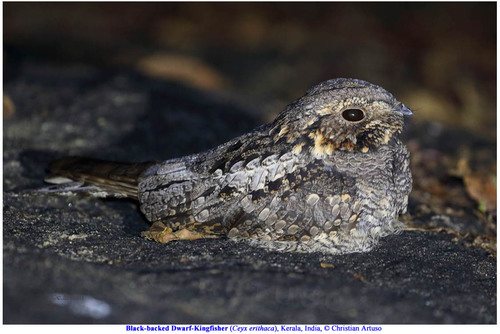
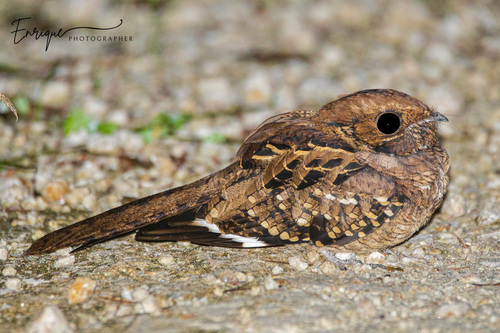
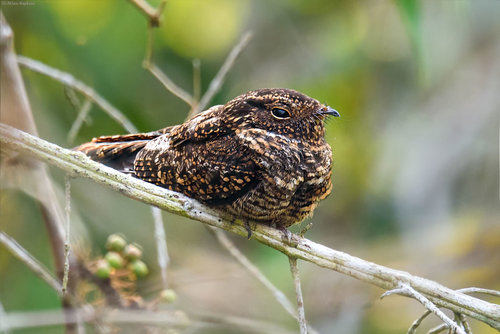
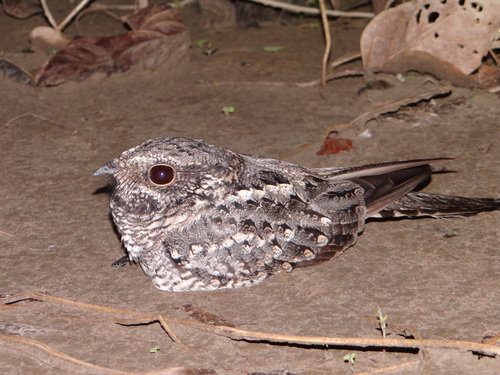
Caprimulgus climacurus Vieillot, 1824, commonly called the long-tailed nightjar, measures 29 to 43 cm in total length, and the species is sexually dimorphic.
Tail Structure
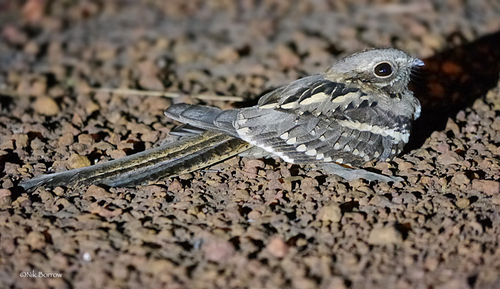
It has a long, graduated tail, with tail length ranging 200–304 mm for males and 156–256 mm for females.
Plumage and Sexual Dimorphism
Its plumage is primarily rufous-brown to gray-brown, and has pale bands across the forewing and along the trailing edge of the flight feathers; these bands are white in males and buff in females. Males may also have a white throat patch, and all individuals have brown bills, legs, and feet.
Immature Plumage
Sexually immature long-tailed nightjars are more similar in appearance to females, but their plumage is generally paler.
Similar Species Identification
The identification features of the long-tailed nightjar are similar to those of the slender-tailed nightjar (Caprimulgus clarus) and square-tailed nightjar (Caprimulgus fossii). Non-breeding or moulting long-tailed nightjars may have shorter tails, which can add to identification difficulty.
Distinguishing Features Between Similar Species
These three species can usually be distinguished because they mostly occupy non-overlapping geographic ranges and have different songs.
Song Characteristics
The song of the long-tailed nightjar is a rapid, sustained, higher-pitched churring that occurs at approximately 42–43 churring units per second, which is much faster than the 7–8.6 units per second of the slender-tailed nightjar and the 16–18 units per second of the square-tailed nightjar.
Range Overlap Identification
In areas where the ranges of the long-tailed nightjar and slender-tailed nightjar do overlap, the two can be told apart by the long-tailed nightjar’s relatively redder plumage.
Primary Feather Moult
The long-tailed nightjar’s primary feather moulting pattern follows the typical strategy seen in other nightjars, where primary feathers are replaced in a descending order.
Secondary Feather Moult
Its secondary feather moult is unusual, however, and follows two separate moult centres. The first centre starts at the outermost secondary feather and moults ascendant toward the fifth secondary, while the second starts at the ninth secondary and follows a centrifugal (outermost to innermost) moult pattern.
Moult Duration
Total moult duration is estimated to be approximately 70 days, and moult typically pauses during mid-winter.
Geographic Distribution
The long-tailed nightjar is distributed across the Afrotropical realm, found in the following African countries: Angola, Benin, Burkina Faso, Cameroon, Central African Republic, Chad, Republic of the Congo, Democratic Republic of the Congo, Ivory Coast, Eritrea, Ethiopia, Gabon, Gambia, Ghana, Guinea, Guinea-Bissau, Kenya, Liberia, Mali, Mauritania, Niger, Nigeria, Senegal, Sierra Leone, Sudan, Tanzania, Togo and Uganda.
Habitat Preferences
It occurs mainly in open areas across the northern Afrotropics, including roadsides, savannas, semi-arid deserts, and lowland forest clearings. It is often found living alongside the standard-winged nightjar (Macrodipteryx longipennis).
Egg-Laying Season
The long-tailed nightjar’s egg-laying season varies by geographic location: it runs from March to September in Gambia and Senegal, May to August in northern Nigeria, January to October in southern Nigeria, March to August in Mali, March to June in northeastern Congo, and either February to April or April to June in eastern Africa.
Nesting Habits
The species does not build a nest; instead, it lays its eggs on a cleared patch of ground that measures roughly 4 by 5 cm. Nest sites include bare ground, open soil, sand, cleared patches between pebbles or leaf litter, areas beside pathways, thickets, or under small bushes in agricultural fields.
Clutch Size
Clutch size is typically two eggs.
Egg Appearance and Camouflage
The eggs are ellipsoidal with a matte finish, and their base colour ranges from whitish, cream, buff, or pinkish to match the colour of the surrounding ground. Their surface is patterned with grey, grey-purple, and chestnut brown blotches and thick marbling, which further helps camouflage the eggs.
Incubation Behavior
The incubating adult bird rests flat directly on top of the eggs with its eyelids closed.