The Felidae family includes all cats, from the mighty lion and tiger to the elusive snow leopard and tiny black-footed cat. This guide covers the world's wild cat species with photos and key features.
🐱 Animal Families
Cat Family (Felidae) — Wild Cats of the World
1
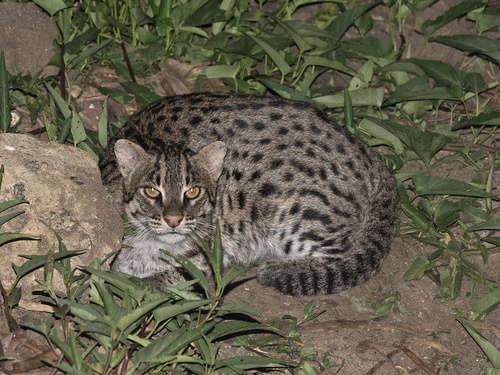
Prionailurus viverrinus, the fishing cat, is a wetland-associated wild cat native to South and Southeast Asia adapted for catching aquatic prey.
The fishing cat, with the scientific name Prionailurus viverrinus (Bennett, 1833), has the following characteristics. Its fur is deep yellowish-grey marked with black lines and spots. Two stripes run across its cheeks, and another two extend from above the eyes to the neck, with broken lines across the forehead. It has two rows of spots around its throat. Spots on the shoulder are longitudinal, wh...
View full details → 2
Prionailurus bengalensis javanensis (Desmarest, 1816)
Prionailurus bengalensis javanensis (Desmarest, 1816)
🦋 Animalia Felidae
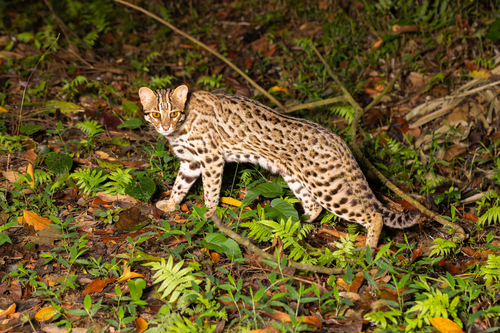
Prionailurus bengalensis javanensis is an Asian wild small cat subspecies with varied traits, wide Asian range, and solitary nocturnal habits.
Prionailurus bengalensis javanensis, the Javan leopard cat, is a subspecies of leopard cat that is roughly the size of a domestic cat, but more slender. It has longer legs, with well-defined webbing between its toes. Its small head has two prominent dark stripes, and a short, narrow white muzzle. Two dark stripes run from the eyes to the ears, and smaller white streaks run from the eyes to the nos...
View full details → 3
Prionailurus bengalensis, the leopard cat, is a widely distributed small wild cat native to Asia. This is its full description.
Prionailurus bengalensis, commonly called the leopard cat, is roughly the size of a domestic cat, but has a more slender build, longer legs, and distinct webbing between its toes. Its small head has two prominent dark stripes and a short, narrow white muzzle. Two dark stripes run from the eyes to the ears, and smaller white streaks run from the eyes to the nose. The backs of its moderately long, r...
View full details → 4
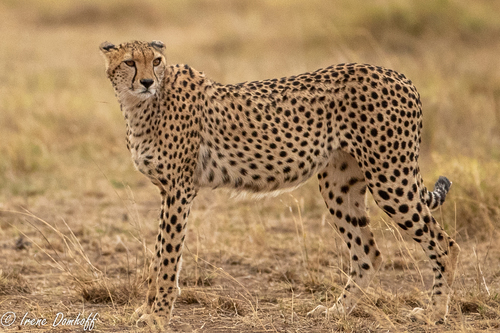
Acinonyx jubatus, the cheetah, is a running-specialized big cat native to Africa and central Iran, with declining global populations.
Characteristics The cheetah (Acinonyx jubatus) is a slim-bodied, spotted cat with a small, streamlined head, short snout, black tear-like facial streaks, deep chest, long limbs, and a long tail. Its slender, canid-like body shape is highly adapted for running, and contrasts sharply with the bulky bodies of members of the Panthera genus and cougars. Cheetahs typically stand 67–94 cm (2.20–3.08 ft) ...
View full details → 5
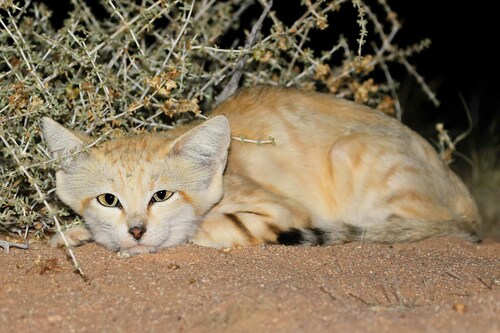
The sand cat (Felis margarita) is a small wild cat adapted to live in sandy and stony deserts across North Africa, Southwest and Central Asia.
Felids margarita Loche, 1858, commonly known as the sand cat, has the following characteristics. Its fur is pale sandy isabelline, and is much lighter on the lower head, around the nose, throat, and belly. A faint reddish line stretches from the outer corner of each eye across the cheeks. The limbs have dark brown to blackish bars, and the tail has a black tip with two or three dark rings alternat...
View full details → 6
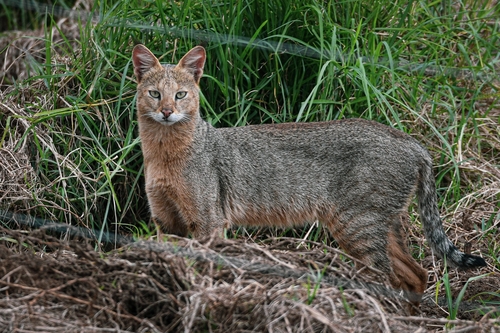
Felis chaus, the jungle cat, is the largest extant Felis species native to broad swathes of Asia and the Middle East.
Characteristics: The jungle cat (Felis chaus Schreber, 1777) is a medium-sized, long-legged cat, and the largest of all living Felis species. Its typical head-and-body length ranges from 59 to 76 cm (23 to 30 in), it stands nearly 36 cm (14 in) tall at the shoulder, and it weighs 2–16 kg (4.4–35.3 lb). This species' body size decreases from west to east across its range, a pattern attributed to gr...
View full details → 7
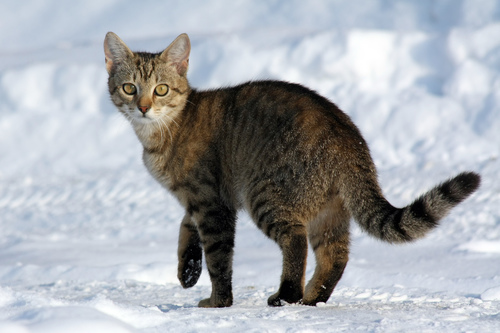
Felis catus, the domestic cat, is the only domesticated felid, kept as pets and existing as feral populations globally.
The cat (Felis catus), also known as the domestic cat or house cat, is a small carnivorous mammal. It is an obligate carnivore, meaning it requires a predominantly meat-based diet. Its retractable claws are adapted for killing small prey such as mice and rats. It has a strong, flexible body, quick reflexes, and sharp teeth, with well-developed night vision and sense of smell. It is a social specie...
View full details → 8
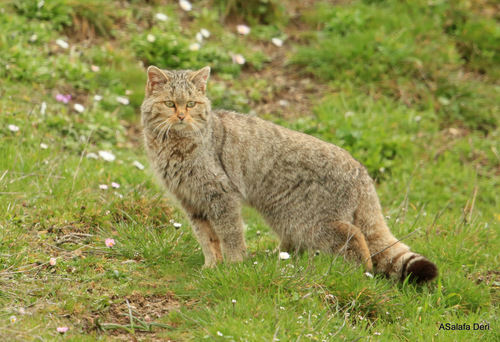
This is a detailed description of the European wildcat, covering its characteristics, distribution, habitat, and ecology.
Characteristics: The European wildcat's fur ranges in colour from brownish to grey, with paler contour hairs. It has five broken stripes on its forehead that split into small spots. A dark stripe behind the shoulders widens into a spinal stripe that runs to the base of the tail. Irregular dark stripes on its sides break up on the hind legs, forming a blotched pattern. Its tail is bushy, marked wit...
View full details → 9
Felis silvestris Schreber, 1777 (European wildcat) is a wild feline native to much of Europe, with distinct physical and ecological traits.
The European wildcat, with the scientific name Felis silvestris Schreber, 1777, has fur that ranges in color from brownish to grey, with paler outer contour hairs. It has five broken stripes across the forehead that split into small spots; four well-developed dark bands on the top of the head and forehead also split into small spots. Two short, narrow stripes usually appear on the shoulders, in fr...
View full details → 10
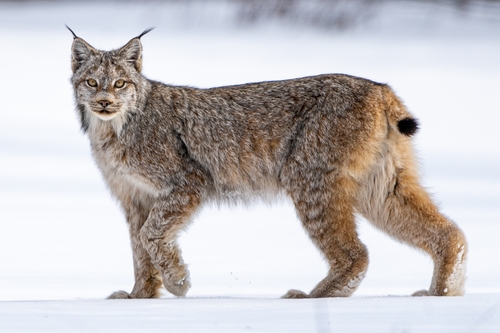
The Canada lynx (Lynx canadensis) is a medium-sized North American wild cat adapted for snowy boreal forests preying primarily on snowshoe hares.
The Canada lynx (Lynx canadensis Kerr, 1792) is a lean, medium-sized wild cat. It is identified by long, dense fur, triangular ears with black tufts at the tips, and broad, snowshoe-like paws. Like the bobcat, its hindlimbs are longer than its forelimbs, which makes its back slope downward toward the front. This species shows sexual dimorphism: males are larger and heavier than females. Total body...
View full details → 11
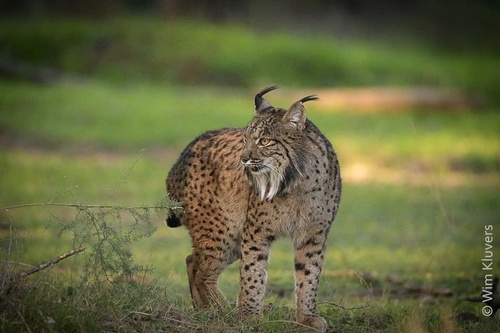
Lynx pardinus, the Iberian lynx, is a small spotted wild cat endemic to the Iberian Peninsula that has recovered from severe population decline.
The Iberian lynx, scientifically named Lynx pardinus (Temminck, 1827), has short bright yellowish to tawny spotted fur. Its spots vary in shape and size, ranging from small round forms to elongate shapes; the spots are arranged in lines, and decrease in size from the back toward the sides. There are two distinct basic coat pattern variations: one found in Sierra Morena has many very small brown to...
View full details → 12
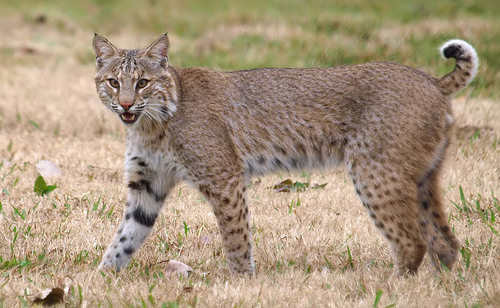
Lynx rufus, the bobcat, is a small North American lynx species with a distinctive bobbed tail, described here in full biological detail.
Scientific name: Lynx rufus (Schreber, 1777) Description: The bobcat resembles other midsize species in the genus Lynx, and is on average the smallest of the four species in this genus. Its coat color varies, though it is generally tan to grayish-brown, marked with black streaks across the body and dark bars on the forelegs and tail. Its spotted patterning works as camouflage. The ears are pointe...
View full details → 13
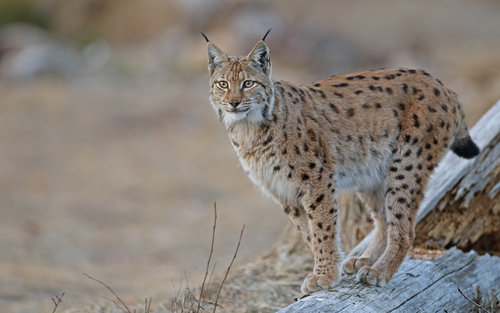
This is a detailed description of the Eurasian lynx, covering its characteristics, habitat, distribution, and reproduction.
The Eurasian lynx has a relatively short, reddish or brown coat marked with black spots, whose number and pattern vary greatly. Its underparts, neck, and chin are whitish. Individuals living at the southern end of the species’ range have more brightly colored fur with a greater number of spots. In winter, the fur becomes much thicker, and ranges in color from silver-grey to greyish brown. Some ind...
View full details → 14
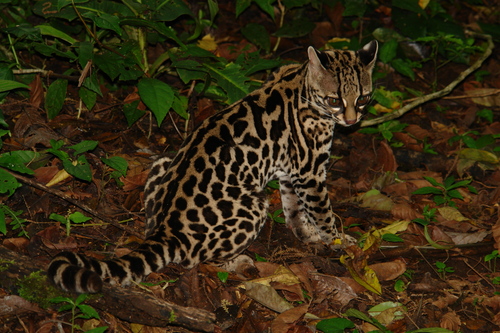
The margay (Leopardus wiedii) is a small, tree-adapted wild cat native to the forests of Central and South America.
Characteristics: The margay (Leopardus wiedii) is very similar in appearance to the larger ocelot (Leopardus pardalis), though it has a slightly shorter head, larger eyes, and longer tail and legs. It weighs 2.6 to 4 kg (5.7 to 8.8 lb), has a body length of 48 to 79 cm (19 to 31 in), and a tail length of 33 to 51 cm (13 to 20 in). Unlike most other cats, female margays only have two teats. Its fur...
View full details → 15
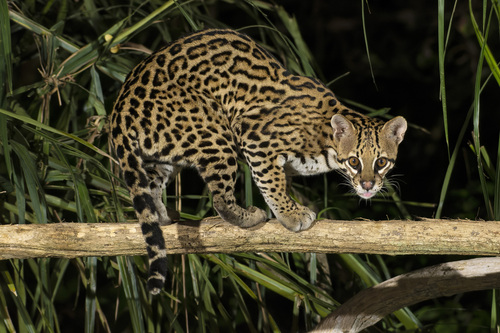
Leopardus pardalis, the ocelot, is a distinctive small wild cat native to the Americas with solitary, nocturnal behavior.
The ocelot, scientifically named Leopardus pardalis (Linnaeus, 1758), has distinct fur characteristics. Its fur has a background color ranging from creamy, tawny, yellowish, reddish gray to gray, covered extensively with solid black markings. Spots on the head and limbs are small, while markings on the back, cheeks, and flanks take the form of open or closed bands and stripes. A small number of da...
View full details → 16
Leopardus geoffroyi (d'Orbigny & Gervais, 1844)
Leopardus geoffroyi (d'Orbigny & Gervais, 1844)
🦋 Animalia Felidae
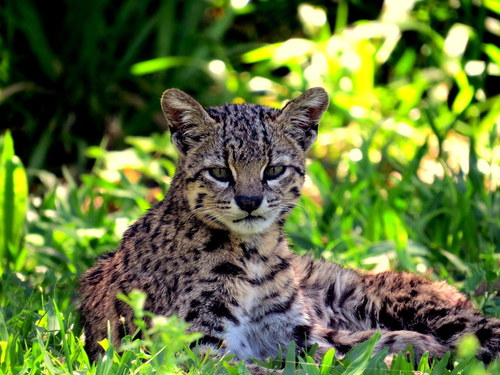
Geoffroy's cat (Leopardus geoffroyi) is a small, spotted wild cat native to South America, with specific described traits, habits and reproduction.
Geoffroy's cat (Leopardus geoffroyi) is roughly the size of a domestic cat, with many black spots and dark bands across its cheeks, head, neck, tail, and limbs. The base color of its fur changes across its range: northern populations have brownish-yellow coats, while southern populations have more grayish coats. The fur on its underbelly is cream-colored or white, and the backs of its ears are bla...
View full details → 17
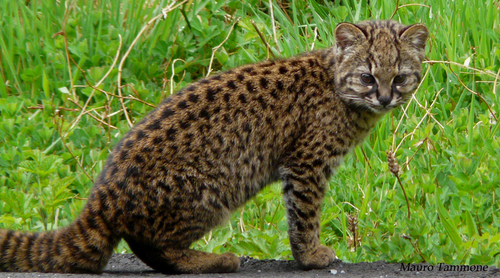
Leopardus guigna, the kodkod, is a small wild cat native to southern South American temperate rainforests.
The kodkod, with the scientific name Leopardus guigna (Molina, 1782), has the following core characteristics. Its fur color ranges from brownish-yellow to grey-brown, with dark spots across its body, a pale underside, and a ringed tail. Its ears are black with a distinct white spot, and the dark spots on its shoulders and neck almost merge into a series of dotted streaks. Melanistic kodkods with s...
View full details → 18
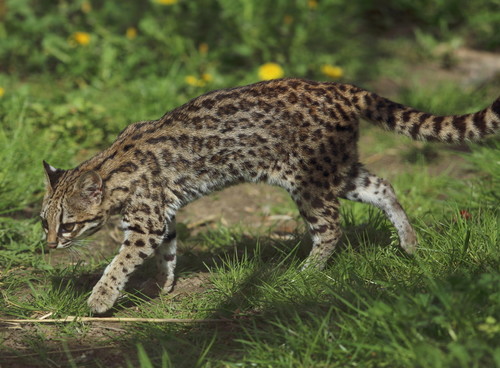
Leopardus guttulus, the southern tigrina, is a small wild cat species found in parts of eastern South America.
The southern tigrina, scientifically named Leopardus guttulus (Hensel, 1872), has a yellowish-ochre coat marked with open black rosettes. It is slightly darker than the oncilla, has larger rosettes, and a slightly shorter tail. However, it is extremely hard to tell the two species apart by appearance alone, as genetic variation within each species is greater than variation between the two species....
View full details → 19
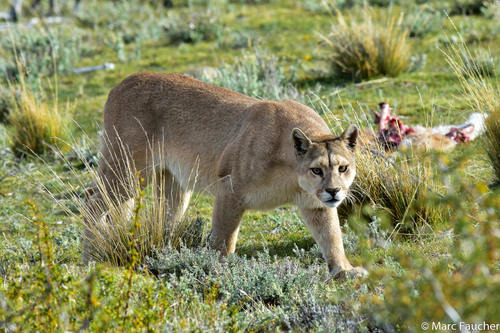
Puma concolor (cougar) is a large American feline with detailed physical traits, range, ecology, and life history.
Puma concolor, commonly known as the cougar, has a round head and erect ears. Its strong forequarters, neck, and jaw are adapted to grasp and hold large prey. It has four retractile claws on each hind paw, and five retractile claws on each forepaw, including one dewclaw. Its larger front feet and claws are specialized adaptations for clutching prey. The cougar is a slender, agile feline, and is th...
View full details → 20

Leptailurus serval, the serval, is a medium-sized African wild cat with distinctive long legs and large ears.
Leptailurus serval, commonly known as the serval, is a slender, medium-sized wild cat. It measures 54 to 62 cm (21–24 in) tall at the shoulder, with a typical head-and-body length between 67 and 100 cm (26–39 in). Males are sturdier than females; servals weigh 8 to 18 kg (18–40 lb), with females generally being lighter. Its most notable features include a small head, large ears, a spotted and stri...
View full details → 21
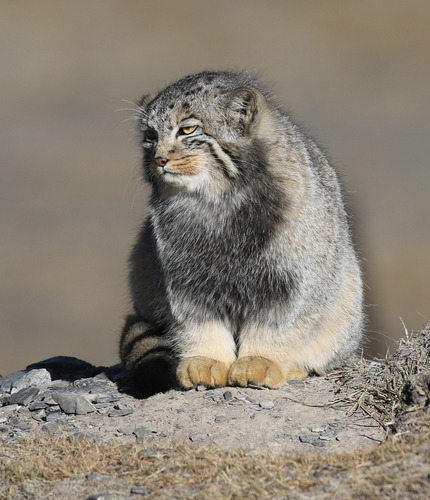
This is a detailed biological description of Pallas's cat (Felis manul Pallas, 1776) covering its traits, range, behaviour and reproduction.
This description covers the characteristics, distribution and habitat, behaviour and ecology, and reproduction and life cycle of Pallas's cat (Felis manul Pallas, 1776). For physical characteristics: Pallas's cat has light grey fur with pale yellowish-ochre or pale yellowish-reddish undertones, with some hair tips white and others blackish. Its fur becomes greyer and denser, with fewer visible ma...
View full details → 22
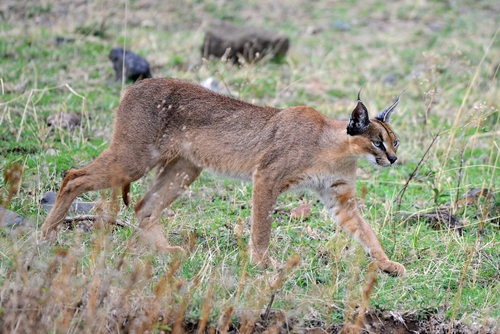
Caracal caracal is a medium-sized tufted-eared wild cat found across Africa and western, central and southern Asia.
Caracal (Caracal caracal (Schreber, 1776)) is a moderately sized, slender cat with a robust build, short face, long canine teeth, tufted ears, and long legs. It stands 40–50 cm (16–20 in) tall at the shoulder. Its tan, bushy tail reaches the animal's hocks. Caracals are sexually dimorphic, with females smaller than males across most body measurements. Its distinct facial features include 4.5 cm (1...
View full details → 23
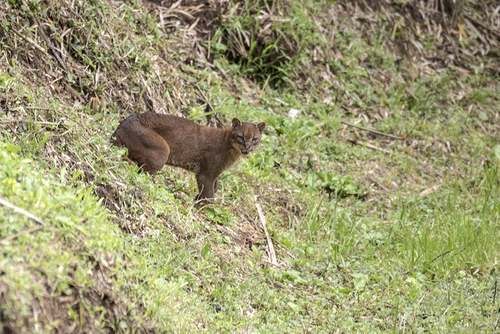
The African golden cat is a small wild cat native to African forests, with varied fur coloration and elusive behavior.
The African golden cat, scientifically named Profelis aurata (Temminck, 1827), has a wide range of fur colors, from chestnut or reddish-brown, greyish brown to dark slate. Some individuals have spots that range in color from faded tan to black. In other individuals, spotting is only present on the belly and inner legs. The cat’s undersides, as well as the areas around its eyes, cheeks, chin, and t...
View full details → 24
Puma yagouaroundi (É.Geoffroy Saint-Hilaire, 1803)
Puma yagouaroundi (É.Geoffroy Saint-Hilaire, 1803)
🦋 Animalia Felidae
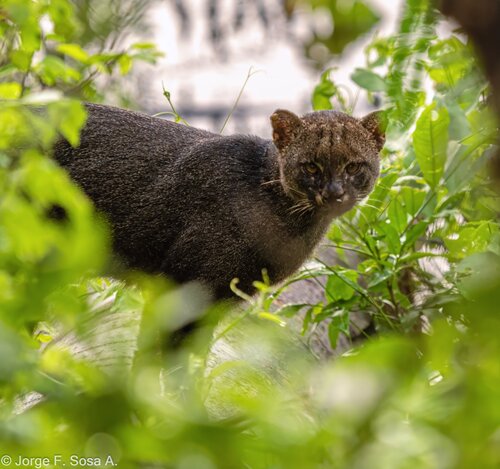
Jaguarundi (Puma yagouaroundi) is a uniform-colored medium-sized neotropical wild cat native to the Americas, with distinct traits and ecology.
The jaguarundi (Puma yagouaroundi) is a medium-sized wild cat with a slender build and uniform coloration, whose external appearance differs greatly from other neotropical cats such as the small, spotted cats of the genus Leopardus. This distinctiveness has been linked to differences in its karyotype: the jaguarundi has 38 chromosomes, unlike the 36 chromosomes found in other small South American ...
View full details → 25
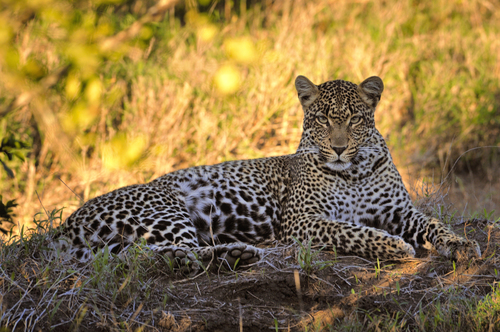
Panthera pardus (leopard) is a widely distributed wild cat with varied traits, behavior, and life history detailed across Africa and Asia.
This description covers the characteristics, distribution and habitat, behaviour and ecology, and reproduction and life cycle of Panthera pardus, the leopard, first described by Linnaeus in 1758. Characteristic details: The leopard's fur is generally soft and thick, and is notably softer on the belly than on the back. Skin colour varies between individuals from pale yellowish to dark golden, with...
View full details → 26
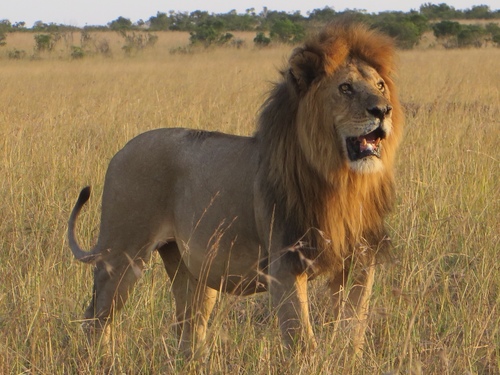
Panthera leo, the lion, is a large muscular cat with two main existing populations, one in African savannas and one in western India.
The lion is a muscular, broad-chested cat with a short, rounded head, a reduced neck, and round ears; male lions have broader heads. Fur color ranges from light buff to silvery grey, yellowish red, and dark brown, with underparts generally lighter in color. Newborn lions have dark spots that fade as the cub reaches adulthood, though faint spots often remain visible on the legs and underparts. All ...
View full details → 27
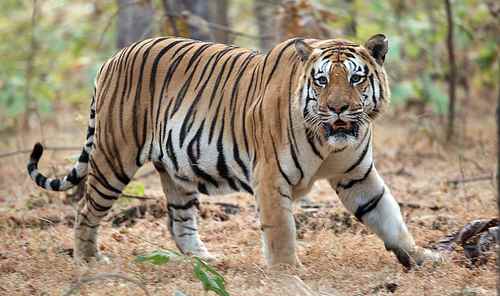
Panthera tigris, the tiger, is a large felid with wide ranging size variation, native to South and East Asia.
The tiger, Panthera tigris, has typical felid morphology: a muscular body, shortened legs, strong forelimbs with wide front paws, a large head, and a tail approximately half the length of the rest of its body. There are five digits including a dewclaw on the front feet and four on the back feet; all have compact, curved retractile claws that can reach 10 cm (3.9 in) long. The tiger has rounded ear...
View full details → 28
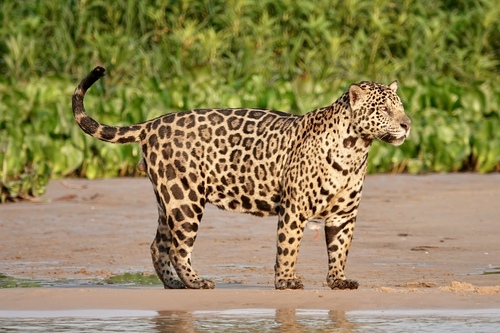
Panthera onca, the jaguar, is the largest American big cat, with detailed traits, range, behavior and reproduction.
The jaguar, whose scientific name is Panthera onca (Linnaeus, 1758), is a compact, muscular big cat. It is the largest cat native to the Americas, and the third largest cat in the world — only tigers and lions grow larger than jaguars. Jaguars measure 57 to 81 cm (22.4 to 31.9 in) tall at the shoulders. Their size and weight vary significantly based on sex and region: most jaguars typically weigh ...
View full details → 29
Uncia uncia, the snow leopard, is a cold mountain-adapted big cat with a broad Central Asian range.
The snow leopard, scientifically named Uncia uncia (Schreber, 1775), has whitish to grey fur with black spots on its head and neck, and larger rosettes on its back, flanks, and bushy tail. It has a short muzzle, domed forehead, and large nasal cavities. Its fur is thick, with hairs 5 to 12 cm (2.0 to 4.7 in) long, and its underbelly is whitish. Snow leopards have a stocky, short-legged build and a...
View full details → 30
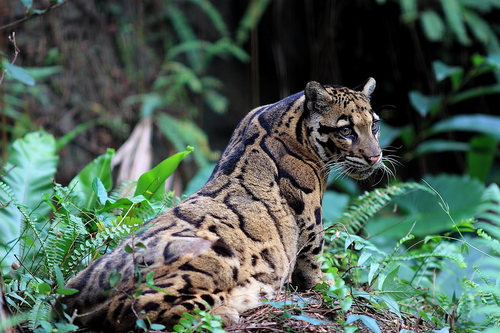
Neofelis nebulosa, the clouded leopard, is a medium-sized wild cat native to South and East Asia.
This species is Neofelis nebulosa (Griffith, 1821), commonly called the clouded leopard. The clouded leopard’s fur has a dark grey or ochreous base color, which is often mostly covered by a pattern of black and dark dusky-grey blotches. Its head has black spots, and its ears are entirely black. Partly fused or broken stripes run from the corner of the eyes across the cheek, from the corner of the...
View full details →Frequently Asked Questions
How many species are in the Felidae family?
This guide features 30 representative species from the Felidae family. The full family contains many more species worldwide — explore them all on iNature.
How to identify Felidae species?
Felidae species share common features in their flowers, leaves, and growth patterns. This guide provides photos and descriptions for 30 species. For instant field identification, use the iNature app.
Sources: GBIF, iNaturalist, Wikipedia · Disclaimer
Identify any species instantly — even offline
iNature uses on-device AI to identify plants, animals, fungi and more. No internet needed.
Download iNature — FreeStart Exploring Nature Today
Download iNature for free. 10 identifications on us. No account needed. No credit card required.
Download Free on App Store
