About Leopardus geoffroyi (d'Orbigny & Gervais, 1844)
Size Comparison
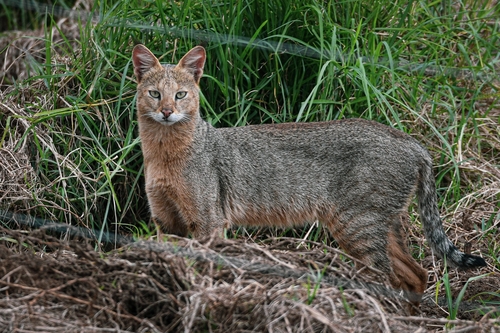
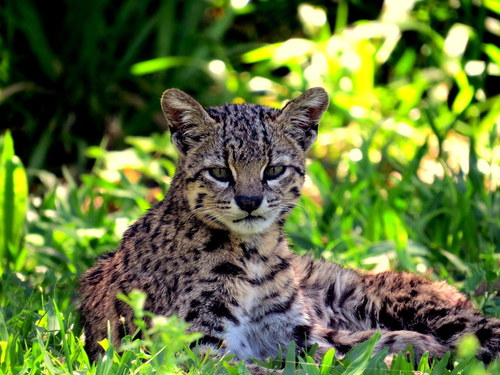
Geoffroy's cat (Leopardus geoffroyi) is roughly the size of a domestic cat, with many black spots and dark bands across its cheeks, head, neck, tail, and limbs.
Base Coat Variation
The base color of its fur changes across its range: northern populations have brownish-yellow coats, while southern populations have more grayish coats.
Underbelly and Ear Markings
The fur on its underbelly is cream-colored or white, and the backs of its ears are black with white spots.
Melanism Occurrence
Melanistic (all-black) individuals are common.
Head and Body Length
Head and body length is about 60 cm (24 in), and it has a relatively short tail measuring around 31 cm (12 in).
Adult Weight Range
Adults weigh between 2 and 5 kg (4.4 and 11.0 lb), though some individuals have been recorded reaching up to 7.8 kg (17 lb).
Size Dimorphism
Males are generally larger than females, and southern individuals are larger than those from the northern part of the species' range.
Bite Force
Its bite force quotient at the canine tip is 106.3.
Country Distribution
This cat species is found in Argentina, Bolivia, Brazil, Chile, Paraguay, and Uruguay.
Habitat Range and Elevation
It lives across pampas and savanna landscapes in the Gran Chaco, extending from southern Bolivia to the Straits of Magellan, and occurs at elevations ranging from sea level up to 3,800 m (12,500 ft) in the Andes.
Preferred Habitats
It prefers open woodland or scrubland with abundant cover, but can also be found in grasslands and marshy areas.
Rarity in Chile
It is thought to be rare within Chile.
Activity and Social Behavior
Geoffroy's cat is nocturnal and a solitary hunter, only meeting other members of its species during the mating season.
Scanning Behavior
Individuals have been observed standing on their hind legs to scan the surrounding area, using their tail as a balance support—an unusual behavior among cats.
Climbing Behavior
It is capable of climbing trees but rarely does so, except when leaving faeces to scent mark its territory.
Diet Composition
It primarily preys on rodents, hares, other small mammals, birds, snakes, small lizards, and insects, and will occasionally eat frogs and fish.
Home Range Size
Females hold home ranges between 2 to 6 km2 (0.77 to 2.32 sq mi), while male home ranges can be as large as 12 km2 (4.6 sq mi).
Breeding Season
The species' breeding season runs from October to March.
Estrus Cycle
During this period, females enter estrus for up to twelve days at a time, with estrus events occurring between three and five weeks apart.
Mating Behavior
Mating is brief and frequent, and often occurs on high ledges or similar sites.
Gestation and Birth Period
Gestation lasts 72 to 78 days, and most births take place between December and May.
Litter Size
Litters have one to three kittens, with one or two kittens being more common.
Newborn Kitten Traits
Kittens are born blind and helpless, weighing around 65 to 95 g (2.3 to 3.4 oz), and develop more slowly than domestic cat kittens.
Kitten Early Development
Kittens' eyes open between eight and nineteen days after birth, and they start eating solid food at six or seven weeks old.
Maturation Timeline
Kittens become independent of their mother at around eight months old, but do not typically reach sexual maturity until 18 months for females and 24 months for males.