About Puma concolor (Linnaeus, 1771)
Head and Jaw Structure
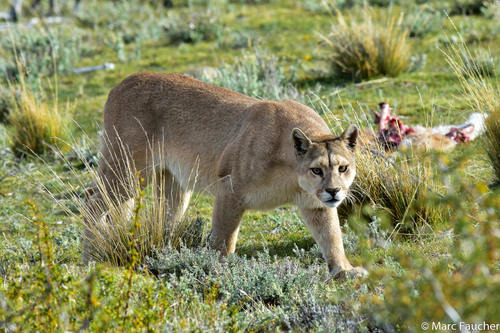
Puma concolor, commonly known as the cougar, has a round head and erect ears. Its strong forequarters, neck, and jaw are adapted to grasp and hold large prey.
Paw and Claw Structure
It has four retractile claws on each hind paw, and five retractile claws on each forepaw, including one dewclaw. Its larger front feet and claws are specialized adaptations for clutching prey.
General Body Size Ranking
The cougar is a slender, agile feline, and is the fourth largest cat species in the world. Adults stand 60 to 90 cm (24 to 35 in) tall at the shoulders.
Body Length Measurements
Adult males measure around 2.4 m (7 ft 10 in) from nose to tail tip, while adult females average 2.05 m (6 ft 9 in). Overall nose-to-tail length for the species generally ranges from 1.50 to 2.75 m (4 ft 11 in to 9 ft 0 in), with the tail typically making up 63 to 95 cm (25 to 37 in) of this total length.
General Weight Range
Males usually weigh between 53 to 72 kg (117 to 159 lb), and females typically weigh between 34 and 48 kg (75 and 106 lb). Cougar body size decreases closer to the equator and increases towards the poles.
Recorded and Regional Weights
The largest scientifically recorded cougar, shot in 1901, weighed 105.2 kg (232 lb); claims of larger individuals at 125.2 kg (276 lb) and 118 kg (260 lb) have been reported, but these are likely exaggerated. In North America, male cougars average 62 kg (137 lb), while females in the same region average around 42 kg (93 lb).
British Columbia Cougar Weights
In British Columbia, adult male cougars average 56.7 kg (125 lb) and adult females average 45.4 kg (100 lb), though multiple wild male cougars in British Columbia have weighed between 86.4 and 95.5 kg (190 and 211 lb).
Comparison to Jaguars
Depending on location, cougars can be smaller or larger than jaguars, but they are less muscular and less powerfully built than jaguars, so their average body weight is lower. Unlike cougars, whose size increases with distance from the equator (a pattern that crosses the northern portion of South America), jaguars are generally smaller north of the Amazon River in South America and larger south of the Amazon River.
Jaguar Weight Examples
For example, South American jaguars are comparatively large and may exceed 90 kg (200 lb), while North American jaguars in Mexico's Chamela-Cuixmala Biosphere Reserve weigh approximately 50 kg (110 lb), which is about the same weight as an average female cougar.
Adult Fur Coloration
Cougar fur color is generally plain and tawny, ranging from silvery-grey to reddish, with lighter patches on the underbody including the jaws, chin, and throat.
Juvenile Appearance
Cougar kittens are spotted at birth, and are born with blue eyes and tail rings. Juveniles are pale, with dark spots still visible on their flanks.
Leucistic Cougar Record
A leucistic (pure white) cougar was recorded by camera trap in Serra dos Órgãos National Park, Rio de Janeiro in 2013, confirming that pure white individuals exist within the species, though they are extremely rare.
Locomotion Adaptations
The cougar has large paws, and proportionally the largest hind legs in the Felidae family, an adaptation that enables great leaping ability and powerful short sprints. It can leap from the ground up to 5.5 m (18 ft) high into a tree.
Vocalization Trait
It is the largest felinae species that can purr.
Species Range
The cougar has the largest range of any wild land mammal in the Americas, spanning 110 degrees of latitude from the Yukon in Canada to the southern Andes in Chile.
North American Range Status
The species was extirpated from most of eastern North America, with the exception of Florida; however, cougars may be recolonizing their former range, and isolated populations have been documented east of their current range in both the Midwestern United States and Canada.
General Habitat Preferences
Cougars can live in all forest types, lowland and mountainous deserts, and open areas with little vegetation, up to an elevation of 5,800 m (19,000 ft). In the Santa Ana Mountains, cougars prefer steep canyons, escarpments, rim rocks, and dense brush.
Recorded Habitat Locations
They have been recorded in the Sierra de San Carlos in Mexico, in secondary and semi-deciduous forests of the El Eden Ecological Reserve on the Yucatán Peninsula, in the lower montane forest of Montecristo National Park and in a river basin above 700 m (2,300 ft) in Morazán Department, El Salvador (recorded in 2019), in a palm oil plantation near riparian forest in the Llanos Basin and near water bodies in the Magdalena River Valley in Colombia, and in bushland with abundant vegetation cover and prey in the human-modified landscape of central Argentina.
Ecological Role
The cougar is a keystone species in Western Hemisphere ecosystems, as it links numerous species across many trophic levels. It interacts with 485 other species through being a food source, preying on other species, leaving behind carcass remains, and having competitive effects on other predators that share its habitat.
Female Reproductive Maturity
Female cougars reach sexual maturity between 18 months and three years of age. They experience estrus for approximately eight days of a 23-day reproductive cycle, and have a gestation period that ranges from 82 to 103 days, with an average length of approximately 91 days.
Mating Behavior
Both adult males and females may mate with multiple partners, and a single female's litter can have cubs from multiple different fathers. Copulation is brief but frequent.
Reproductive Rate Factors
Chronic stress can lead to low reproductive rates both in captivity and in the wild. Only female cougars participate in parenting.
Litter Characteristics
Litter sizes range from one to six cubs, with an average of two. Protected sites such as caves and other rock alcoves are used as dens for litters.
Cub Early Development
Cubs are born blind, and are completely dependent on their mother at birth. They begin weaning at around three months of age.
Juvenile Hunting Development
As they grow, they accompany their mother on outings, first visiting her kill sites, and begin hunting small prey on their own after six months of age. Kitten survival rates average just over one surviving kitten per litter.
Dispersal Patterns
Juvenile cougars stay with their mother for one to two years. When the female enters estrus again, her existing offspring must disperse, otherwise any new male cougar will kill them.
Dispersal Distance and Mortality
Males tend to disperse much farther from their maternal range than females. One study found that cougars that travel farthest from their maternal range have a high mortality rate, often from conflicts with other cougars.
New Mexico Dispersal Study
In a study area in New Mexico, males dispersed farther than females, crossed large areas of non-cougar habitat, and are likely primarily responsible for nuclear gene flow between separate cougar habitat patches.
Wild Life Expectancy
Life expectancy for cougars in the wild is 8 to 13 years, with an average of 8 to 10 years. One female cougar at least 18 years old was reported killed by hunters on Vancouver Island.
Captivity Life Expectancy
Cougars can live up to 20 years in captivity. Causes of death for wild cougars include disability, disease, competition with other cougars, starvation, accidents, and hunting in regions where hunting cougars is allowed.
Disease Prevalence
Feline immunodeficiency virus is well-adapted to infect cougars.