About Felis margarita Loche, 1858
Taxonomy and Common Name
Felids margarita Loche, 1858, commonly known as the sand cat, has the following characteristics.
Dorsal and Ventral Coat Color
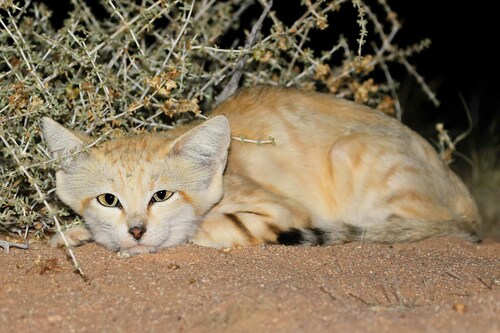
Its fur is pale sandy isabelline, and is much lighter on the lower head, around the nose, throat, and belly.
Facial Markings
A faint reddish line stretches from the outer corner of each eye across the cheeks.
Limb and Tail Markings
The limbs have dark brown to blackish bars, and the tail has a black tip with two or three dark rings alternating with buff bands.
Individual Marking Variation
Markings differ between individuals: some have no spots or stripes, some have faint spots, and some have both spots and stripes.
Head Base Color
Its head is sandy brown.
Eye and Nose Features
The large greenish-yellow eyes are ringed with white, and the nose is blackish.
Whisker Length
Its white whiskers can grow up to 8 cm (3.1 in) long.
Ear External Appearance
Its ears are tawny at the base and tipped with black.
Ear Structure Comparison to Domestic Cat
The outer ear is similar to that of a domestic cat, but its ear canal is around twice the size.
Hearing Sensitivity
Acoustic input-admittance is about five times higher than in a domestic cat, and the sand cat's hearing sensitivity is around 8 decibels greater than that of the domestic cat.
Central Asian Winter Coat
In Central Asia, the sand cat's winter coat is very long and thick, with hairs reaching up to 51 mm (2 in) in length.
Claw Characteristics
Its forelimb claws are short and very sharp, while its hind foot claws are small and blunt.
Paw Fur Protection
The undersides of its paws are protected from extreme temperatures by a thick covering of fur.
Interdigital Toe Fur Function
Long hairs growing between its toes form a fur cushion over the foot pads that insulates them when moving over hot sand, and this feature obscures the cat's tracks, making them hard to identify and follow.
General Body Shape and Tail Length
The sand cat has a distinct flat, wide head, short legs, and a relatively long tail measuring 23–31 cm (9.1–12.2 in).
Body Size Measurements
It stands 24–36 cm (9.4–14.2 in) at the shoulder, weighs 1.5–3.4 kg (3.3–7.5 lb), and has a head-and-body length of 39–52 cm (15–20 in).
Ear Placement and Head Appearance
Its 5–7 cm (2.0–2.8 in) long ears are set low, giving the head a broad, flat appearance.
Skull Structure
Its skull has an arched lateral outline and wide zygomatic arches.
Outer Ear Hearing Adaptations
The ear pinnae are triangular, and the ear canal is very wide, which enhances the cat's sense of hearing.
Inner Ear Structure and Protection
Compared to other small wild cats, the auditory bullae and passages from the external ears to the eardrum are greatly enlarged; long, closely spaced white hairs protect the inner parts of the ears from foreign objects.
Bite Force Metrics
Its bite force at the canine tip is 155.4 Newton, and its bite force quotient at the canine tip is 136.7.
Global Distribution Range
The sand cat lives in both sandy and stony deserts, with a wide but discontinuous distribution across the deserts of North Africa, Southwest Asia, and Central Asia.
Habitat Preference
It prefers flat or undulating terrain with sparse vegetation of grasses or small bushes, and avoids bare shifting sand dunes that support very little prey.
Regional Records Introduction
Verified regional records include the following.
Western Sahara Records
In the Western Sahara, sand cats were repeatedly sighted and photographed in the Dakhla-Oued Ed-Dahab region between 2005 and 2016, and sand cat kittens hiding beneath a tuft of Panicum turgidum grass were sighted and photographed in the area in April 2017.
Algeria Records
One individual was recorded near a salt cedar mound in the Ahaggar Mountains of Algeria in 2008.
Unconfirmed North African Records
There are no confirmed records from Mauritania, Tunisia, or Libya.
Mali Records
One individual was briefly sighted at night in Mali's Lake Faguibine area in 2011.
Niger Ténéré Desert Records
Sand cats were observed in the Ténéré Desert in the 1980s, and again between 2008 and 2015.
Egypt Records
Sightings in Egypt's rocky Western and Eastern Deserts date to the mid-1980s, and sand cats were sighted in the Sinai Peninsula in the mid-1990s.
Arabian Peninsula First Records
On the Arabian Peninsula, Wilfred Thesiger discovered a sand cat skin in a Rub' al Khali desert oasis in 1948.
Saudi Arabia Najd Region Records
In Saudi Arabia's Najd region, sand cats have been captured and found trapped in the wire mesh fence surrounding Saja Umm Ar-Rimth Natural Reserve, adjacent to Mahazat as-Sayd Protected Area.
Saudi Arabia Tabuk Region Records
In the Tabuk Region, two sand cats were killed by hunters in 2013 and 2016, and one individual was captured by a local farmer in 2014 and held in a cage.
Saudi Arabia Turaif Area Records
Sand cats were also observed in three locations in the Turaif area of northern Saudi Arabia in 2014–2015.
Saudi Arabia Rub' al Khali Seasonal Habitat Use
In 'Uruq Bani Ma'arid on the western edge of the Rub' al Khali, sand cats use gravel valley and sand dune habitats during the cool October to April season, and mainly use sand dune habitat during the hot May to September season.
United Arab Emirates Al Ain Records
A sand cat was sighted on a gravel plain between dunes in the Al Ain Region of the Emirate of Abu Dhabi in 2003.
United Arab Emirates Al Dhafra Records
Several sand cats were recorded in a protected area in Al Dhafra, Abu Dhabi between April and December 2015, after no sightings had been recorded there for ten years.
Oman Records
It was recorded at multiple locations in Oman's Dhofar Governorate between 2021 and 2022.
Israel Historical Records
In southern Israel, four sand cats were radio-collared and tracked over several months in the late 1980s in the Arabah Valley, which lies mostly in Jordan; the monitored sand cats often roamed in Israeli military camps and crossed the international border.
Israel Local Extinction Status
Since 2002, the sand cat has been considered locally extinct in Israel, as it has not been recorded there since the turn of the 21st century.
Jordan Records
In Jordan, a sand cat was sighted for the first time in 1997 during a survey of an eastern desert area of the country.
Syria Records
In Syria, sand cats were sighted and photographed by camera trap in a protected area near Palmyra in 2000 and 2001.
Iraq Records
Sand cats live in desert areas of the Najaf, Muthanna, and Al Anbar Governorates of western Iraq.
Iran General Distribution
In Iran, it occurs in arid flat plains and sandy desert of Abbas'abad Wildlife Reserve, Kavir National Park, and Petergan Rural District.
Iran Sistan and Baluchestan Records
Between March 2014 and July 2016, sand cats were also observed at elevations of 900–1,100 m (3,000–3,600 ft) in Sistan and Baluchestan Province, primarily in habitat dominated by black saxaul.
Central Iran Habitat
In central Iran, surveys in 2014–2016 found sand cats primarily in sand dunes and sabulous areas.
Pakistan First Record
The first sand cat detected in Pakistan was found in 1966 near the Lora River in Balochistan.
Pakistan Chagai Hills Records
In the late 1960s, sand cats were also encountered in the Chagai Hills, an extremely arid area with rolling sand dunes and stony plains at an elevation of around 1,200 m (3,900 ft).
Central Asia Historical Distribution
In Central Asia, the sand cat was known to occur up to the late 1960s in the Karakum Desert from the Ustyurt Plateau in the northwest to the Kopet Dag Mountains in the south, and from the Kyzylkum Desert to the Syr Darya River and the northern border of Afghanistan.
Central Asia Recent Breeding Records
Adult sand cats with kittens were photographed in the southern Kyzylkum Desert in spring 2013 and 2014.
Social Structure
The sand cat is solitary, except during the mating season and when a female is raising kittens.
Vocalizations
It makes loud, high-pitched, short rasping sounds, especially when seeking a mate, and its vocalizations are similar to those of the domestic cat.
Scent and Marking Behavior
It communicates via urine spraying, scent marks, and scratch marks, and buries its feces and covers them with sand.
Locomotion Pattern and Speed
It moves in a distinct way: with its belly close to the ground, it runs fast with occasional leaps. It can produce sudden bursts of speed, and can sprint at 30–40 km (19–25 mi) per hour.
Israel Sand Cat Night Movement Range
Four radio-collared sand cats in Israel moved long distances of 5–10 km (3.1–6.2 mi) in a single night.
Israel Sand Cat Activity Rhythm
They were generally active throughout the night, hunting and travelling an average distance of 5.4 km (3.4 mi), and retreated underground at dawn to stay in burrows during the day.
Burrow Use
Over the survey period, they used multiple burrows within their home ranges.
Burrow Structure
Burrows are around 1.5 m (4 ft 11 in) deep, dug into slightly sloping ground, and usually have only a single entrance, though burrows with two or three entrances have been found.
Burrow Origins
These burrows are either abandoned by foxes or porcupines, or originally dug by gerbils or other rodents.
Seasonal Activity Patterns
In winter, sand cats stay in the sun during the day, while during the hot season they are crepuscular and nocturnal.
Israel Male Home Range Size
A male sand cat in Israel had a home range of 16 km2 (6.2 sq mi).
Morocco Sand Cat Movement Data
In Morocco, a male sand cat travelled 14.1 km (8.8 mi) in 30 hours. A female sand cat used an area of 13.4 km2 (5.2 sq mi) over six days, and two males had home ranges of 21.8 and 35.3 km2 (8.4 and 13.6 sq mi).
Raven Nest Resting Behavior
In 2018, multiple sand cats were observed resting in brown-necked raven nests built in umbrella thorn acacia trees in the Moroccan Sahara.
Female Oestrus Behavior
In terms of reproduction and life cycle, oestrus in female sand cats lasts five to six days, during which females frequently call and scent mark.
Gestation and Litter Size
After a gestation of 59 to 66 days, females give birth to a litter of two to three kittens.
Kitten Birth Characteristics
Newborn kittens weigh 39 to 80 g (1.4 to 2.8 oz) and have spotted pale yellow or reddish fur.
Kitten Growth and Development
They grow relatively rapidly, reaching three-quarters of adult size within five months. They are fully independent by the end of their first year, and reach sexual maturity shortly after their first year.
Litter Frequency
In some areas, sand cats produce two litters per year.
Captive Kitten Survival Rate
Of 228 sand cats born in zoos globally by 2007, only 61% of kittens survived to 30 days old. Most deaths were caused by maternal neglect from first-time mothers.
Captive Lifespan
Sand cats can live up to 13 years in captivity.
Wild Lifespan Status
Life expectancy for wild sand cats has not been documented.
Generation Length
The sand cat's generation length is approximately 4 years and 9 months.