About Leopardus guigna (Molina, 1782)
Taxonomy and Introduction
The kodkod, with the scientific name Leopardus guigna (Molina, 1782), has the following core characteristics.
Fur Coloration
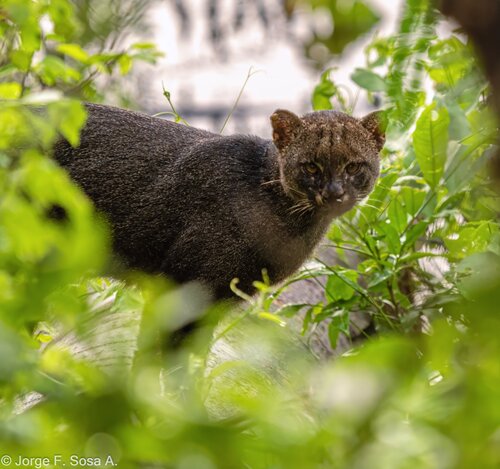
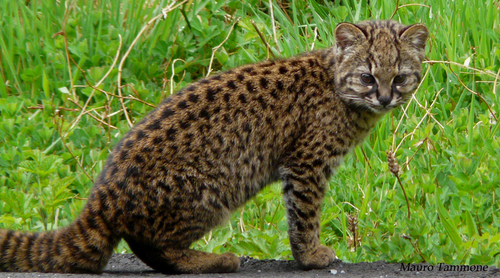
Its fur color ranges from brownish-yellow to grey-brown, with dark spots across its body, a pale underside, and a ringed tail.
Marking and Ears
Its ears are black with a distinct white spot, and the dark spots on its shoulders and neck almost merge into a series of dotted streaks. Melanistic kodkods with spotted black coats are quite common.
Body Structure
This species has a small head, large feet, and a thick tail.
Body Size
Adult head-to-body length measures 37 to 51 cm (15 to 20 in), paired with a short 20–25 cm (7.9–9.8 in) tail, a shoulder height of approximately 25 cm (9.8 in), and a body weight between 2 and 2.5 kg (4.4 and 5.5 lb).
Primary Habitat Association
The kodkod is strongly associated with mixed temperate rainforests of the southern Andean and coastal ranges, particularly the Valdivian and Araucaria forests of Chile, which are characterized by bamboo in the understory.
Habitat Preference
It prefers evergreen temperate rainforest habitats over deciduous temperate moist forests, sclerophyllous scrub, and coniferous forests.
Altered Habitat Tolerance
It is tolerant of altered habitats, and can be found in secondary forest, shrub, and primary forest, as well as on the fringes of settled and cultivated areas.
Elevational Range
Its range extends up to the treeline at approximately 1,900 m (6,200 ft).
Argentina Distribution
In Argentina, it has been recorded in moist montane forest that shares Valdivian temperate rain forest characteristics, including a multi-layered structure with bamboo, and numerous lianas and epiphytes.
Activity Pattern
In terms of ecology and behavior, kodkods are equally active during the day and night, though they only enter open terrain after dark.
Resting Sites
During the day, they rest in dense vegetation in ravines, along heavily vegetated streams, and in piles of dead gorse.
Climbing Ability
They are excellent climbers, and can easily climb trees more than one meter in diameter.
Diet and Prey
They are terrestrial predators that hunt birds, lizards, and rodents in ravines and forested areas, with documented prey including southern lapwing, austral thrush, chucao tapaculo, huet-huet, domestic geese, and chicken.
Territory Size
Male kodkods maintain exclusive territories ranging from 1.1 to 2.5 km2 (0.42 to 0.97 sq mi), while females occupy smaller ranges of only 0.5 to 0.7 km2 (0.19 to 0.27 sq mi).
Reproduction
For reproduction, the gestation period for kodkods lasts about 72–78 days, with an average litter size of one to three kittens.
Lifespan
This species may live up to around 11 years old.