About Prionailurus viverrinus (Bennett, 1833)
Taxonomy
The fishing cat, with the scientific name Prionailurus viverrinus (Bennett, 1833), has the following characteristics.
Basic Fur Markings
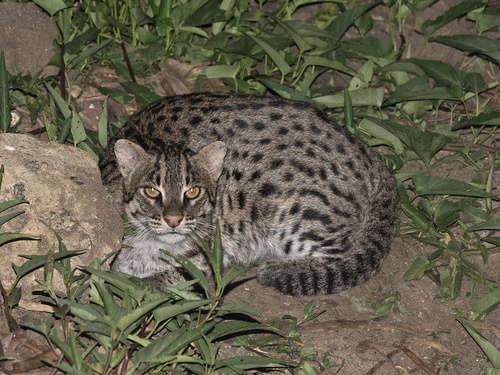
Its fur is deep yellowish-grey marked with black lines and spots. Two stripes run across its cheeks, and another two extend from above the eyes to the neck, with broken lines across the forehead. It has two rows of spots around its throat.
Spot Variation
Spots on the shoulder are longitudinal, while spots on the sides, limbs, and tail are roundish. The background fur colour varies between individual fishing cats, ranging from yellowish tawny to ashy grey, and stripe size ranges from narrow to broad. The fur on the belly is lighter than the fur on the back and sides.
Ear Characteristics
Its ears are short and rounded, set low on the head, with a white spot on the back of each ear.
Tail Characteristics
Its tail is short, measuring less than half the combined length of the head and body, and has a few black rings at its tip.
Fur Adaptation
The fishing cat's short, dense layered fur is thought to be an aquatic adaptation: it creates a water barrier and provides thermal insulation, while a separate layer of protruding long guard hairs creates the species' distinctive pattern and glossy sheen.
Genus Size Status
The fishing cat is the largest species in the Prionailurus genus.
Body Size and Build
It has a stocky, muscular build, with a head-to-body length ranging from 57 to 78 cm (22 to 31 in), a tail length of 20 to 30 cm (8 to 12 in), and medium to short legs.
Weight and Sexual Dimorphism
Females weigh 5 to 9 kg (11 to 20 lb), while males weigh 8 to 17 kg (18 to 37 lb), showing pronounced sexual dimorphism. The fishing cat is around twice the size of a domestic cat.
Skull Dimensions
Its elongated skull has a basal length of 123–153 mm (4.8–6.0 in) and a post-orbital width of 27–31 mm (1.1–1.2 in).
Tongue Characteristics
Its tongue is about 12 cm (4.7 in) long, with large, cylindrical papillae near the front.
Paw and Claw Features
Fishing cat paws are partly webbed, and their claws are incompletely sheathed, only becoming partially covered when fully retracted.
General Distribution
The fishing cat has a broad but discontinuous distribution across South and Southeast Asia.
Habitat Preferences
It predominantly inhabits densely vegetated wetlands around slow-moving water bodies, including low-salinity sites like oxbow lakes, and high-salinity sites like tidal creeks and mangrove forests. Along these water bodies, it hides within thick cover in forests, shrublands, reed beds, and grasslands. Most recorded observations of the species come from lowland areas.
Country Specific Distribution Records
Specific confirmed records of the fishing cat include: Chotiari Dam area in Pakistan's Sindh Province in 2012; Shuklaphanta, Bardia, Chitwan, and Parsa National Parks, plus Koshi Tappu Wildlife Reserve, in the Nepal Terai; Ranthambore National Park, Pilibhit, Dudhwa, and Valmiki Tiger Reserves, Sur Sarovar Bird Sanctuary, unprotected areas in West Bengal, Lothian Island Wildlife Sanctuary in the Sundarbans, Bhitarkanika Wildlife Sanctuary and unprotected coastal districts in Odisha, and Coringa Wildlife Sanctuary, Krishna Wildlife Sanctuary, and adjoining reserve forests in Andhra Pradesh, India; reported presence across most divisions of Bangladesh; tea estates, Maduru Oya National Park, and multiple coastal to hilly localities in Sri Lanka; the Ayeyarwady Delta in Myanmar in 2016 and 2018; Khao Sam Roi Yot National Park, Thale Noi Non-Hunting Area, and Kaeng Krachan National Park, plus wetlands outside protected areas in Phitsanulok Province, Bang Khun Thian District, Samut Sakhon, Phetchaburi, Songkhla Provinces, and a mangrove site in Pattani between 2007 and 2016, in Thailand; a single camera trap photograph in Kulen Promtep Wildlife Sanctuary in March 2003, and later records in Peam Krasop Wildlife Sanctuary and Ream National Park in 2015, in Cambodia.
Java Range Status
The island of Java marks the southern limit of the fishing cat's range; by the 1990s, fishing cats were considered scarce there, restricted to tidal forests on sandy or muddy shores, older mangrove stands, and abandoned mangrove plantation areas containing fishponds.
Distribution Absences
There are no confirmed records of the fishing cat in Peninsular Malaysia, Vietnam, and Laos.
Activity Pattern
In terms of behaviour and ecology, the fishing cat lives in dense vegetation near water and is thought to be primarily nocturnal.
Swimming Ability
It is a proficient long-distance and underwater swimmer.
Social Structure
Adult males and females without dependent young are solitary.
Home Range Size
Recorded home ranges are 4 to 6 km2 (1.5 to 2.3 sq mi) for females, and 16 to 22 km2 (6.2 to 8.5 sq mi) for males.
Resting Habits
It has been observed resting in thick grassy habitats, often near a water body but sometimes far from water.
Vocalisation
Adult fishing cats produce a "chuckling" vocalisation.
Scent Marking Behaviours
It marks its home range by leaving scent marks via cheek-rubbing, head rubbing, chin rubbing, neck rubbing, and urine-spraying; it also sharpens its claws and performs flehmen response.
Urine Scent Composition
The strong scent of fishing cat urine markings comes from 3-Mercapto-3-methylbutan-1-ol, a breakdown product of felinine.
Keoladeo National Park Diet
Analysis of fishing cat feces collected in India's Keoladeo National Park shows fish makes up around three-quarters of its diet; the remaining portion consists of birds, small rodents, and insects, with molluscs, reptiles, amphibians, cattle carrion, and grass as supplementary food.
Godavari Delta Diet
In the Godavari River delta, fish is the main prey, including flathead grey mullet, green chromide, and Mozambique tilapia, which make up three fifths of the diet, while rodents and crabs make up the rest. This diet composition stays relatively consistent throughout the year.
Hunting Behaviours
Fishing cats have been observed hunting along the edges of watercourses, grabbing prey from the water, and sometimes diving into the water to catch prey further from banks. It prefers to hunt in shallow water, and spends around half its time lying in wait for prey to approach.
Wild Mating Season
Regarding reproduction and development, wild fishing cats most likely mate during January and February, with most wild kittens observed in March and April, though mating may occur as late as June.
Gestation Period
In captive individuals, gestation lasts 63–70 days.
Litter Size
Females give birth to an average of two to three kittens, with litter sizes ranging from one to four.
Early Kitten Development
Kittens weigh around 170 g (6.0 oz) at birth, and are able to move actively by one month of age. They start playing in water and eating solid food at around two months old, but are not fully weaned until they reach six months old.
Juvenile Development Milestones
They reach full adult size at around eight and a half months old, grow in their full adult canine teeth by 11 months, and reach sexual maturity at approximately 15 months old.
Lifespan and Generation Length
Captive fishing cats live up to 10 years, and the species has a generation length of five years.