About Threskiornis spinicollis (Jameson, 1835)
Scientific Nomenclature and Basic Size
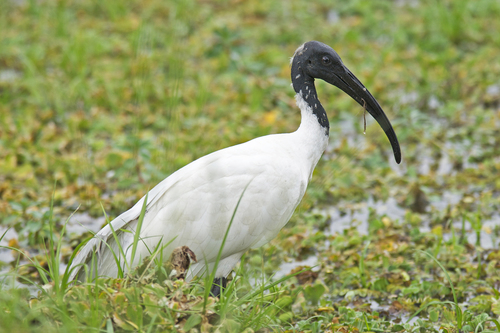
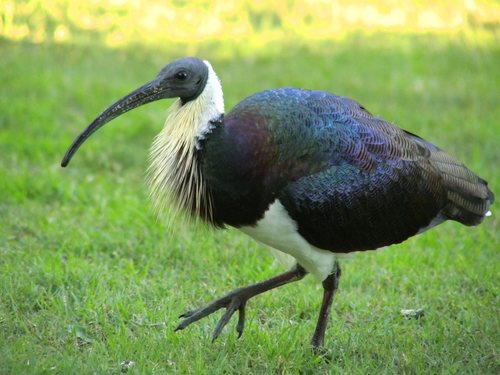
Straw-necked ibises (scientific name Threskiornis spinicollis (Jameson, 1835)) are large birds, measuring around 59–76 cm (23–30 in) long, with a bare black head and a long, downcurved black bill.
Plumage and Wing Appearance
They have distinctive, highly iridescent plumage that can look fairly uniformly dirty dark brown in poor light; their wings are dark, and show an iridescent, multicolored sheen in sunlight. They have a shiny blue-black back with a metallic purple, green and bronze glow, and a dark collar.
Body and Leg Coloration
The upper neck, underparts and undertail are all white; their legs are usually red near the top and dark grey toward the feet. Adult birds have straw-colored feathers on the neck, which gives the species its common name.
Wingspan and Weight
Their wingspan ranges from about 100–120 cm (39.5–47 in), and their weight is generally 1.1–1.5 kg (2.5–3.5 lb).
Adult Sexual Dimorphism
Males and females have similar appearances, though males have longer bills, and females have a dark band across their upper breast.
Juvenile Characteristics
Juveniles have duller coloration, shorter bills with less curvature, and do not have the straw-like plumes on the neck.
Australian Distribution
Straw-necked ibises are commonly found across Australia, and nest at least occasionally in all mainland Australian states and territories, except for the arid interior. They are most abundant on Australia's east coast, and are vagrant to New Zealand, Norfolk Island and Lord Howe Island.
Extra-Australian Range
They are seen less often in New Guinea and Indonesia, and occasionally appear in Tasmania and other Bass Strait islands.
Preferred Habitats
They inhabit shallow freshwater wetlands, cultivated pastures, edges of swamps and lagoons, and both wet and dry grasslands. They tend to avoid arid and saltwater areas, as well as coastal mudflats.
Movement Behavior
They are extremely nomadic, constantly moving to search for suitable habitats. They are frequently spotted standing on the high branches of bare trees, silhouetted against the sky.
Breeding Season Timing Influences
The breeding season of this species is highly variable, and is mainly influenced by water conditions. In southwestern Australia, breeding normally occurs from August to December; occasional small-scale breeding takes place in the north.
Regional Breeding Patterns
Breeding has been observed in every month across central and northern regions, and usually occurs in the year following heavy rain in these areas.
Nest Construction and Placement
They build large, rough, cup-shaped nests made of sticks and trampled plants, placed among reeds, paperbarks, bulrushes, or in trees over water.
Colony Breeding Habits
They breed in colonies, often alongside the Australian white ibis. Nests are reused year after year.
Clutch and Incubation Details
Clutches contain 2 to 5 eggs, and incubation lasts around 24 to 25 days, done by both parents.
Parental Care and Fledging
Both parents feed and care for the young, which fledge about 35 days after hatching. Feeding occurs via regurgitation, and continues for up to two weeks after the young leave the nest.