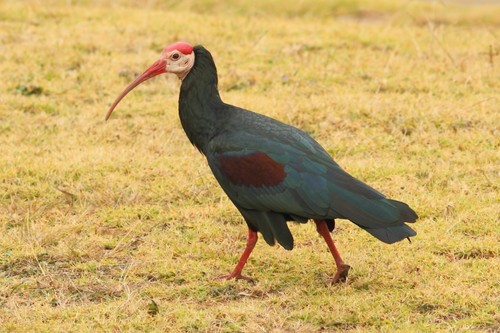
About Geronticus calvus (Boddaert, 1783)
Species Naming and Endemic Status
The southern bald ibis, scientifically named Geronticus calvus, is an uncommon bird that is endemic to the highlands of southern Africa.
Historical South African Breeding Population Estimate
In South Africa, this species’ total breeding population was once estimated at around 4,600 birds.
2020s Global Population Estimate
As of the 2020s, the total global population is estimated to be between 6,500 and 8,000 individuals, with a breeding population of 1,600 to 2,000 birds.
Biology Research Status
Little is currently known about the biology of this species.
Body Plumage Coloration
Its body plumage is dark green, marked with iridescent streaks of green, violet, and bronze. The neck bears long blue-green feathers.
Age-Related Plumage Differences
Adult individuals have copper-colored plumage on their shoulders, while juvenile southern bald ibises have predominantly dull grey plumage.
Scientific Name Etymology
The species’ scientific name Geronticus calvus translates to “bald, old man”, which refers to the bird’s featherless, wrinkled head and face.
Head Identification Features
The bird’s bare whitish head skin is the key identifying feature of this species. It has a red, dome-shaped crown on the top of its head.
Bill and Leg Coloration
Its bill is down-curved and red, and its legs are also red.
Eye Color
The eyes are colored orange-red.
Geographic Range Restriction
The southern bald ibis has a very restricted geographic range.
Distribution Range
It is confined to the eastern highland and mountainous regions of South Africa, and its range extends from the highlands of Lesotho into Eswatini.
Movement Patterns
It only makes short-distance movements within its established home range.
Breeding Nest Site Locations
This species is a cliff-nester, and breeds on open mountain face areas, river gorges, and sometimes around waterfalls.
Breeding Habitat Characteristics
Its breeding habitat is primarily mountainous grassland, located at altitudes between 1,200 and 2,000 meters above sea level.
Grassland Nutritional Classification
This grassland is classified as “sour”, because its foliage has low nutritional value in late summer and early autumn, after grazing by mammals.
Nest Site Accessibility Challenges
Southern bald ibises nest on cliff ledges, and breeding observations are hard to collect because most of these nesting sites are largely inaccessible.
Colony Breeding Structure
Most colonies breed together, but some breeding pairs nest separately from the main group.
Egg Laying Period
Females lay their eggs between late July and mid-October.
Juvenile Flight Feather Development
Young birds develop flight feathers between mid-October and December.
Nest Construction Details
Nests are built mostly from sticks and grass, and nest building typically begins around two weeks before the first egg is laid.
Incubation Period Length
After the first egg is laid, incubation lasts between 26 and 32 days.
Late Incubation Behavior
Incubating adults change position and rotate the egg more frequently starting around three days before the egg is due to hatch.
Post-Hatching Chick Feeding
After hatching, chicks are fed by regurgitation from their parents for the first 7 to 10 days.
Juvenile Nest Departure and Flight Development
Young birds leave the nest to wander around after 35 days, and gain the ability to fly between 40 and 50 days after hatching.
Post-Flight Juvenile Behavior
Even after they can fly, juveniles still spend most of their time on cliff ledges or in the nest.