About Bostrychia hagedash (Latham, 1790)
Physical Dimensions
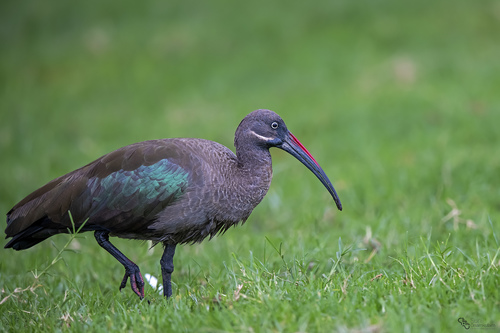
Bostrychia hagedash, commonly called the hadada ibis, is a large species of ibis that measures about 76 cm (30 in) in length. Adult hadada ibises have an average body mass of 1.2 kilograms (2.65 lbs).
Plumage and Markings
Males and females have identical plumage, which is primarily grey to partially brown. A narrow, roughly horizontal white stripe runs across the hadada's cheeks; this stripe is sometimes called a "moustache", though it does not extend to the corners of the mouth. The plumage on the wings has an iridescent purple sheen, which is created by optical microstructures within the feathers.
Bill and Leg Features
The bird has blackish legs and a large grey-to-black bill; during the breeding season, the basal half of the upper mandible (culmen) becomes red, and the upper surfaces of the toes also turn red when breeding begins.
Wing Function
Hadada ibises have powerful, broad wings that allow for quick take-offs and easy maneuvering through dense tree cover.
Onomatopoetic Name Origin
The hadada ibis has an extremely loud, distinctive call that sounds like "haa-haa-haa-de-dah", which is the origin of its onomatopoetic common name.
Common Call Contexts
This call is most often heard when the birds are flying, are startled, or are communicating socially, for example early in the morning in residential suburbs. When roosting, they produce a single loud "haaaa" call.
Foraging Contact Call
While foraging, their contact call is a low growl similar to that of a young puppy.
General Habitat Range
Hadada ibises are found throughout Sub-Saharan Africa, living in open grasslands, savannas, and wetlands, as well as in urban parks, school fields, green corridors, and large gardens.
Country Distribution
Specifically, this species occurs in Sudan, Burundi, Ethiopia, Senegal, Uganda, Tanzania, Gabon, the Democratic Republic of Congo, Cameroon, the Canary Islands, Gambia, Kenya, Somalia, Lesotho, Eswatini, Botswana, Mozambique, Zimbabwe, Namibia, and South Africa.
20th Century Range Expansion
In southern Africa, the species' distribution range increased by nearly two and a half times during the 20th century, following the introduction of trees into previously treeless areas. Irrigation projects may have also aided this expansion, as hadada ibises appear to need moist, soft soil to probe for food.
Roosting and Movement Patterns
Hadada ibises roost in groups in trees. They fly out to forage in the mornings with loud calls and return to their roosts in the evenings with regular consistency.
Primary Prey Items
Hadada ibises feed on insects, millipedes, and earthworms, using their long, scimitar-like bill to probe soft soil. They also eat larger insects such as the Parktown prawn, along with spiders and small lizards, and they feed readily on snails.
Human-Associated Foraging Benefits
They often clear garden beds around residential areas, and are particularly welcome on bowling greens and golf courses because they diligently extract moth and beetle larvae that feed on grass roots.
Sensory Bill Adaptations
Like other ibis species (including spoonbills) and some other probing feeders such as sanderlings and kiwis, hadada ibises have sensory pits around the tips of their bills. These pits allow them to locate unseen prey such as shallow subterranean larvae, insects, and earthworms while foraging.
Urban Tolerance
Hadada ibises have become very common in many African cities and tolerate close proximity to humans. They are able to judge the direction of a human's gaze and the speed of a human's approach to plan their escape strategy.
Airport Strike Risks
Hadada ibises have been involved in several bird strikes at airports in Kenya and South Africa.
Breeding Pair Bonds
Hadada ibises are monogamous, and pair bonds are thought to last year-round. Breeding starts after the rains; in Cape province, breeding occurs mainly between October and November.
Nest Characteristics
The nest is a platform made of twigs, built on a major branch of a large tree, typically in a branch fork. Despite the species being moderately gregarious, unlike most ibis species, hadada ibises do not nest in groups.
Incubation and Hatching
Both parents share incubation of a clutch of three to four eggs. Incubation lasts approximately 26 days.
Chick Rearing and Fledging
Parents feed the young by regurgitating food. Many young birds die after falling from the nest, and surviving young fledge after about 33 days.