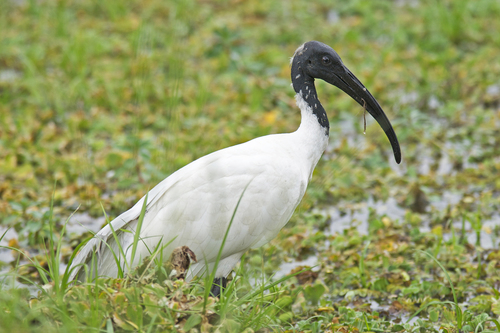
About Threskiornis melanocephalus (Latham, 1790)
Species Classification and Range
The black-headed ibis (Threskiornis melanocephalus) is one of several large waterbird species found in south and southeast Asia.
Adult Size
Adult individuals measure 65 to 76 centimetres in length.
Non-breeding Adult Plumage
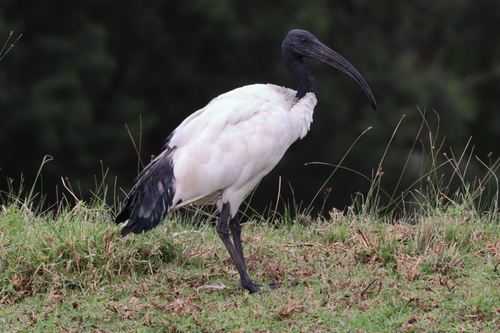
Their white plumage creates a sharp contrast with their prominent bare black neck and head, and a black down-curved beak.
Breeding Adult Plumage Variations
Adult tails have light grey ornamental feathers that turn solid black during the breeding season. During breeding, bare patches under the wing turn blood-red. The head of some breeding adults develops a blueish tinge, or very rarely a pink or bright red patch behind the neck.
Additional Breeding Adult Traits
Some breeding adults also grow tufts of white feathers behind the neck, and rarely develop yellowish colouration on the breast and back.
Sex and Juvenile Appearance
The sexes are identical in appearance, but juveniles can be distinguished from adults by their greyish feathering on the neck and speckled brown-grey feathering on the wings and back.
Vocalization
Like storks and spoonbills, this species lacks a true voice-producing mechanism, and is silent except for ventriloquistic grunts made by paired individuals at the nest.
Native Distribution
Black-headed ibises are native to Bangladesh, Cambodia, China, Hong Kong, India, Indonesia, Malaysia, Myanmar, Nepal, Pakistan, the Philippines, the Russian Federation, Sri Lanka, Thailand and Vietnam.
Migrant/Vagrant Distribution
They are migratory or vagrant in Japan, the Republic of Korea, the Lao People's Democratic Republic and Mongolia.
Population Status
The species is a widespread breeding bird in India, Sri Lanka, Nepal and Myanmar, and has declined considerably, with only a few locations or breeding colonies remaining in Cambodia, Indonesia, Malaysia, Thailand, and Vietnam. The most rapid recent population decline is suspected to have occurred in Sumatra.
Habitat Adaptability
The black-headed ibis is highly adaptable, and can use a wide range of both natural and man-made habitats.
Habitat Types
These include freshwater and saltwater marshes, lakes and ponds, as well as rice fields, freshly ploughed crop fields, irrigation canals, riversides, reservoirs, urban lakes, open sewage gutters, grazing lots, and garbage dumping sites.
Agricultural Landscape Habitat Use
In agricultural landscapes such as south-western Uttar Pradesh, India, ibises change their use of preferred foraging habitats by season. In summer, they mostly use and prefer natural marshes and fallow fields, but in the monsoon they spread out more evenly and also use a variety of agricultural fields.
Forested Landscape Habitat Use
In landscapes with more forests and rocky hills, such as southern Rajasthan, wetlands are the preferred habitat year-round, and there is little difference in habitats used between different seasons.
Urban Landscape Habitat Use
In more urban landscapes, black-headed ibis abundance is positively associated with crop fields, wetlands and open areas. Open sewage lines are used more often during dry summers, and ibises increase their use of grazing lands during the monsoon.
Nesting Habits
Black-headed ibises nest in heronry colonies near wetlands. They build a platform nest out of sticks, lined with grass and threads.
Roosting Sites
Old trees in cities are used for night roosting and nesting.
Daily Activity Budget
A study of the daily activity budget of black-headed ibises in a protected wetland found that the species spends the largest share of its time feeding (48%), followed by resting (23%).