About Geronticus eremita (Linnaeus, 1758)
Scientific Naming and General Appearance
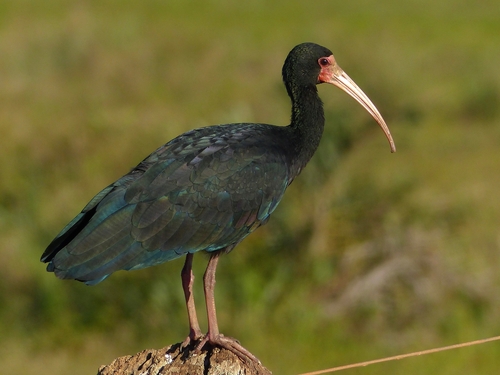
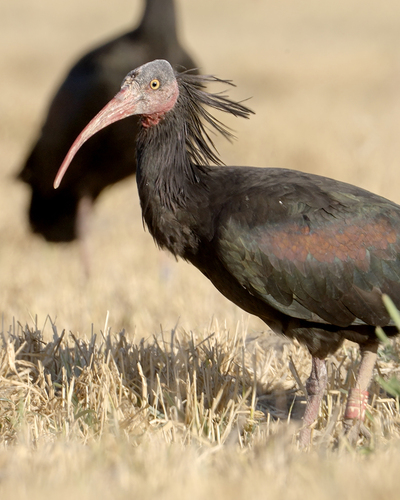
The northern bald ibis, scientifically named Geronticus eremita, is a large bird with glossy black plumage.
Size Measurements
It measures 70–80 cm (28–31 in) in length, has a 125–135 cm (49–53 in) wingspan, and an average weight of 1.0–1.3 kg (35–46 oz).
Plumage Details
Its black feathers have bronze-green and violet iridescence, and a wispy ruff sits on its hind neck.
Bare Body Part Coloration
The face and head are bare of feathers and dull red, while the long curved bill and legs are red.
Flight Characteristics
In flight, this species produces powerful, shallow, flexible wing beats.
Vocalizations
It makes guttural hrump and high, hoarse hyoh calls at breeding colonies, and is silent at other times.
Sexual Dimorphism
The sexes have similar plumage, but males are usually larger than females and have longer bills, a trait shared with other colonially breeding ibises; longer-billed males have more success attracting mates.
Chick Plumage
Downy chicks have uniformly pale brown plumage.
Juvenile Appearance and Maturation
Fledged juveniles look like adults except they have a dark head, light grey legs, and a pale bill; the unfeathered areas of their head and neck gradually turn red as they mature.
Geographic Bill Length Variation
Moroccan individuals have significantly longer bills than Turkish individuals of the same sex.
Subspecies Taxonomy Uncertainty
If the eastern and western populations are treated as separate subspecies, it is unclear which qualifies as the nominate (first-named) form, because the original species description was based on an now-extinct Swiss population of unknown lineage.
Distinction from Southern Bald Ibis
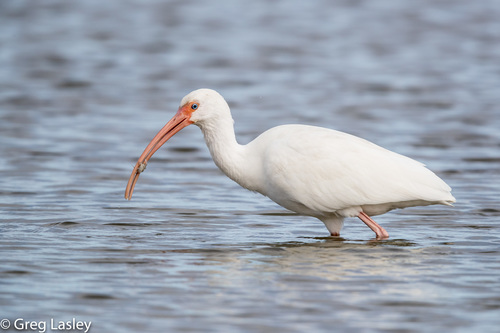
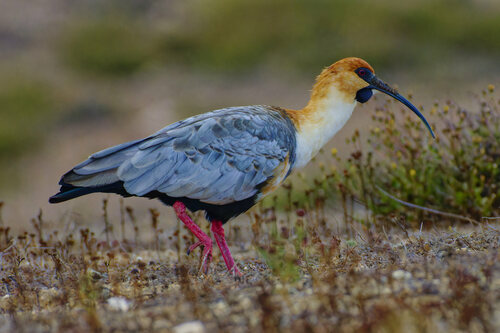
The northern bald ibis is easily told apart from its close relative the southern bald ibis of Southern Africa, which has a whitish face.
Distinction from Glossy Ibis (Overall)
It may also be confused with the similarly dark-plumaged glossy ibis, which shares part of its range, but the northern bald ibis is larger and stockier than the glossy ibis.
Distinction from Glossy Ibis (Flight)
When in flight, where bill and face color may not be visible, the northern bald ibis has a different profile due to its less rounded wings and shorter neck; its relatively short legs mean its feet do not extend past the tail, unlike the glossy ibis.
Breeding and Foraging Habitat
Unlike many other ibises that nest in trees and feed in wetlands, the northern bald ibis breeds on undisturbed cliff ledges, and forages for food in irregularly cultivated, grazed dry areas including semi-arid steppes and fallow fields.
Habitat Proximity Requirement
A key habitat requirement is that suitable steppe feeding areas must be close to breeding cliffs.
Historical Global Range
The northern bald ibis was once widespread across the Middle East, northern Africa, and southern and central Europe.
Fossil Evidence
Fossil bones dating to the Mesolithic and Neolithic Periods have been found at Solothurn.
Former European Breeding Range
It bred along the Danube and Rhone Rivers, in the mountains of Spain, Italy, Germany, Austria and Switzerland, and very probably also in the Upper Adriatic region.
Historical European Nesting Sites
Before vanishing from Europe at least three centuries ago, it nested on both cliff ledges and castle battlements.
Current Range Status
It is now extinct across most of its former range.
Current Wild Breeding Population (Morocco)
Today, almost the entire wild breeding population of just over 500 birds lives in Morocco, at Souss-Massa National Park (with three documented colonies) and near the mouth of the Oued Tamri north of Agadir (with a single colony that holds almost half of the Moroccan breeding population).
Moroccan Colony Movement
Some birds move between these two Moroccan sites.
Turkish Colony Religious Protection
Religious traditions helped a Turkish colony of this species survive long after it disappeared from Europe: the ibis was believed to migrate annually to guide Hajj pilgrims to Mecca, so it was protected for its religious significance, and an annual festival celebrated its return north.
Turkish Colony Location
The Turkish population was centered near the small town of Birecik in southeast Turkey.
Early 20th Century Turkish Population
In the first half of the 20th century, the Birecik colony maintained a relatively stable population of around 500 breeding pairs, reaching an estimated total population of about 3,000 around 1930.
Turkish Population Decline and Captive Breeding Start
By the 1970s, numbers dropped drastically, and a captive breeding program was started in 1977 with one adult pair and nine chicks collected from the wild.
Captive Breeding Program Outcomes
The program largely failed to reverse the decline: there were 400 birds in 1982, five pairs in 1986, and seven pairs in 1987.
Final Wild Turkish Population Returns
Only three birds returned from their wintering grounds in 1989, and just one in 1990.
Turkish Wild Extinction
The returning birds died before they could reproduce, leaving the species extinct in the wild in Turkey as of 1992.
Post-extinction Turkish Flock Management
After the wild Turkish population became non-viable, the colony was maintained as a flock that flew free most of the year but was caged in autumn to stop migration.
Post-Turkish Extinction Wild Range Knowledge
After the migratory Turkish colony died out, the northern bald ibis was only known to survive in the wild at the Moroccan sites, though occasional sightings in Yemen, Eritrea, Saudi Arabia, and Israel during the 1980s and 1990s suggested an unrecorded colony still existed somewhere in the Middle East.
Syrian Colony Rediscovery Surveys
Intensive field surveys in spring 2002, relying on knowledge from Bedouin nomads and local hunters, found that the species had never gone completely extinct on the Syrian desert steppes.
Syrian Nesting Site Findings
Systematic searches located 15 old nesting sites; one site near Palmyra still held an active breeding colony of seven individuals.
Syrian Population Decline Causes
Though the ibis had been declared extinct in Syria for more than 70 years, it had remained relatively common in desert areas until 20 years before the survey, when a combination of overexploitation of its range and increasing hunting pressure triggered a dramatic population decline.
Moroccan Population Movement Patterns
Moroccan breeding birds are resident, dispersing along the coast after the nesting season.
Moroccan Residency Explanation
It has been suggested that coastal fog provides extra moisture for this population, allowing them to stay year-round.
Historical Migratory Patterns and Vagrancy
Away from the coastal Moroccan sites, the northern bald ibis historically migrated south for the winter across the rest of its former range, and was previously recorded as a vagrant in Spain, Iraq, Egypt, the Azores, and Cape Verde.
Syrian Migratory Tracking Results
In 2006, satellite tagging of 13 Syrian birds showed that three tagged adults plus a fourth untagged adult wintered together from February to July in the Ethiopian highlands, where the species had not been recorded for nearly 30 years.
Syrian Migratory Route
They traveled south along the eastern side of the Red Sea through Saudi Arabia and Yemen, and returned north through Sudan and Eritrea.