About Testudo horsfieldii Gray, 1844
Taxonomy and Size Range
The Russian tortoise (scientific name Testudo horsfieldii Gray, 1844) is a small tortoise species, with an overall size range of 13–25 cm (5–10 in). Females grow slightly larger, reaching 15–25 cm (6–10 in), an adaptation to accommodate eggs. Males average 13–20 cm (5–8 in).
Sexual Dimorphism
This species is sexually dimorphic. Males are usually smaller than females, and tend to have longer tails that are generally tucked to the side, as well as longer claws. Females have a short, fat tail and shorter claws than males.
Cloaca Morphology
Males have a slit-shaped cloaca (vent) near the tip of the tail, while females have an asterisk-shaped cloaca.
Limb Toe Count
Unlike most other tortoises, which typically have five toes, Russian tortoises have four toes on their front limbs.
Coloration
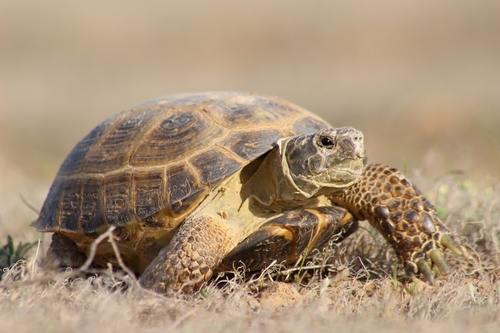
Their coloration varies, but the shell is usually a ruddy brown or black, fading to yellow between the scutes. The body is straw-yellow and brown, with color varying by subspecies.
Courtship Behavior
During courtship, male Russian tortoises court females by bobbing their heads, circling the female, and biting her forelegs. When the female submits, the male mounts her from behind, and produces high-pitched squeaking noises during mating.
Hibernation Period
If conditions are suitable, Russian tortoises hibernate for an average of 8 weeks to 5 months each year; individuals of this species can spend up to 9 full months of the year in dormancy.
Habitat Preferences
Russian tortoises thrive in dry, open areas, and favor sandy locations that are easy to move through and suitable for burrowing. While they primarily prefer arid environments, they can survive well in areas with 70 percent humidity, and actually require some rain to soften soil so they can dig their burrows.
Burrow Characteristics
These burrows can reach up to 2 meters (6 ft 7 in) deep. The tortoises retreat to these burrows during midday heat and at night, only emerging to forage at dawn or dusk when temperatures are cooler.
Social Behavior
Russian tortoises are quite social; they will visit nearby burrows, and sometimes multiple individuals will spend the night together in a single burrow.