About Chelonoidis carbonarius (Spix, 1824)
Morphological Variation Overview
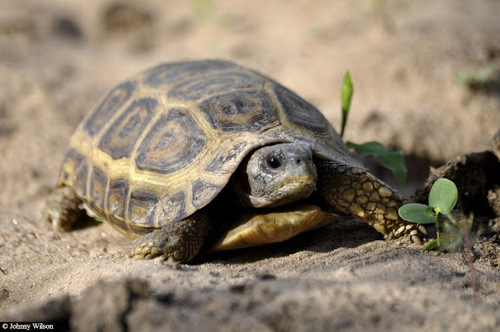
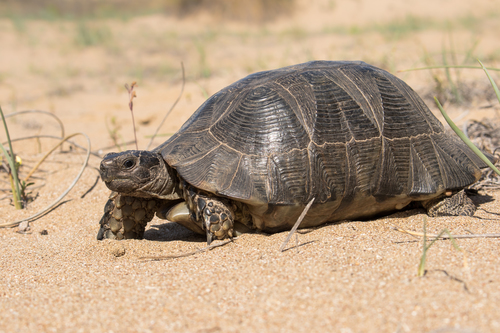
Red-footed tortoises (Chelonoidis carbonarius (Spix, 1824)) have sex, regional, and individual variations in color, shell shape, and minor anatomical characteristics. Adult carapaces are generally elongated ovals with nearly parallel sides, though male sides may curve inward.
Carapace Shape
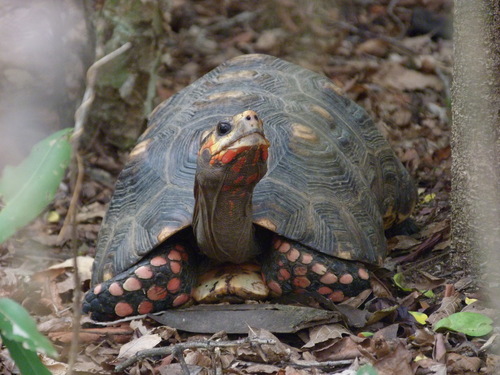
The carapace is fairly highly domed and smooth with a rather flat back; some individuals, especially captive specimens, may have raised or pyramided scutes. A high point over the hips is common, with a small sloped section over the neck.
Carapace Central Scute Coloration
Vertebral and costal scutes (along the center and sides of the carapace) are black or dark brown with a pale yellow areole at the center.
Marginal Scute Structure
Marginals (scutes along the carapace edge) tuck under along the sides and flare slightly over the limbs. They are dark with a pale aureole along the middle of the lower edge.
Specialized Carapace Scutes
The nuchal scute (the marginal over the neck) is absent, and the marginals over the tail are fused into one large supracaudal scute. Growth rings are clearly visible in most individuals, but wear smooth with age.
Plastron General Structure
The plastron (bottom shell) is large and thick along the edges. The gulars (frontmost pair of plastron scutes) do not protrude far past the front of the carapace.
Plastron Sexual and Regional Variation
The male plastron is deeply indented, and anal scutes (the rearmost pair of plastron scutes) can be used to sex the animal, while the plastron color pattern varies by region.
Head Shape
The head is relatively small with a squared-off profile, is flat on top, and is longer than it is wide. The eye is large with a brown, almost black iris, and rarely has any visible sclera around it.
Jaw Structure
The upper jaw is slightly hooked, and notched at the front middle. Each jaw has 15 to 20 fine tooth-like grooves along each side.
Tympanum Structure
A nearly circular tympanum sits behind and below the eye, and is covered by a dark scale.
Head and Neck Scale Coloration
Head scales are generally small and irregular, becoming small and pebbly on the neck. Many of the scales are colored pale yellow to brick red, especially those on the top of the head, above the tympanum, around the nostrils, on the lower jaw, and on the sides of the neck.
Head Color Variation
Males are usually slightly more colorful than females, and overall color varies by region.
Limb Structure
Limbs are generally cylindrical, with five claws on the forelimbs and four on the hindlimbs, with no visible toes. Forelimbs are slightly flattened, and their front surface is covered with large scales that mostly match the color of the head.
Forelimb Scale Comparison
These scales are not as large or protrusive as they are in more primitive species like the African spurred tortoise (Geochelone sulcata).
Tail Structure
The tail is muscular, its length and overall shape vary by sex, and it has no claw at the tip.
Adult Size Overview
Average adult size varies by region and sex, and so-called giant individuals are often encountered. Red-footed tortoises average 30–35 cm (12–14 in) long, with males slightly larger overall.
Large Size Records
Tortoises up to 45 cm (18 in) are fairly common, and individuals over 50 cm (20 in) are occasionally found. The largest known specimen, collected from Paraguay, was 60 cm (24 in) long and weighed over 28 kg (62 lb).
Giant Size Hypotheses
It is unknown if giant size comes from diet availability, genetic factors, longevity, or other causes.
Juvenile Carapace Appearance
Hatchling and young red-footed tortoises have much rounder, flatter carapaces that start out mostly pale yellow to brown. New growth adds dark rings around the pale center of each scute.
Juvenile Marginal Scutes
The marginals of very young tortoises are serrated, especially over the hind limbs. This serration likely aids camouflage against leaf litter and makes young tortoises harder to eat.
Juvenile Coloration
Young tortoises are generally more colorful overall.
Male Carapace Sexual Dimorphism
Males are slightly larger and more colorful overall than females. Male carapaces from north of the Amazon basin have a wasp waist, or constrictions along the sides.
Male Plastron Sexual Dimorphism
The male's deeply indented plastron helps with positioning during mating.
Tail Sexual Dimorphism
The male's tail is long and muscular, generally carried along one side, while the female's tail is short and conical.
Anal Scute Sexual Dimorphism
Anal scutes differ between sexes: in males they are shaped to give the tail more mobility, while in females they provide more protection to the hind end. In males, the gap between the points of the anal scales and the marginals is wider, and the anal scutes form a broader angle (almost a straight straight line across) to allow the tail to move laterally.
Female Anal Scute Structure
In females, the angle is more closed (around 90°) and the points sit closer to the marginals.
Mainland Distribution Range
Red-footed tortoises range from southeastern Panama to Venezuela, Guyana, Suriname, and Guiana in the north; south along the Andes to the west in Colombia, Ecuador, Peru, and Bolivia; east to Brazil, and south through Bolivia and Paraguay to possibly northern Argentina. In Panama, they occur from the Darien Gap to the Panama Canal.
Distribution Gaps
They are not evenly distributed across their range: they are not often found in central Brazil or in heavily forested areas generally, and have only been formally documented in Peru since 1985. Accurate range mapping is complicated by the large size of the range, political and geographic barriers, and unclear collection localities for many specimens.
Caribbean Island Populations
They are also found on several Caribbean Islands, though it is not always clear if they are native or introduced by humans. Many of these island populations appear to have been established in the 17th century as food sources or pets.
Caribbean Island Localities
They can be found on the former Netherlands Antilles, Trinidad, Tobago, Grenada, Barbados, St. Vincent, the Grenadines, Santa Lucia, Martinique, Dominica, Guadalupe, the Leeward Islands, the Virgin Islands, Barbuda (where they live in sink-hole forests), and Puerto Rico.
Habitat Climate Requirements
The preferred habitat of the red-footed tortoise varies slightly by region, but generally has fairly consistent seasonal temperatures near 30 °C (86 °F), that rarely drop below 20 °C (68 °F) or rise over 35 °C (95 °F), generally with high humidity and abundant rainfall, though some parts of their range can be quite dry. Most of their range has cooler wet seasons (April to August) and warmer dry seasons (September to March), but parts of the southern range experience occasional cold snaps.
Habitat Type Preferences
Red-footed tortoises are often found in or near transitional areas between forest and savannah, such as forest clearings, wood edges, or along waterways.
Northern Range Activity Patterns
In the northern part of their range, daily climate changes very little and rarely gets too hot, so red-footed tortoises do not enter any form of dormancy and can forage throughout the day. In one studied area, tortoises were most active after 3:00pm, unlike many species from warmer climates that are most active in the morning and evening.
Southern Range Dormancy
Tortoises from the southern parts of the range experience much hotter, colder, and drier conditions than most of the range, and aestivate when food becomes scarce. They may aestivate or brumate when temperatures are low enough.
Rest Period Duration
Most tortoise species spend most of the day inactive, and red-footed tortoises generally spend over 50% of daylight hours at rest. They may rest for even longer stretches after a large meal, with five to ten-day rest periods being common. One large specimen stayed in the same position for over a month.
Resting Camouflage
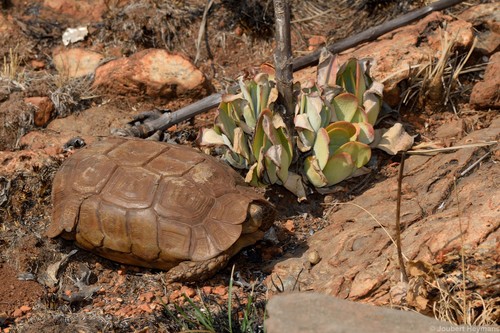
Resting tortoises barely move, which allows leaf litter to accumulate on them, and termites have even built tunnels on the carapaces of resting red-footed tortoises.
Shelter Site Purposes
They seek shelter that helps with thermoregulation and protects them from predators.
Common Shelter Sites
Favored shelter sites include treefalls, debris piles, burrows (especially those of armadillos in the Dasypodidae family and agoutis of the Dasyprocta genus), hollow logs, holes, and heavy vegetation cover. They generally prefer tight-fitting resting spaces, and will occasionally wedge themselves between roots and tree trunks while remaining otherwise exposed.
Shelter Site Usage Behavior
Burrows and holes are often flooded, and tortoises will rest in the water and mud with only their nostrils and eyes exposed. In warmer weather, they press against moister, cooler surfaces within shelter sites.
Shelter Site Preferences
Individual tortoises have personal preferences, with many always seeking out a specific type of shelter. Shelters are often communal, with as many tortoises fitting into the available space.
Scent Trail Use
Good shelters are so important, and visibility is so poor in their habitats, that tortoises leave scent trails that they or other tortoises can follow. Some shelters are so heavily used that clear dirt trails lead to them, though individual tortoises do not regularly return to the same shelter.
Feeding Site Behavior
Besides communal shelters and scent marking, red-footed tortoises show other signs of semisocial behavior: they show little aggression at feeding sites, do not defend territory, and will feed together at fruit falls and carrion (though it is not unusual for one tortoise to block access or even attempt to carry off some of the food).
Following Behavior
Red-footed tortoises often follow each other, usually a smaller individual follows a larger one, and males quite often follow other males, though all combinations are seen. They have also been observed following apparent scent trails laid by an individual one or two days earlier.
Captive Habitat General Requirements
For captive red-footed tortoises to stay healthy, heat, light, and humidity must be kept within proper guidelines.
Captive Temperature Guidelines
They are most active at temperatures from 27 to 30 °C (81 to 86 °F). A warmer area of 30 to 31 °C (86 to 88 °F) is recommended, and night temperatures can drop a few degrees lower.
Captive Humidity and Lighting Guidelines
High humidity should be available in at least one part of the captive habitat. Lighting should be low and diffuse, or plenty of shade must be provided.
Captive UVB Lighting Requirement
If the tortoise is kept indoors for extended periods, lights that emit UVB wavelengths are recommended to help it correctly metabolize calcium and regulate the pineal gland.