About Chersina angulata (Schweigger, 1812)
Scientific Nomenclature
This species is scientifically named Chersina angulata (Schweigger, 1812).
General Appearance
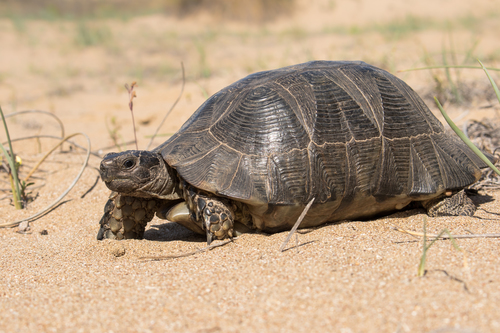
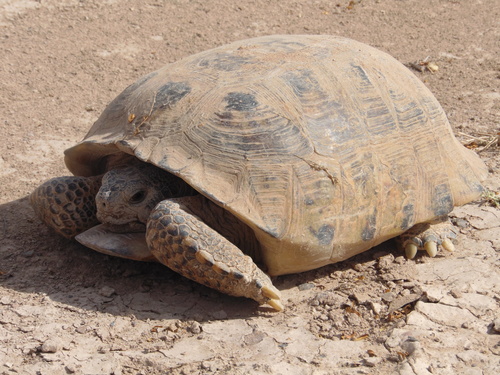
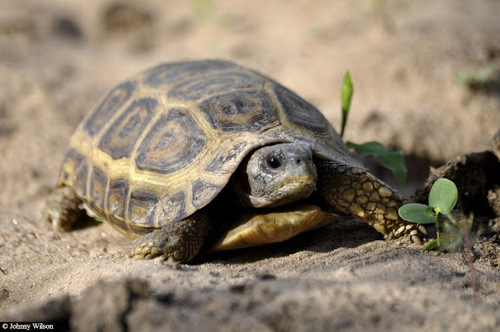
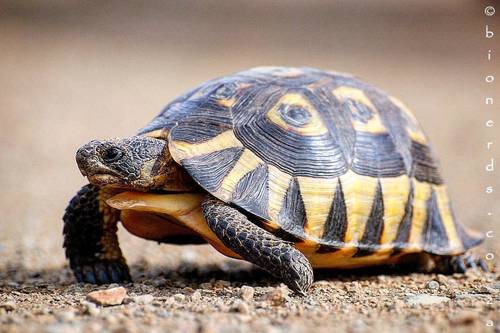
It is a small, shy tortoise with a relatively variable shell.
Gular Shield Protrusions
Individuals can often be distinguished by their prominent "bowsprits"—protrusions of the gular shields from their plastrons under the chin, which males use to fight for territory or females.
Gular Shield Uniqueness
Uniquely among southern African tortoises, this species has only one gular shield under its chin; all other southern African tortoises have a divided, double-scaled gular.
Limb Claw Count
Angulate tortoise specimens have five claws on their front legs and four claws on each back leg.
Nuchal Scute Trait
Like most other southern African tortoises, they also have a nuchal scute.
Native Habitat Vegetation and Climate
The natural habitat of Chersina angulata is fynbos, karoo, albany thickets, and coastal scrub (strandveld) vegetation in south-western South Africa, a region with semi-arid and Mediterranean climate and winter rainfall.
Species Adaptability
Within this climatic range, the angulate tortoise is a tough, highly adaptable species.
Northern Geographic Range
Geographically, its natural range spans the Cape Floristic Region, reaching as far north as southern Namibia.
Eastern Geographic Range
To the east, its range extends along the Cape's southern coast as far east as East London.
Dassen Island Colony
An especially dense colony of this species lives on Dassen Island, off the South African coast.
Introduced Namibian Colonies
Small colonies have additionally been introduced by tourists to domestic gardens in Swakopmund and Walvis Bay, further north in central Namibia.
Coastal Population Density
Across its entire range, this tortoise usually reaches its highest population densities near the coast.
Inland Population Distribution
Inland, it occurs at lower densities, though smaller populations are even found in parts of the Karoo.
Natural Predators
Within its natural range, natural predators of the species include mongoose, jackals, badgers, baboons, and predatory birds, which target infant tortoises.
Wildfire Mortality
Periodic wildfires are perhaps the largest cause of death for this species in its natural habitat, capable of killing hundreds of thousands of individuals at a time.
Human-Caused Threats
Due to human activity, the species is increasingly threatened by habitat destruction from agriculture and other development, illegal collection for the pet trade, and deaths when tortoises cross busy roads.
Invasive Predator Impact
Human-introduced species such as the pied crow kill thousands of infant angulate tortoises every year, especially along the West Coast where this invasive species is spreading rapidly.