About Chelonoidis denticulatus (Linnaeus, 1766)
Scientific Nomenclature and Size Ranking
Yellow-footed tortoises, scientifically named Chelonoidis denticulatus (Linnaeus, 1766), are a large tortoise species. They rank as the fifth-largest tortoise species overall, and the third-largest mainland tortoise species, ranking behind the Aldabra giant tortoise (Aldabrachelys gigantea), Galapagos giant tortoise (Chelonoidis niger), African spurred tortoise, and Asian forest tortoise.
Typical and Maximum Length
Their typical average length is 40 cm (15.75 in), but much larger individual specimens are common. The largest known specimen is a female that measured 94 cm (37 in) long.
Similarity to Red-footed Tortoise
This species closely resembles the red-footed tortoise, and the two can sometimes be difficult to distinguish, especially when specimens are preserved. This similarity has caused a great deal of confusion around the names and ranges of the two species.
Carapace General Shape
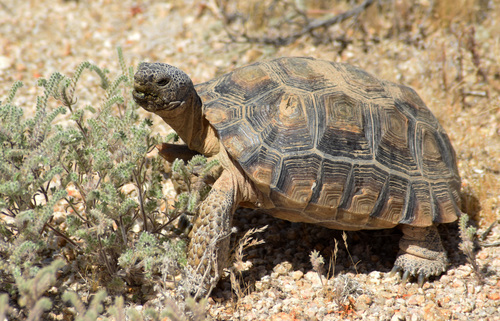
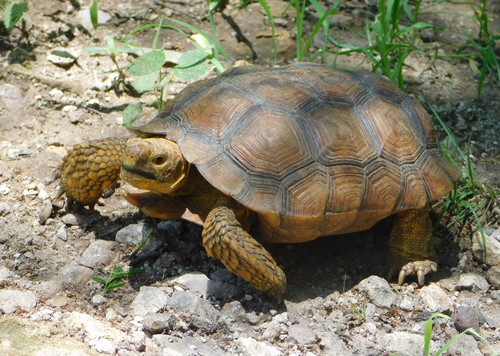
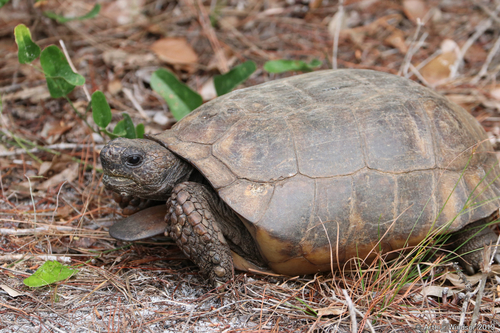
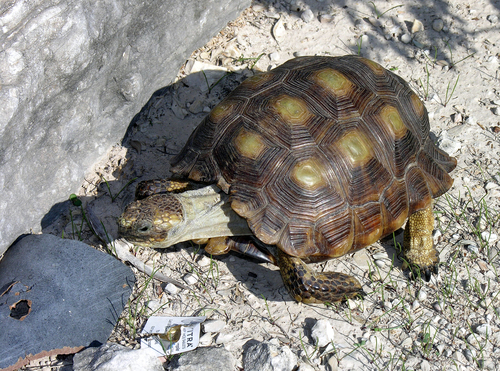
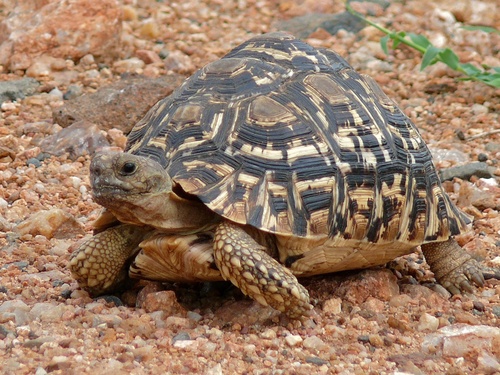
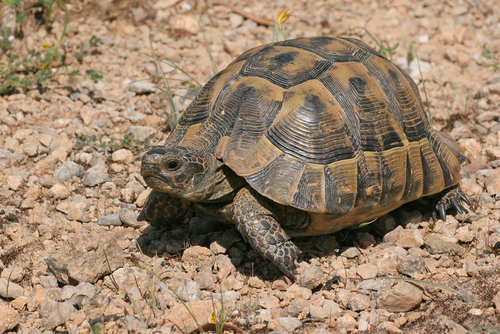
The carapace, or top of the shell, is a long oval with parallel sides and a high-domed back that is generally flat along the vertebral scutes (the scutes, or shell scales, that run along the top of the carapace), with a slight peak near the hind end.
Carapace Scute Count
Yellow-footed tortoises have five vertebral scutes, four pairs of costal scutes, eleven pairs of marginal scutes, no nuchal scute (the marginal scute over the neck), and a large, undivided supracaudal scute (the marginal scute over the tail).
Juvenile Carapace Features
In young yellow-footed tortoises, the front and rear marginal scutes (scutes along the edge of the carapace) are slightly serrated.
Carapace Coloration
The carapace ranges from yellowish brown to dark brown, and may even be black along the edges of the scutes. The areola in each scute is pale yellow, orange, or light brown, and blends into the darker surrounding carapace.
Plastron Structure
The plastron, or bottom of the shell, is thick around its edges, and the gulars (the front pair of plastron scutes) do not extend past the carapace.
Plastron Coloration
The plastron is yellow-brown, and turns nearly black near its seams.
Head General Structure
The head is relatively small, and longer than it is wide. The upper jaw has three tooth-like points.
Head Sensory Features
Yellow-footed tortoises have large black eyes, with a tympanum behind each eye.
Head and Limb Skin Color
The skin of the head and limbs is black, with yellow to orange scales on top and around the eye and ear.
Forelimb Structure
The forelimbs have five claws, are long and slightly flattened. They are covered with fine, dark scales, and slightly overlapping larger scales on the front that are the same color as the scales on the head.
Hind Limb Structure
The hind limbs are elephant-like, have four claws, and are covered in small scales that match the color of the forelimbs.
Tail Features
Tail length varies by sex, and the tail has a row of colored scales along its sides.
Habitat Preference Disagreement
There is disagreement among experts about what habitat yellow-footed tortoises prefer. Some researchers argue they prefer grasslands and dry forest areas, and that rainforest habitat is most likely marginal for the species. Other researchers suggest humid forest is the species' preferred habitat.
Confirmed Habitat Range
Regardless of preference, they are found in drier forest areas, grasslands, savanna, and rainforest belts that adjoin more open habitats.
Range Overlap with Red-footed Tortoise
The red-footed tortoise shares part of its range with the yellow-footed tortoise. In the shared range in Surinam, red-footed tortoises have moved out of forests into grasslands created by slash-and-burn agriculture, while yellow-footed tortoises have remained in the forest.
Breeding Season Timing
Breeding is synchronized with the start of the rainy season, which runs from July to September, when a general increase in the species' activity is observed.
Male Sex Recognition via Head Movement
Males identify other males by eliciting a characteristic head movement: a series of jerks away from, and back to, a mid-position. Another male will respond with the same head movements. A lack of head movement in response is the first indication that the other tortoise is female.
Additional Recognition Cues
Scientific experimentation and observation has also shown that correct head coloration is required for recognition. The male will then sniff the cloacal region of the other tortoise.
Copulation Process
Copulation usually follows this recognition, though sometimes there is a period of biting at the legs. During courtship and copulation, the male makes clucking sounds very similar to those of a chicken, with a set pattern of pitch changes in the clucks.
Male Aggression and Territoriality
Rival males will battle, attempting to overturn each other, but neither males nor females defend territories. Yellow-footed tortoises are considered nomadic in their movements.
Sexual Size Dimorphism Correlate
In almost every tortoise species where male combat occurs, males are always larger than females. This differs from aquatic turtle and tortoise species, where males are usually smaller than females and do not engage in male-to-male combat.
Evolution of Larger Males
It is thought that species with male combat evolved larger males because larger males have a better chance of winning a battle and mating with a female, passing on genes for larger size to their offspring.
Evolution of Smaller Males
Species with smaller males evolved smaller size because smaller males are more mobile and can mate with a large number of females, passing on genes for smaller size to their offspring.