About Indotestudo elongata (Blyth, 1854)
Shell Shape and Margins
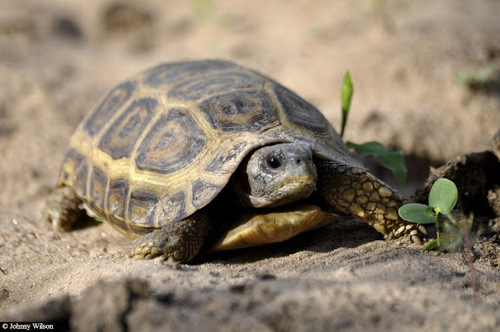
Description: The shell is considerably depressed, over twice as long as it is deep, with a flat vertebral region. Its anterior and posterior margins are slightly turned backward, strongly serrated in young specimens, and only feebly serrated in old specimens.
Shell Shield Surface Features
Shell shields show concentric striations, except in old individuals. A nuchal shield is present (rarely absent), and it is narrow and elongate. The supracaudal shield is undivided and more or less incurved.
Vertebral Shield Proportions
In adults, the first vertebral shield is usually nearly as long as it is broad; all other vertebral shields are broader than long, and nearly as broad as the costal shields.
Plastron Overall Shape
The plastron is large, truncate at the anterior end, and deeply notched at the posterior end.
Plastron Suture Lengths
The suture between the pectoral shields is as long as, or longer than, the suture between the humeral shields. The suture between the gular shields is as long as, or a little shorter than, the suture between the pectoral shields. The anal shields form a very short suture, or are entirely separated by the anal notch.
Axillary and Inguinal Shields
The axillary and inguinal shields are moderate in size.
Head and Jaw Morphology
The head is moderate in size, with a pair of large praefrontal shields, usually followed by a nearly equally large frontal shield. The beak is weakly hooked and tricuspid. The alveolar ridge of the upper jaw is short and rather feeble.
Limb and Tail Features
The anterior face of the fore limbs has moderate, unequal-sized, imbricate scales, which are largest toward the outer side. There are no enlarged tubercles on the thighs. The tail ends in a claw-like horny tubercle.
Shell Coloration
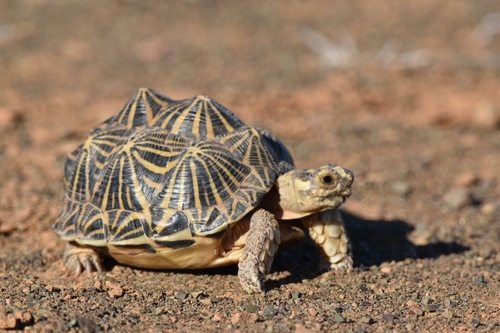
Both the carapace and plastron are greenish yellow; each shield has an irregular black spot or blotch, which may cover most of the shield, or may be much broken up or indistinct.
Geographic Range
Distribution: This species is found in India (Tripura, Jalpaiguri, East Bengal, and Singhbhum in Jharkhand), Nepal, Mizoram, Bangladesh, Myanmar (also called Burma), Laos, Thailand (including Phuket), Cambodia, Vietnam, Western Malaysia, and Southern China.
Type Locality
The type locality is Arakan, Tenasserim, Burma.