About Notamacropus parryi Bennett, 1835
Common Name & Distinguishing Markings
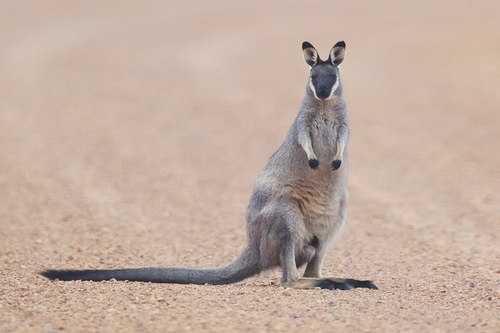
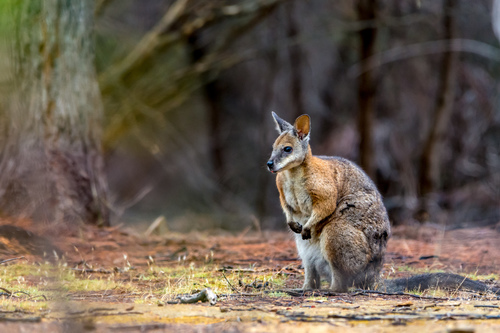
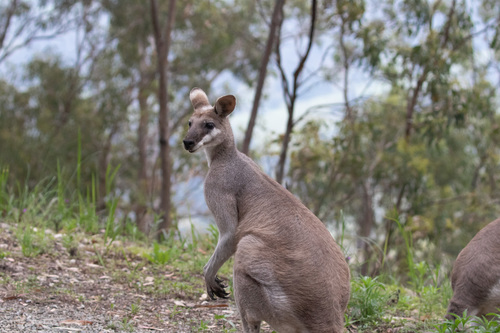
This species, commonly known as the whiptail wallaby, can be distinguished by its paler overall colouring and a white stripe running under its face.
Facial Fur Coloration
Chocolate-brown fur covers the muzzle portion of the face.
Body Fur Pattern & Coloration
The chest is patterned black and white, and the rest of the body is covered in fur ranging from grey to brown.
Male Size & Weight
Male whiptail wallabies weigh between 14 and 26 kg (31 to 57 lb), and stand 70 to 93 cm (28 to 37 in) tall.
Female Size & Weight
Females weigh between 7 and 15 kg (15 to 33 lb), and stand 65 to 75 cm (26 to 30 in) tall.
Mating Dominance
Only the most dominant males mate with females.
Male Reproductive Assessment Behavior
A male wanders through groups of females, sniffing their cloacae and tasting their urine to assess reproductive status.
Oestrus Mate Guarding
When a male locates a female approaching oestrus, he remains with her, but may be replaced by a more dominant male before she enters oestrus.
Oestrus Cycle Length
The oestrus cycle of the whiptail wallaby lasts 42 days.
Pouch Development Period
Joeys remain in their mother's pouch for the first nine months of life.
Post-Pouch Maternal Association
After leaving the pouch, they will still stay with their mother for up to 18 additional months.
Joey Movement Behavior
Whiptail wallaby joeys follow their mothers continuously and do not hide in vegetation.
Subadult Male Dispersal
Subadult male whiptail wallabies sometimes leave their natal groups.