About Setonix brachyurus (Quoy & Gaimard, 1830)
Taxonomy and Size
The quokka (Setonix brachyurus (Quoy & Gaimard, 1830)) weighs 2.5 to 5.0 kg (5+1⁄2 to 11 lb) and measures 40 to 54 cm (16 to 21 in) in body length, with a 25 to 30 cm (9.8 to 12 in) tail. This tail length is quite short for a macropod.
Body Structure
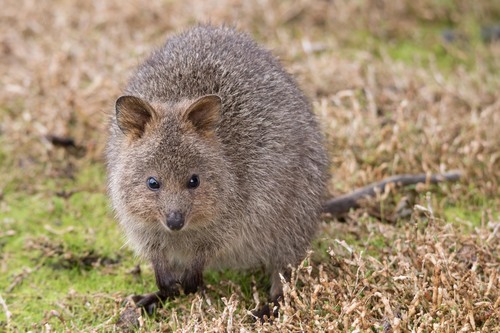
Quokkas have a stocky build, well-developed hind legs, rounded ears, and a short, broad head. While they look very similar to a very small kangaroo, they can climb small trees and shrubs that reach up to 1.5 metres (4 ft 11 in) in height.
Fur Coloration
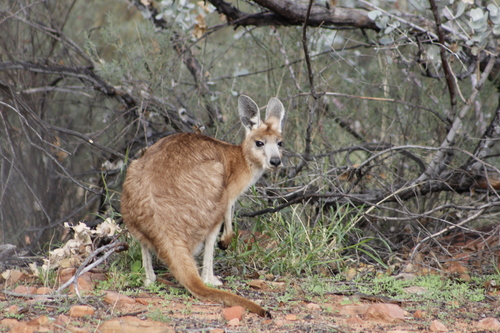
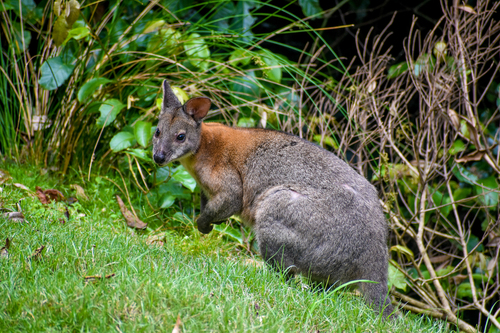
Their coarse fur is grizzled brown, fading to a buff colour on the underbelly.
Lifespan
The average lifespan of a quokka in the wild is 10 years.
Diurnal Shelter
Quokkas are nocturnal, and sleep during the day sheltered within Acanthocarpus preissii plants, which they also rely on for protection and hiding from threats, thanks to the plants' spines.
Mating System
Quokkas have a promiscuous mating system.
Gestation and Offspring Production
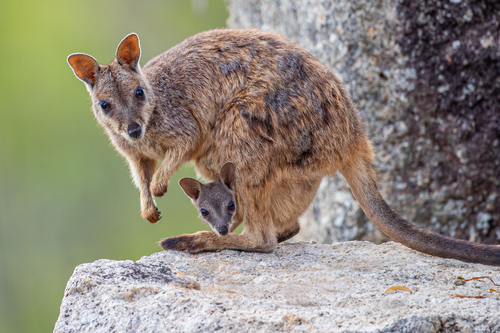
After a one-month gestation period, females give birth to a single young, called a joey. Females can produce offspring twice a year, and produce an average of 17 joeys over the course of their lifespan.
Joey Development
The joey lives in its mother's pouch for six months. After leaving the pouch, the joey continues to nurse from its mother for an additional two months, and is fully weaned around eight months after birth.
Sexual Maturity
Female quokkas reach sexual maturity after roughly 18 months.
Predator Evasion Strategy
If a female carrying a joey in her pouch is chased by a predator, she may drop the joey to the ground; the joey will make noises that may attract the predator's attention, allowing the mother to escape.
Mainland Habitat Preferences
On the Australian mainland, quokkas prefer areas with more vegetation, which provides both a wider variety of food and cover from predators including dingoes, red foxes, and feral cats.
Wild Distribution
In the wild, quokkas only live across a very small restricted range in the South West of Western Australia, where they occur as multiple small, scattered populations.
Island Populations
One large population lives on Rottnest Island, and a smaller population is found on Bald Island, near Albany. These two islands are free of the predators listed above.
Rottnest Island Habitat
On Rottnest Island, quokkas are common and live in a variety of habitats, from semiarid scrub to cultivated gardens.
Preferred Daytime Shelter
Prickly Acanthocarpus plants, which are difficult for humans and other large animals to walk through, are the quokka's preferred daytime sleeping shelter.
Climbing Ability
Additionally, quokkas are known for their ability to climb trees.