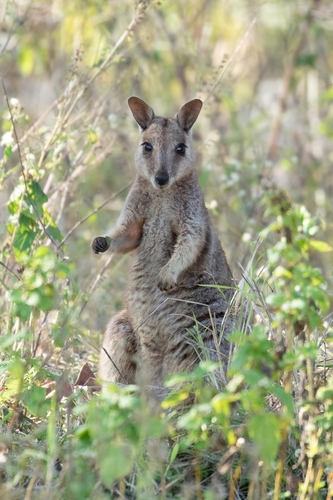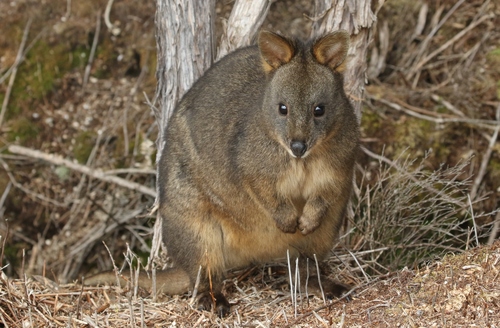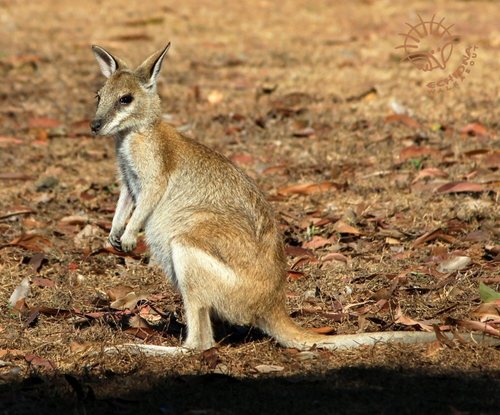
About Macropus agilis (Gould, 1841)
Sexual Size Dimorphism
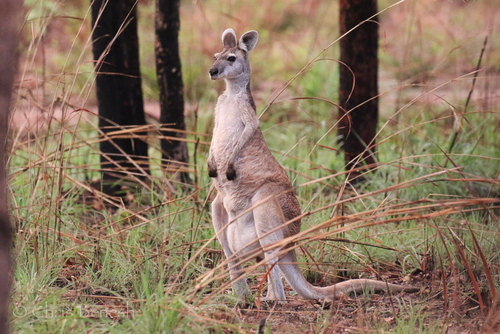
Male agile wallabies (Macropus agilis) are noticeably larger than females. Males reach a maximum head and body length of 85 cm (33 in) and weigh between 16 and 27 kg (35 to 60 lb), while females grow to 72 cm (28 in) in head and body length and weigh 9 to 15 kg (20 to 33 lb).
Tail Length
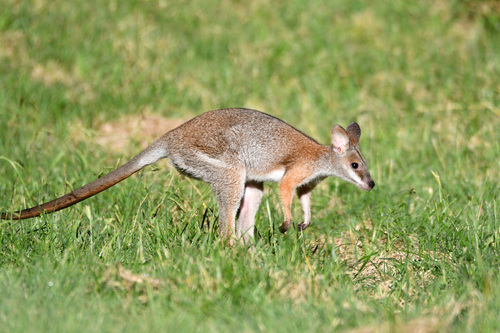
Both sexes have long, flexible tails, making the animal's total full body length double its head and body length.
Head and Tail Markings
This species has relatively large ears edged with black, and the tip of the tail is also black.
Body Coloration
Their backs are sandy brown, and their underparts are whitish.
Striped Markings
They have a dark stripe running between their ears, a pale stripe on each cheek, and an additional pale stripe across each thigh.
Geographical Range
The agile wallaby is distributed across northern Australia, Papua New Guinea, and the Indonesian province of South Papua.
Australian Abundance
It is the most common wallaby across much of northern Australia.
Queensland Distribution
It is also quite common in northern Australia and along the eastern coast of Queensland, with isolated populations located in southeastern Queensland around Coomera, Jacobs Well, and Hope Island.
Island Distribution
It is present but uncommon on Stradbroke Island and Woogoompah Island in the Southern Moreton Bay Islands, and it may still survive on Peel Island.
Australian Habitats
In Australia, the typical habitats of the agile wallaby are dry open woodland, heaths, dunes, and grassland.
Habitat Associations
It is often found near rivers and billabongs.
Feeding Habits
When grass is scarce, it will sometimes feed on shrubs or move onto agricultural land, including sugar cane plantations.