About Notamacropus irma (Jourdan, 1837)
Taxonomy
Notamacropus irma, the western brush wallaby, is a species of the genus Notamacropus.
Body Length and Height
It has a head and body length of up to 900 millimetres, a tail length between 600 and 950 mm, and a standing height of around 800 mm.
Weight and Sexual Size Dimorphism
Adult western brush wallabies weigh between 7.0 and 9.0 kg, and males and females are very similar in size.
Tail Proportions
The tail is proportionally long relative to the species' smaller body size.
Base Coat Coloration
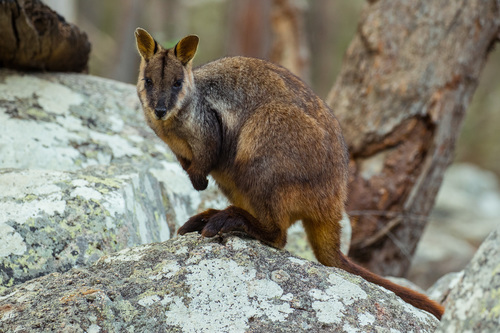
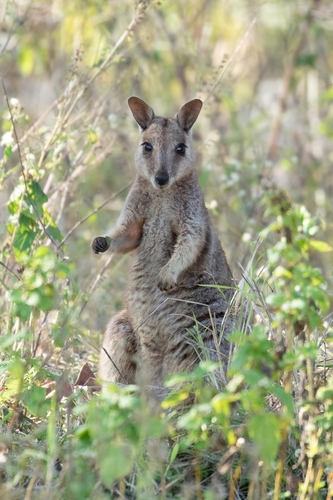
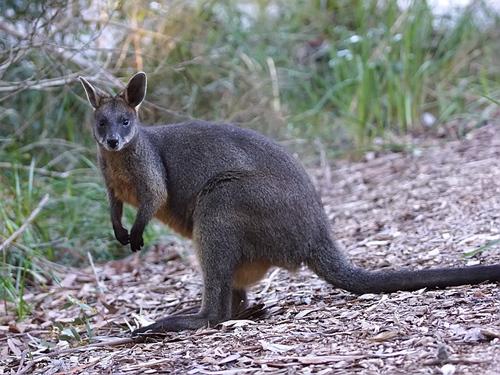
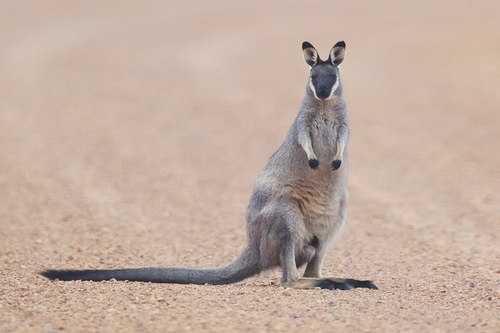
The species' base coat is pale to mid gunmetal grey, a colouration that resembles larger kangaroos found in the same region.
Facial Markings
A distinct white stripe runs from the ear to the mouth on the face.
Distinctive Limb and Tail Features
Other identifiable features include black and white ears, black hands and feet, and a crest of black hairs on the tail.
Dorsal Barring Variation
Some individuals have faint dark barring on their back and rump.
Geographic Range
The western brush wallaby occurs in the southwest coastal region of Western Australia, spanning from Kalbarri south to Cape Arid, and is concentrated most heavily near the Swan River.
Habitat Occurrence Patterns
It can be found in some areas of mallee and heathland, and is uncommon in wet sclerophyll forests.
Unoccupied Habitat
No populations exist in true Karri forests, due to the thick undergrowth these forests have.
Preferred Forest Habitat
The species prefers tall open forests that provide good grazing.
Favored Open Habitat Characteristics
It particularly favors open, seasonally damp flat areas with low grasses and open scrubby brush; this open habitat supports its speed when moving low to the ground.
Reproductive Knowledge Status
Despite decades of research into the reproductive behaviour of the western brush wallaby, most of its reproductive habits remain relatively unknown.
Birth Season
Young are typically born in April and May.
Female Pouch Morphology
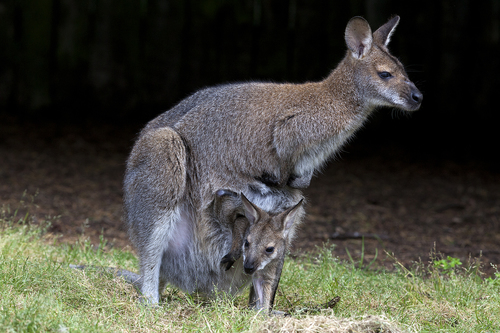
Like all marsupials, females have a well-developed forward-opening pouch that holds four teats.
Litter Size
Females usually give birth to one young at a time, and twin births are rare.
Gestation Period
Gestation lasts between three and five weeks.
Lactation Period
After birth, young enter a seven-month lactation period that ends in October or November.
Post-Pouch Weaning Behavior
After leaving the pouch, young go through a weaning period where they still put their head into the pouch to temporarily attach to a teat.