About Gallinago nigripennis Bonaparte, 1839
Size
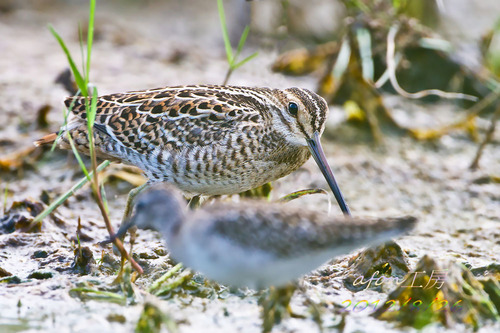
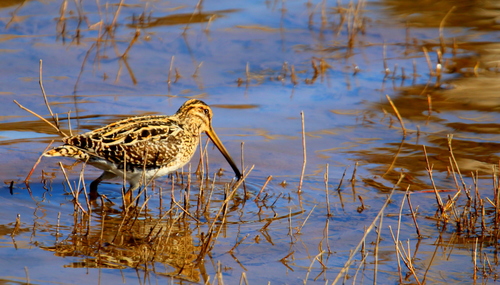
This species of snipe, Gallinago nigripennis, is 30–32 cm (12–13 in) long. As a wader, it has a stocky body and relatively short legs.
Dorsal Plumage
Its upperparts, head, and neck are streaked and patterned with bold dark brown stripes; the gold edges of its feathers form lines running down its back.
Ventral Plumage
The belly is white, with some brown barring on the flanks that never extends to the belly.
Bill Characteristics
Its very long, straight bill is pinkish-brown and fairly robust.
Limb Coloration
The legs and feet range in color from yellowish-olive to greenish-grey.
Sexual Dimorphism
Males and females are similar in appearance.
Immature Plumage
Immature birds differ only by having pale fringes on the wing coverts.
Vocalizations
When taking off, this snipe produces a hleep call; during the breeding season, it has a far-carrying kip call.
Flight Plumage Features
In flight, it displays white trailing edges on the wings and white tail corners.
Sympatric Similar Species
Within its range, this African snipe can only be confused with three migratory snipe species: the common snipe, pin-tailed snipe, and great snipe.
Great Snipe Distinction
The great snipe is noticeably larger, darker, and has a relatively shorter bill.
Pin-tailed Snipe Distinction
The pin-tailed snipe lacks white trailing wing edges and has very little white on its tail corners.
Common Snipe Ground Identification
The common snipe is very similar to the African snipe, though the African species is darker on its upperparts and has a longer bill; identifying the two when they are on the ground is very difficult.
Common Snipe Flight Identification
In flight, the African snipe has slower, more fluttering flight on more rounded wings, zig-zags less when flushed, and often shows noticeably more extensive white in the tail.