About Tringa solitaria A.Wilson, 1813
Physical Measurements
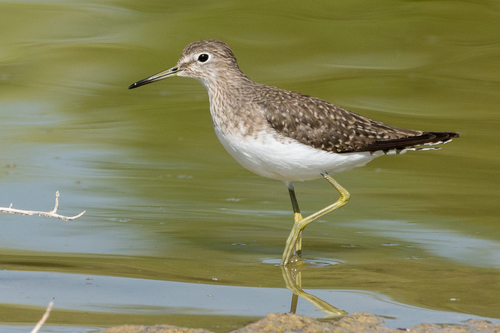
Tringa solitaria, commonly known as the solitary sandpiper, measures 18–23 cm (7.1–9.1 in) in length, has a wingspan reaching up to 50 cm (20 in), and weighs 31–65 g (1.1–2.3 oz). It is a stocky wader with a dark green back, greyish head and breast, and white underparts elsewhere.
In-Flight Identification
In flight, it is easily identifiable by its uniformly dark upper and lower wings, plus a dark rump and dark central tail. This dark rump and tail center distinguishes it from its close relative, the slightly larger, broader-winged green sandpiper (T. ochropus) of Europe and Asia, which has a bright white rump.
Vocalization
The solitary sandpiper gives a characteristic three-note whistle when flying.
Shared Traits With Green Sandpiper
Both the solitary sandpiper and the green sandpiper have brown wings marked with small light dots, and a subtle but contrasting pattern on the neck and chest. Unlike most other scolopacids, both species also nest in trees.
Breeding Range
This species breeds in woodlands throughout Alaska and Canada.
Migration and Winter Range
It is migratory, and spends the winter in Central and South America (particularly in the Amazon River basin), as well as the Caribbean. It is a very rare vagrant to western Europe, appearing there in summer and fall.