About Bartramia longicauda (Bechstein, 1812)
Taxonomic Naming
Bartramia longicauda (Bechstein, 1812), commonly called the upland sandpiper, has the following description and range details.
Adult Body Size
Adult individuals are approximately 30 cm (12 in) long, with a wingspan of 66 cm (26 in) and an average weight of 170 g (6 oz).
Body & Head Shape
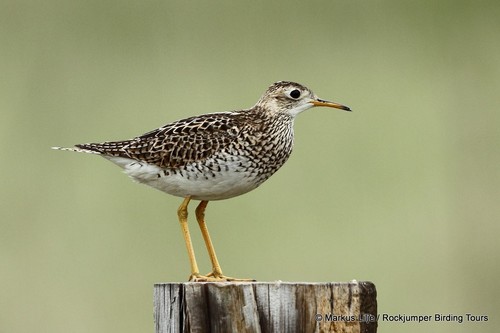
This species has a distinctive shape: a small, dove-like head set on a long neck.
Dorsal Plumage
The back and wings are heavily marbled in black and brown.
Neck & Breast Markings
The neck is streaked with dark brown, and this streaking extends down through the breast to the flanks.
Ventral Plumage
The belly and undertail coverts are white.
Tail Morphology
Compared to other sandpipers, this species has a quite long tail.
Head & Leg Features
Upland sandpipers also have a white eye-ring and long yellow legs.
Core North American Breeding Range
This species breeds across a large North American range: from eastern Alaska, southeast of the Rocky Mountains through Montana to northern Oklahoma, then northeast to Pennsylvania, New England, and the extreme southern portions of Quebec and Ontario.
Isolated Breeding Populations
There are also separate local breeding populations in northeast Oregon and west central Idaho.
Wintering Range
They spend the winter in northeastern Argentina, Uruguay, and southern Brazil.
Vagrant Records
It is an extremely rare vagrant to Europe and the South Pacific, with only one recorded sighting each from Australia and New Zealand.
General Habitat Preference
Despite being classified as sandpipers, upland sandpipers prefer open country with tall grasses over coastal habitat.
Eastern North American Habitat
In eastern North America, they are also found at airports, blueberry farms, and abandoned strip mines.
Core Habitat Range
The species' true core range and habitat lies in the northern midwest United States.