About Calidris pygmaea (Linnaeus, 1758)
Scientific Nomenclature
This species has the scientific name Calidris pygmaea (Linnaeus, 1758), commonly called the spoon-billed sandpiper. Its most distinctive feature is its spatulate bill.
Breeding Adult Plumage
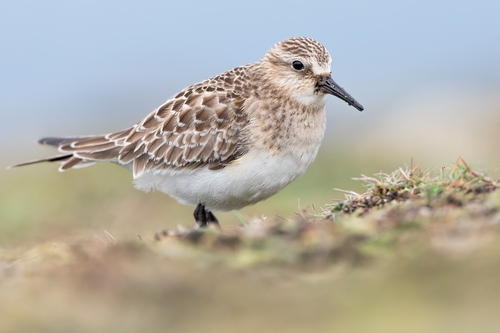
Breeding adult spoon-billed sandpipers have a red-brown head, neck, and breast with dark brown streaks, and blackish upperparts with buff and pale rufous fringing.
Non-breeding Adult Plumage
Non-breeding adults do not have reddish colouration; instead they have pale brownish-grey upperparts, with whitish fringing to the wing-coverts. All adults have white underparts and black legs.
Body Length
The species has a total length of 14–16 cm (5.5–6.3 in).
Detailed Morphometrics
Detailed measurements are: wing 98–106 mm, bill 19–24 mm, bill tip breadth 10–12 mm, tarsus 19–22 mm, and tail 37–39 mm.
Vocalizations
Contact calls of this species include a quiet preep or a shrill wheer. The song, produced during display, is an intermittent buzzing and descending trill transcribed as preer-prr-prr.
Male Display Flight
Male display flight combines singing with brief hovers, circling, and rapid diving.
Breeding Range
The breeding habitat of the spoon-billed sandpiper is sea coasts and adjacent hinterland on the Chukchi Peninsula, extending southwards along the isthmus of the Kamchatka Peninsula.
Migration and Wintering Range
It migrates down the Pacific coast through Japan, Korea and China to its main wintering grounds in south and southeast Asia, where it has been recorded from India, Bangladesh, Sri Lanka, Burma, Thailand, Vietnam, the Philippines, Peninsular Malaysia and Singapore.
Phylogenetic Relationships
Phylogenetic analyses of complete mitogenome sequences indicate that South Korean and Chinese C. pygmaea groups are closely related to Arenaria interpres, due to similarity in their series of protein-coding genes.
2024 Sighting Record
In March 2024, a spoon-billed sandpiper was sighted at Balanga, Bataan mudflat in the Philippines.
Feeding Behavior
In terms of behaviour and ecology, the spoon-billed sandpiper feeds by moving its bill from side to side as it walks forward with its head down.
Nesting Habits
This species nests in June–July on coastal tundra areas, choosing grassy locations close to freshwater pools.
Diet
Spoon-billed sandpipers feed on tundra moss, small animal species including mosquitoes, flies, beetles, and spiders, and at certain times also feed on marine invertebrates such as shrimp and worms.