About Caranx crysos (Mitchill, 1815)
Common Name and Size
Caranx crysos, commonly known as the blue runner, is a moderately large fish. The maximum confirmed size for this species is 70 cm in length and 5.05 kg in mass, though most individuals grow to less than 35 cm long.
Body Shape
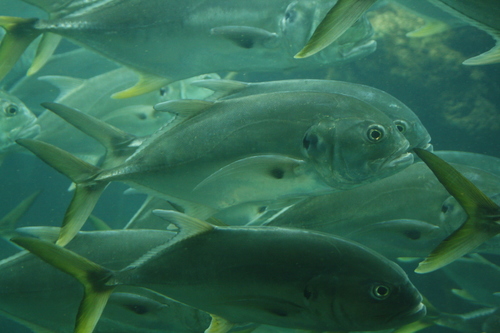
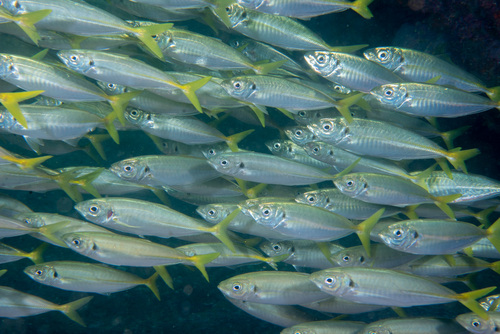
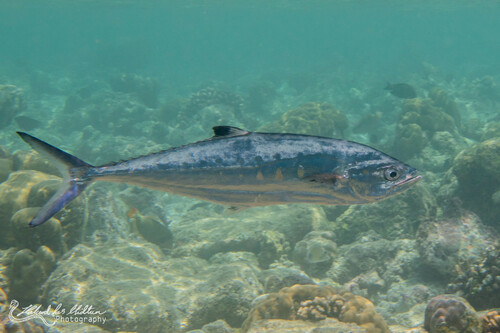
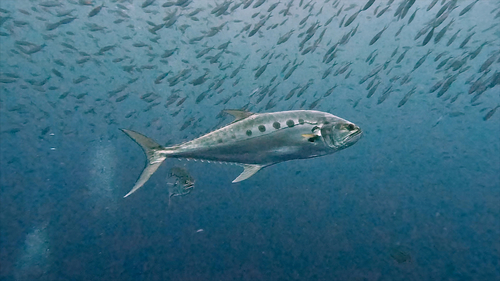
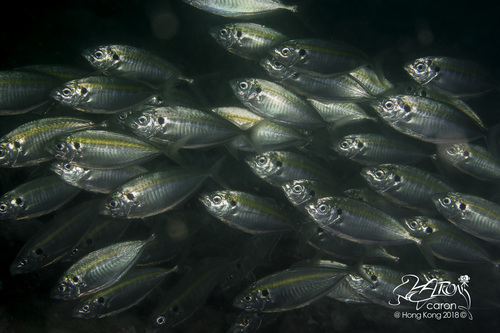
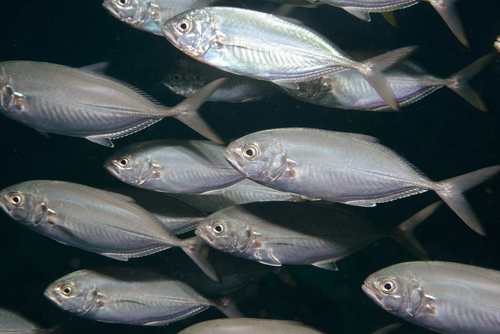
The blue runner is morphologically similar to many other jack (carangid) species, with an elongated, moderately compressed body where the dorsal and ventral profiles have roughly equal convexity, and a slightly pointed snout. A moderately well-developed adipose eyelid covers the posterior section of the eye, and the back edge of the jaw sits vertically below the center of the eye.
Dorsal Fin Structure
The dorsal fin is split into two parts: the first holds 8 spines, while the second holds 1 spine followed by 22 to 25 soft rays. The anal fin has 2 spines detached from the anterior section, followed by 1 spine and 19 to 21 soft rays.
Pectoral Fin Structure
The pectoral fins, which have 21 to 23 rays, grow more falcate (curved like a sickle) as the fish ages, and are slightly longer than the head.
Lateral Line Structure
The lateral line has a prominent but short anterior curve; the curved section intersects the straight section below the spine of the second dorsal fin. The straight section holds 0 to 7 scales followed by 46 to 56 very strong scutes, and bilateral keels are present on the caudal peduncle.
Scale Coverage
In total, there are 86 to 98 scales and scutes along the entire lateral line, and the entire chest is covered in scales.
Dentition
The upper jaw holds an irregular outer series of canines, with an inner band of small, regularly spaced teeth, while the lower jaw holds a single band of small teeth.
Gill Raker Count
The species has a total of 35 to 42 gill rakers: 10 to 14 on the upper limb and 25 to 28 on the lower limb. This gill raker count is the only feature that distinguishes C. crysos from Caranx caballus.
Vertebrae Count
The blue runner has 25 vertebrae.
Body Coloration
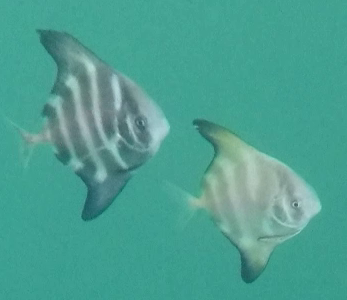
The species' dorsal colour ranges from bluish green to olive green, fading to silvery grey or brassy on the underside. Juveniles often have 7 dark vertical bands across their bodies.
Fin and Operculum Coloration
Fin colour varies, with all fins ranging from dusky or hyaline to olive green. The species also has a dusky spot on the upper operculum, which may not be distinct.
Overall Distribution
The blue runner is widely distributed across tropical and temperate waters of the Atlantic Ocean, found along both the eastern American coastline and the western African and European coastlines.
Western Atlantic Range
In the western Atlantic, the southernmost confirmed record of the species comes from Maceio, Brazil. From there, it ranges north along the Central American coastline, through the Caribbean and its many archipelagos.
Northern Western Atlantic Range
From the Gulf of Mexico, its range extends north along the U.S. coast all the way to Nova Scotia, Canada, and includes several northwestern Atlantic islands. The blue runner is also found on multiple central Atlantic islands, making its distribution span the entire Atlantic Ocean.
Eastern Atlantic Range
In the eastern Atlantic, the southernmost record is from Angola. From there, the blue runner is widely distributed along the west African coast up to Morocco, and extends into the Mediterranean Sea, where it has been recorded from nearly all countries bordering the Mediterranean.
Northeastern Atlantic Records
It is rarely found north of Portugal in the northeastern Atlantic, though there are isolated records of catches from Madeira Island and Galicia, Spain. The furthest north the blue runner has been reported is southern Great Britain, where two specimens were caught in 1992 and 1993.
Range Shift Observations
This and other tropical species are now being found further north more often, and publications note the blue runner has recently established stable populations in the Canary Islands, where it was previously rarely sighted. Some authors attribute this northward shift to rising sea surface temperatures, likely a result of climate change.
General Habitat
Across most of its range, the blue runner is primarily an inshore fish, but it is also known to live on reefs in water deeper than 100 m. Across much of its Central American range, it is quite rare inshore, and is more commonly seen on outer reefs.
Pelagic and Reef Habitat
The blue runner is primarily a semi-pelagic fish, inhabiting both inshore reefs and outer shelf edges, sill reefs, and the upper slopes of deep reefs. Individuals on shallower reefs often move between reef patches across large expanses of sand.
Juvenile Habitat
Juveniles are known to inhabit shallow waters of inshore lagoons, taking shelter around mangroves or in seagrass among coral reef patches. The species has been caught by fishermen in the Mississippi Delta, showing it can tolerate lower salinities in nearly estuarine environments.
Attraction to Structures
Blue runners are easily attracted to any large underwater or floating structure, whether natural or manmade. Multiple studies confirm the species congregates around floating buoy-like fish aggregating devices (FADs) in both shallow water and extremely deep water up to 2500 m, which indicates the species may move pelagically.
Aggregation Behavior Around Floating Objects
In these aggregations around floating objects, blue runners always form small groups at the water surface, while other larger species tend to congregate slightly deeper. Research around oil and gas platforms in the Gulf of Mexico has found blue runners gather in large numbers around these structures during warmer months, modifying their feeding behavior to take advantage of the structure.
Artificial Structure Attraction
Purpose-built artificial reefs and marine aquaculture cage structures also attract the species; artificial reefs have the additional effect of dispersing stray food scraps that the blue runner can use.
Sexual Maturity Length
The blue runner reaches sexual maturity at slightly different lengths across its range, with all existing studies of this conducted in the western Atlantic. Research in northwest Florida found a maturity length of 267 mm.
Regional Maturity Lengths
A study in Louisiana found females reach sexual maturity at 247–267 mm and males at 225 mm, while in Jamaica maturity was estimated at 260 mm for males and 280 mm for females.
Spawning Period
Spawning appears to occur offshore year-round, though multiple peaks in spawning activity have been identified in different parts of the species' range. The peak spawning season in the Gulf of Mexico runs from June to August, with a secondary spawning peak in October in northwest Florida.
Spawning Peak Variation
Elsewhere, peaks in larval abundance indicate spawning occurs during the warmer summer months between January and August. On average, each female releases between 41,000 and 1,546,000 eggs, and larger fish produce more eggs.
Egg and Larval Traits
Both eggs and larvae are pelagic. The blue runner's larval stage has been thoroughly described; distinguishing features include a slightly shallower body than other larval Caranx, and heavy pigmentation across the head and body.
Juvenile Stage Features
During the early juvenile stage, several dark vertical bars are clearly visible on the side. Larvae and small juveniles remain offshore, living either at depths of around 10 to 20 m, or congregating around floating objects, particularly Sargassum mats and large jellyfish.
Ontogenetic Habitat Shifts
As the fish grow, they often move further inshore to lagoons and reefs, before slowly moving to deeper outer reefs when they reach sexual maturity. Absolute growth rates are not well understood, but the species has all adult characteristics when it reaches 59.3 mm in length.
Population Sex Ratios
In all studied populations, adult populations have more females than males, with sex ratios ranging from 1.15 females per male to 1.91 females per male. Annual mortality rates for the Gulf of Mexico population range from 0.41 to 0.53.
Maximum Age
The oldest known individual was 11 years old, based on otolith ring counts.