About Caranx hippos (Linnaeus, 1766)
Taxonomy and Common Name
Caranx hippos, commonly called the crevalle jack, is one of the largest species in the genus Caranx.
Size Records
It reaches a confirmed maximum length of 125 cm and maximum weight of 32 kg, though individuals longer than 65 cm are generally uncommon. Unverified reports of specimens over 150 cm may also belong to this species.
General Morphology
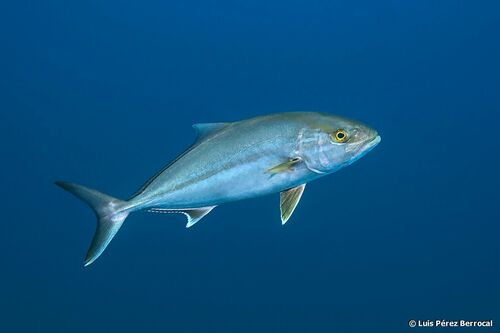
Morphologically, the crevalle jack resembles many other deep-bodied carangids. It has an elongate, moderately compressed body, with a dorsal profile that is more convex than the ventral profile, especially in the anterior section.
Head and Jaw Features
A well-developed adipose eyelid covers the eye, and the posterior tip of the jaw sits vertically under or past the posterior eye margin.
Dorsal Fin Structure
The dorsal fin is split into two distinct parts: the first holds eight spines, while the second holds one spine followed by 19 to 21 soft rays.
Anal Fin Structure
The anal fin has two anteriorly detached spines, followed by one spine and 16 or 17 soft rays.
Paired Fin Structure
Pelvic fins contain one spine and five soft rays, while pectoral fins contain 20 or 21 soft rays. The caudal fin is strongly forked, and the pectoral fins are falcate, longer than the length of the head.
Lateral Line and Scutes
The lateral line has a prominent, moderately long anterior arch, with the curved section intersecting the straight section midway below the second dorsal fin. The straight section holds 23 to 35 very strong scutes, and bilateral keels are present on the caudal peduncle.
Scale Pattern
The chest has no scales, except for a small patch of scales located in front of the pelvic fins.
Dentition
The upper jaw holds a series of strong outer canines, with an inner band of smaller teeth, while the lower jaw holds a single row of teeth.
Internal Anatomy Counts
The species has 35 to 42 total gill rakers and 25 vertebrae.
Pathological Jaw Swelling Record
In 1972, a crevalle jack caught by fishermen off South Carolina had swollen, bulbous mandibles. These swellings were first assumed to be caused by a copepod parasite, but radiographs and subsequent sectioning showed they were bony in nature. The cause of this calcified connective tissue is still unknown, and only one reported case of this condition exists in crevalle jack.
General Body Coloration
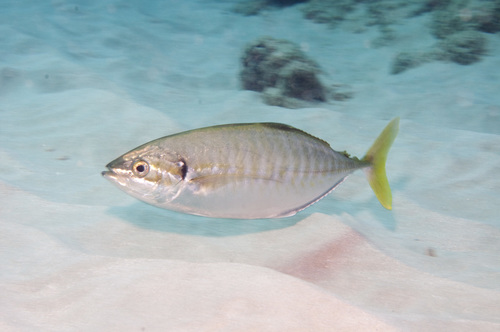
The crevalle jack’s dorsal color ranges from brassy green to blue or bluish-black, fading to silvery white or golden on its ventral side. A dark spot appears on the pectoral fin, and a similar dark to dusky spot appears on the upper margin of the operculum.
Juvenile Coloration
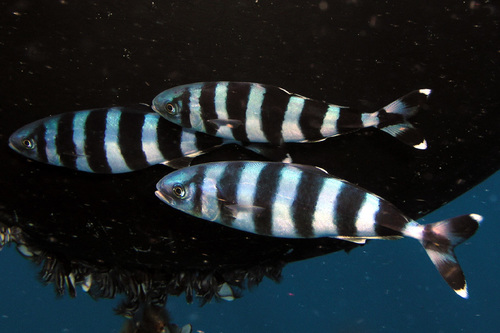
Juveniles have around five dark vertical bands on their sides, which fade as the fish reach adulthood.
Anterior Fin Coloration
The first dorsal fin, pectoral fins, and pelvic fins range from white to dusky, and occasionally have an overall golden tinge.
Anal Fin Coloration
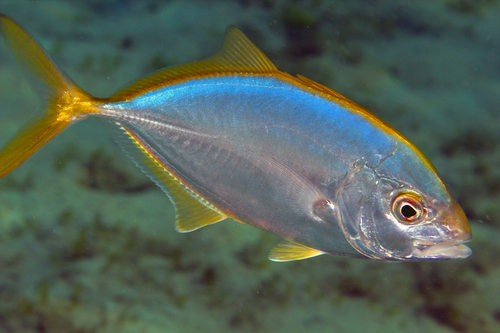
The anal fin lobe is bright yellow, while the rest of the fin ranges from golden to dusky.
Caudal Region Coloration
The underside of the caudal peduncle is often yellow in adult individuals. The caudal fin itself ranges from golden to dusky, and its lower lobe is often a brighter yellow than the upper lobe; both lobes frequently have a black trailing edge.
Overall Distribution Range
The crevalle jack lives in tropical and temperate waters of the Atlantic Ocean, with an extensive range along both the eastern American coastline and the western African and European coastlines.
Western Atlantic Southern Range
In the western Atlantic, the southernmost confirmed record is from Uruguay. From there, the species ranges north along the Central American coastline, throughout the Caribbean, and across many of the region’s numerous archipelagos.
Caribbean Distribution
It is found throughout the Greater Antilles, but is absent from the leeward Lesser Antilles, and its distribution is patchy across other Caribbean archipelagos.
Western Atlantic Northern Range
From the Gulf of Mexico, its range extends north along the U.S. coast, reaching as far north as Nova Scotia in Canada, and includes several northwest Atlantic islands. The crevalle jack is also recorded from Saint Helena Island in the southern Atlantic Ocean.
Eastern Atlantic Southern Range
In the eastern Atlantic, the southernmost confirmed record is from Angola. From there, the species is distributed north along the west African coastline up to West Sahara and Morocco, and its range includes most of the Mediterranean Sea.
Mediterranean Distribution
In the Mediterranean, its range extends as far east as Libya in the south and Turkey in the north, and includes most of the northern Mediterranean, including Greece, Italy and Spain.
Eastern Atlantic Northern Range
The species’ northernmost record in the eastern Atlantic is from Portugal, and it is also known to inhabit many northeastern Atlantic islands, including Cape Verde, Madeira Island, and the Canary Islands.
Misidentification in Eastern Pacific
Many older publications list the species as occurring in the eastern Pacific, but these records are now known to refer to the Pacific crevalle jack, which is classified as a separate species.
Misidentification in Indian Ocean
There are also frequent incorrect mentions of the crevalle jack having a circumtropical distribution and occurring in the Indian Ocean; these records are most likely attributable to similar Indo-Pacific species, specifically the blacktip trevally and giant trevally.
Sympatric Species Confusion
The crevalle jack’s distribution overlaps with that of the similar longfin crevalle jack in the eastern Atlantic, so careful identification is required to tell the two species apart. Within the Atlantic, confusion with both longfin crevalle jack and horse-eye jack (Caranx latus) has led to erroneous records.
Mediterranean Distribution Dispute
Smith-Vaniz and Carpenter suggest this confusion occurred in the Mediterranean, and the species may actually be absent from waters north of Mauritania.
General Habitat Preferences
The crevalle jack occupies both inshore and offshore habitats, with larger adult individuals preferring deeper waters than juveniles.
Inshore Coastal Habitats
In inshore environments, crevalle jack live in shallow flats, sandy bays, beaches, seagrass beds, shallow reef complexes and lagoons.
Brackish Water Tolerance
The species is also known to enter brackish waters, and some individuals have been recorded penetrating far upstream. However, like most euryhaline species, they generally do not move very far upriver.
Salinity Tolerance
The species has been reported from waters with salinities ranging from 0% to 49%, showing it can adapt to a wide range of conditions.
Brackish Water Population Structure
Studies in West Africa found clear differences in population sex ratios in brackish waters, with mature females very rarely observed in these environments.
Inshore Distribution Drivers
Research in the coastal waters of Ghana suggests food availability is the primary factor controlling the species’ inshore distribution.
Offshore Adult Habitats
Adults that move offshore generally do not leave continental shelf waters, but still reach depths of 350 m, and possibly deeper. These individuals live on outer shelf edges, sill reefs and upper slopes of deep reefs, and tend to be more solitary than juveniles.
Artificial Offshore Habitats
Adults have also been sighted around large oil rig platforms throughout the Gulf of Mexico, where they use the man-made structure like a reef to hunt prey.
Larval and Juvenile Pelagic Habitats
The larvae and young juveniles of the species live pelagically offshore along the continental shelf and slope, and are also known to gather around oil platforms and natural floating debris such as sargassum mats.
Population Abundance
The crevalle jack is one of the most abundant large carangids in the Atlantic Ocean. At least two systematic studies place it among the top five most abundant species in their study regions: lagoons in Nigeria and Chiapas, Mexico.
General Migratory Behavior
Both juveniles and adults are known to make seasonal migrations along American and African coastlines.
North American Winter Migration
In North America, young individuals that have settled in northern estuaries move to warmer tropical waters when winter begins, to avoid potential hypothermia.
Cold Temperature Mortality
At least one mass mortality event driven by hypothermia, which killed 200 crevalle jacks, has been reported from the Slocum River in Massachusetts. This confirms that low-temperature mortality is a major risk for north-ranging groups of the species, with temperatures below 9.0 °C apparently lethal to the fish. This risk applies not only to fish that live in rivers, but also to marine migrants that stay too long in temperate regions during winter.
African Migratory Patterns
In Nigeria, and likely other parts of Africa, the species makes seasonal migrations, possibly to access better prey availability, with fish arriving in Nigeria between September and November.
Diel Activity Pattern
The species is more active during the day than at night, which is reflected in larger fishery catches taken during the day.
Schooling Behavior
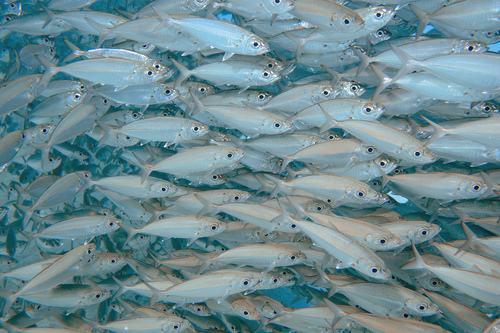
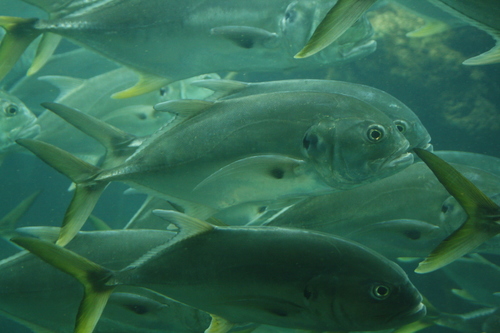
For most of its life, the crevalle jack is a schooling species, forming moderately large to very large, fast-moving schools. At larger sizes, fish become more solitary and move to deeper offshore reefs.
DMSP Aggregation Cue
Evidence from laboratory studies shows crevalle jack can coordinate their feeding and spawning aggregations over coral reefs based on the release of dimethylsulfoniopropionate (DMSP) from the reef. DMSP is a naturally occurring chemical produced by marine algae, and to a lesser extent by corals and their symbiotic zooxanthellae. Field studies have also shown the species becomes more abundant with increasing DMSP levels over coral reefs.