About Selaroides leptolepis (Cuvier, 1833)
Species and Size
The yellowstripe scad, Selaroides leptolepis, is a small fish species that reaches a maximum length of 22 cm, though most individuals grow to less than 15 cm.
Body Shape
It has the body shape typical of many scads: a compressed, elongated oblong body, with equally curved dorsal and ventral profiles. A fairly well-developed adipose eyelid covers the latter half of its eye.
Dentition
Its unique dentition is a key diagnostic feature; the upper jaw and mouth have no teeth at all, while the lower jaw holds a single row of fine villiform teeth.
Dorsal Fin Structure
Its dorsal fin is split into two parts: the first has 8 spines, and the second has 1 spine plus 24 to 26 soft rays.
Anal Fin Structure
Its anal fin has 2 detached spines followed by 20 to 23 soft rays, and there is one recorded case where these two spines were absent. Both the soft dorsal and anal fins have scaly basal sheaths.
Pectoral Fin Structure
The pectoral fin is sickle-shaped (falcate) and does not reach the junction between the curved and straight sections of the lateral line. Another defining characteristic of the species is that its pectoral girdle has no groove.
Lateral Line Characteristics
The anterior curve of the lateral line is moderate; the straight section contains 13 to 25 scales and 24 to 29 small scutes. The entire breast is covered in scales.
Gill Rakers and Vertebrae Count
The species has a total of 40 to 46 gill rakers, and 24 vertebrae.
Body Coloration
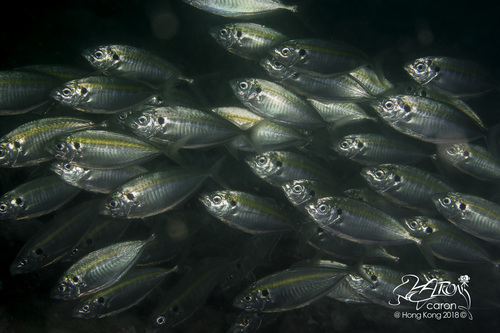
In coloration, the yellowstripe scad is metallic blue to blue-green on its upper body, fading to silvery white on its underside. It has a distinctive broad yellow stripe that runs from the upper margin of the eye to the caudal peduncle.
Markings
A prominent black spot on the operculum often extends onto the shoulder.
Fin Coloration
The dorsal, anal, and caudal fins range from pale to dusky yellow; the pelvic fins are white, and the pectoral fins are hyaline.
Overall Distribution Range
The yellowstripe scad lives in tropical and subtropical waters of the Indian Ocean and western Pacific Ocean.
Indian Ocean Distribution
In the Indian Ocean, its range extends from the Persian Gulf and northern Arabian Peninsula eastward to India and Southeast Asia, and south to northern Australia, where it occurs from Shark Bay in the west to Brisbane in the east. It is also found around offshore Indian Ocean islands like the Maldives.
Western Pacific Distribution
In the western Pacific Ocean, it ranges from Japan in the north south to the Indonesian Archipelago, and east to Pacific islands including New Caledonia and Vanuatu.
Habitat General
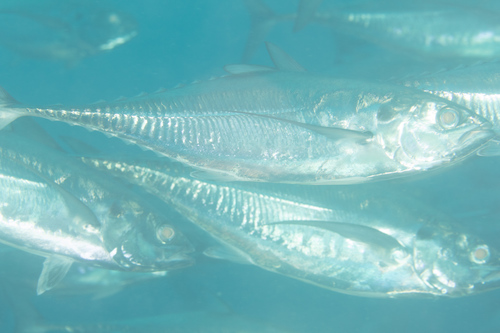
It is primarily an inshore species that forms large demersal schools over soft substrates.
Depth Range in Australia
In Australia, it lives in inshore and shallow shelf waters up to 50 m deep.
Depth Range in Malaysia
In Malaysia, it has been recorded at depths of 70 m, but it is most commonly found between 40 and 60 m deep.
Fisheries Importance
The yellowstripe scad is a common schooling fish across its range, and has been well studied because of its importance to fisheries. It is one of the most abundant fish species in the waters of northern Australia, the Philippines, and parts of India.
Migration Pattern
Only in Taiwan has a clear seasonal migration pattern been recorded: schools move to coastal waters in summer, then return to deeper shelf waters in winter. No other consistent large-scale movements have been recorded across its range.
Diet General
It is a predatory fish that feeds on a variety of crustaceans and other small prey, and its exact diet changes based on location and season.
Prey in Northern Australia
In northern Australia, the most common prey are ostracods, gastropods, and euphausiids.
Prey in India
In India, the diet is broader: crustaceans, particularly decapods and copepods, make up the majority of the diet. Small fish of the genus Anchoviella, pteropods, algal material, diatoms, molluscan larvae, and foraminifera make up the rest of the diet in this region.
Diet Variation
Different size classes of the species feed on different prey, and the overall diet shifts over the year as prey abundance changes.
Feeding Period
It is diurnally active in India, but nocturnal feeding has been reported in other parts of its range.
Feeding During Spawning
Unlike some related fish, the yellowstripe scad continues to feed during spawning, with no noticeable change in its food preferences.
Sexual Maturity Length
Published estimates of the length at which yellowstripe scad reach sexual maturity range between 8.8 cm (for fish less than one year old) and 11.4 cm. Researcher Tandon noted that his estimate was much lower than those from earlier studies, which he attributed to sampling bias caused by larger net mesh sizes used in previous work.
Breeding Season in India
In India, the species has a prolonged breeding season, with each individual spawning only once per year. The breeding season runs from July to March, with two distinct peaks in activity: one from January to April, and another from July to October.
Morphometric Variation
Morphometric studies from this same region found that some morphometric and meristic traits vary in ways that cannot easily be explained by differences between generations or populations. Researchers have suggested that this variation occurs because the two annual spawning peaks happen in different seasons, with very different water temperatures and salinities that influence these traits.
Sex Ratio During Spawning
During spawning, the ratio of males to females is close to 1:1.
Sex Ratio Outside Spawning
Outside of spawning season, the ratio varies by location, and females are usually more abundant. It is unclear why this imbalance occurs, and it may indicate that the sexes segregate between spawning periods.
Fecundity
Fecundity in the yellowstripe scad is directly linked to fish size: a 9.5 cm individual can produce 6300 ova, while a 13.1 cm individual can produce up to 37400 ova.
Egg Characteristics
Egg characteristics, ova maturity stages, and the early post-hatching growth stages are all well documented. The eggs are pelagic, and are found in both coastal waters and lower estuarine waters.
Juvenile Association with Jellyfish
Like the young of other carangids, yellowstripe scad larvae and juveniles associate with large jellyfish, using them for protection. Unlike most other associated species, however, yellowstripe scad swim ahead of the jellyfish's umbrella, and only move in short, sharp jerks in rhythm with the jellyfish's movement.