About Vulpes corsac (Linnaeus, 1768)
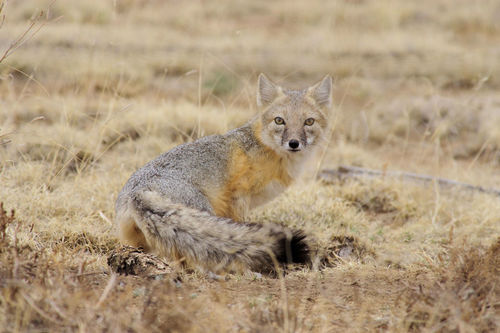
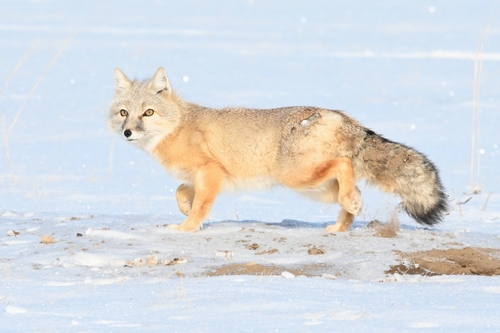
The Corsac fox (scientific name Vulpes corsac, first described by Linnaeus in 1768) is a medium-sized fox. Adults measure 45 to 65 cm in head-and-body length, have tails 19 to 35 cm long, and weigh between 1.6 and 3.2 kilograms. Most of its body fur ranges from grey to yellowish, with paler underparts and pale markings on the mouth, chin, and throat. In winter, its coat becomes much thicker and silkier, takes on a straw-grey colour, and has a darker line running down its back. Compared to other foxes, it has small teeth and a wide skull. One source states this species can climb trees and has been domesticated in the past. It has keen eyesight, keen hearing, and an acute sense of smell. It has multiple scent glands located in the anal region, above the base of the tail, and on the paws and cheeks; some of these glands produce pungent odours, though the odours are not as strong as those found in some other Vulpes species. Corsac foxes bark while hunting or when threatening rivals, and use higher-pitched yelps or chirps as alarm calls or social greetings.
Corsac foxes inhabit the steppes and semidesert of central and northeast Asia. Their range covers all of Kazakhstan, Uzbekistan, and Turkmenistan, and all except the northernmost regions of Mongolia. To the south, their range extends into the northern parts of Iran, Tajikistan, Kyrgyzstan, Afghanistan, and China, and they also live in adjacent regions of Russia. Three subspecies are currently recognized: Vulpes corsac corsac, found in northern Kazakhstan and southern Siberia; V. c. kalmykorum, found in northern Uzbekistan and the Caucasus; and V. c. turkmenicus, found in southern Uzbekistan, Turkmenistan, China, Mongolia, and neighbouring regions. These foxes live in open grassy steppes and semideserts, and avoid dense vegetation, mountainous regions, true deserts with drifting sands, and snowfields deeper than about 15 cm (6 in). They generally stay far from areas with human disturbance.
As an adaptation to the arid climate of their habitat, corsac foxes can go without food and water for extended periods. They are opportunistic foragers and hunters. Their diet varies across their range, and is made up primarily of small and medium-sized vertebrates, insects, and small rodents such as voles, gerbils, jerboas, hamsters, and ground squirrels. They also feed opportunistically on larger prey including hares and pikas, and scavenge carrion and human refuse. While predominantly carnivorous, they occasionally eat fruit and other vegetation, especially in winter when animal prey is less available. Natural predators of the corsac fox include the gray wolf, Eurasian eagle-owl, and other eagles; upland buzzards rarely prey on corsac fox pups. Golden eagles are major predators, with 38% of prey remains found in a Mongolian golden eagle nest belonging to corsac foxes.
Corsac foxes are nocturnal, nomadic hunters of the steppes. They do not maintain defended territories, and unlike some other fox species, they sometimes form packs. Diurnal activity is more common when adults need to feed kits and when food is scarce, such as during winter. Because they cannot hunt in deep snow, they either shelter in dens during harsh weather, or migrate up to 600 km (370 mi) south for winter in the northern parts of their range. They have been reported to follow local antelope herds, relying on the herds to compress snow as they travel. Corsac foxes dig their own generally shallow dens, and also take over burrows originally built by other animals such as marmots, ground squirrels, or badgers. Dens may have multiple entrances, but are usually less than 1 metre deep. Social packs share burrow systems, which consist of several dens connected by holes that resemble "corsac cities". They are excellent climbers, but are rather slow runners that can be caught easily by dogs. While they are typically nocturnal in the wild, they are very active during the day in captivity.
The corsac fox mating season runs from January to March. Males initially fight to gain access to females, but eventually form monogamous pairs, and males assist in raising their young. The mother first builds a birthing den, which is sometimes shared with other pregnant females, but moves her young to new burrows multiple times after birth. Most litters have two to six young, born after a gestation period of 52 to 60 days, though litters of up to ten kits have been recorded. Newborn kits weigh around 60 g (2.1 oz), and have fluffy, light brown fur that yellows as they age. They are born blind, and open their eyes at around two weeks old; they start eating meat at four weeks old, and emerge from the den shortly after. Corsac foxes reach sexual maturity between 9 and 10 months old, and breed for the first time in their second year of life. They live up to 9 years in the wild.