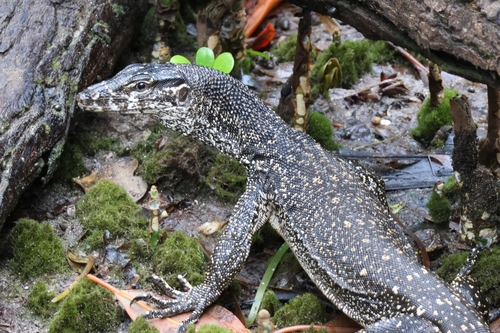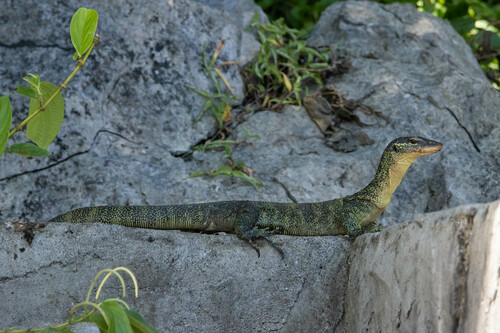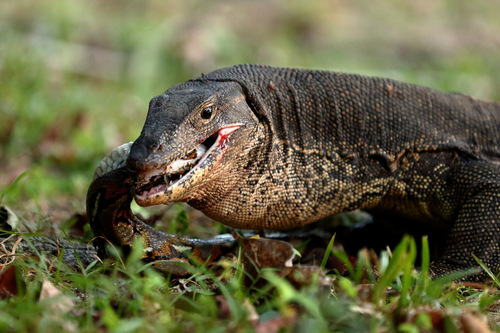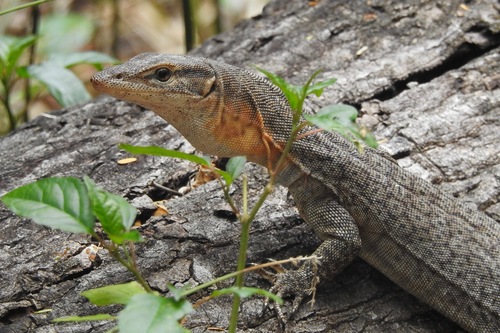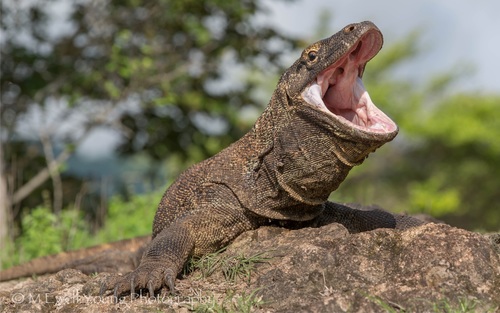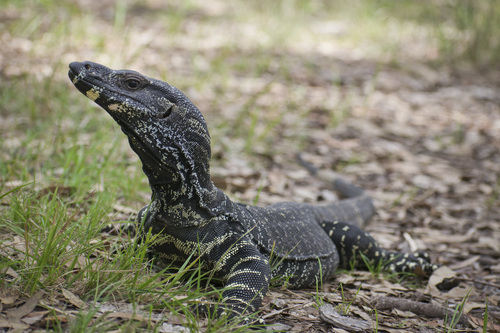
About Varanus varius (Shaw, 1790)
Size
The lace monitor (Varanus varius) is the second-largest monitor lizard species in Australia, out-sized only by the perentie. It can reach a total length of 2 meters (7 feet), with a maximum snout–vent length (SVL) of 76.5 cm, and can weigh up to 14 kilograms (30 pounds).
Sexual Maturity
Males reach sexual maturity at a SVL of 41.5 cm, while females reach sexual maturity at a SVL of 38.5 cm. Females are generally smaller than males, with a maximum recorded SVL of 57.5 cm.
Tail Features
The lace monitor's tail is long and slender, measuring roughly 1.5 times the combined length of its head and body. The base of the tail is cylindrical, and it becomes laterally compressed toward the tip.
Historical Size Reports
Historically, some reports described lace monitors reaching up to 8 feet in total length; whether these reports are accurate or not, lace monitors of this size are very likely no longer found today.
Habitat Use
This common species of monitor is both terrestrial and often arboreal. It is distributed across eastern Australia, ranging from Cape Bedford on Cape York Peninsula to south-eastern South Australia.
Foraging Behavior
It occupies both open and closed forest habitats, and forages over long distances, traveling up to 3 kilometers (1.9 miles) in a single day.
Activity Cycles
It is mainly active from September to May, and becomes inactive during cooler weather, when it shelters in tree hollows, under fallen trees, or under large rocks.
Conservation Status
The International Union for Conservation of Nature classifies the lace monitor as a species of least concern.
Breeding Season Timing
In at least the temperate parts of its range, the lace monitor's breeding season occurs during summer.
Breeding Male Behavior
During the breeding season, male lace monitors fight one another by grappling while standing on their hind legs, and up to six males may gather around a receptive female to attempt courting her.
Mating Duration
Mating lasts for several hours.
Clutch Size
On average, females lay a clutch of eight eggs, and can lay as many as 12 eggs.
Egg Laying Sites
Females most often lay their eggs in active termite nests located either on the ground or in trees. When active termite nests are scarce, females may fight over available nests, or lay their eggs in burrows and potentially hollow logs.
Egg Development
The eggs overwinter and hatch 6 to 7 months after being laid. Hatchlings stay near the nest for around a week or longer before leaving the area.
Nest Fidelity and Lifespan
Females may return to the same termite nest to lay future clutches of eggs. Lace monitors can potentially live for over 20 years.
Wiradjuri Traditional Use
Historically, the Wiradjuri people ate lace monitor meat, and local wisdom advised eating only individuals that came down from trees, as those that fed on the ground tasted like rotting meat.
Tharawal Traditional Use
The Tharawal people collected and ate the species' eggs from sand on riverbanks in the Nattai and Wollondilly regions.
Archaeological Evidence
Goanna (lace monitor) remains have been found in middens in what is now Sydney.
Captive Keeping
Currently, the lace monitor is bred in captivity to be kept as an exotic pet.