About Varanus indicus (Daudin, 1802)
Body Coloration
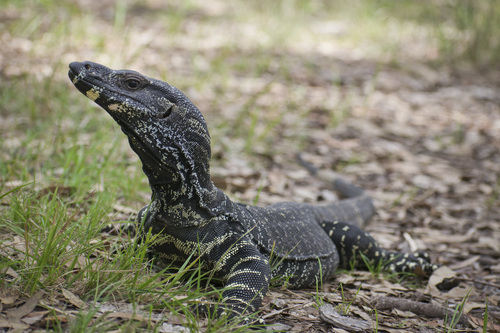
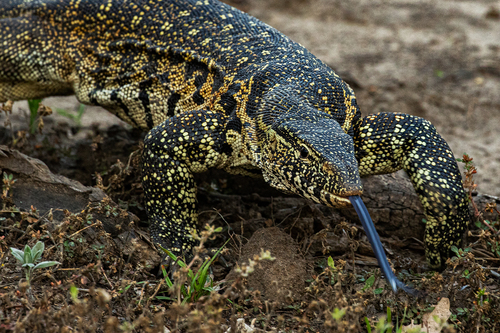
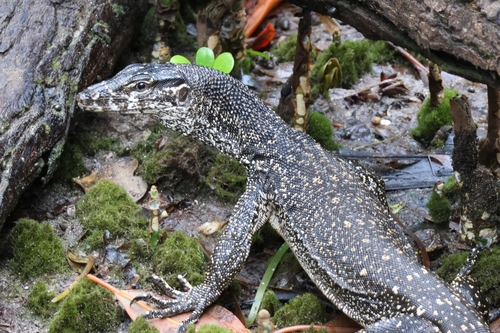
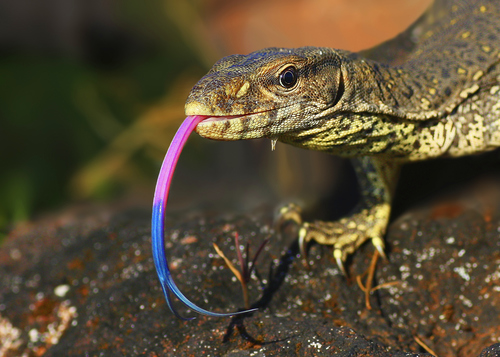
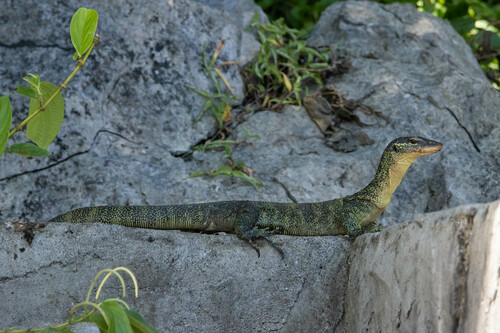
This species, commonly called the mangrove monitor, has a dark green or black body covered with golden-yellow spots, pale coloration on the top of the head, and a solid cream-colored belly with no dark markings. It has a distinctive dark purple tongue and serrated teeth.
Size
Total length varies across the species' range, and it rarely exceeds 1.3 m; Australian specimens are recorded to reach 100 cm in total length by Australian herpetologist Harold Cogger.
Tail Structure
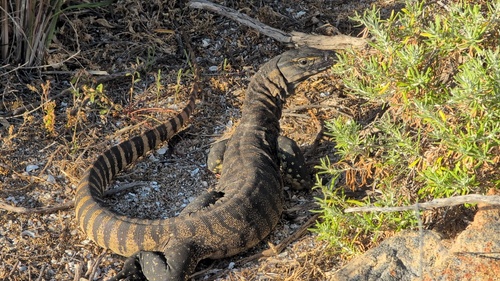
Its tail is almost twice as long as its body, and is laterally compressed to help with swimming. Like the rest of the mangrove monitor's body, the tail is covered in small, oval, keeled scales.
Feeding Adaptations
The species can increase the size of its mouth to eat large prey by spreading the hyoid apparatus and dropping its lower jaw; this looks similar to the feeding process of snakes, though the mangrove monitor's jaw stays rigid. It has a Jacobson's organ that it uses to detect prey: it sticks its tongue out to gather scents, then touches the tongue to the opening of the organ when the tongue is retracted.
Salt Excretion Adaptation
The mangrove monitor is one of only two monitor lizard species that have salt-excreting nasal glands (the other is Varanus semiremex). This adaptation allows it to survive in saltwater conditions and eat marine prey, and the gland likely helped the species reach new islands, supporting its dispersal across the Pacific.
Native Range
The mangrove monitor's native range spans northern Australia, New Guinea, the Solomon Islands, and the Moluccan islands of Morotai, Ternate, Halmahera, Obi, Buru, Ambon, Haruku, and Seram in Indonesia.
Habitat
It lives in damp forests near coastal rivers, mangroves, and permanent inland lakes.
Morphological Variation
Across the species' range, which covers thousands of miles and hundreds of islands, there is extensive variation in size, pattern, and scalation.
Introduced Range
The species has also been introduced to Japan, with introductions occurring since the 1940s.
Reproductive Behavior
During reproduction, males fight over females. One observed mating event saw the male mount the female, then rub his chin on the back of the female's head and forequarters. While mounted and oriented head-to-head, the pair rotated slowly 360 degrees clockwise, with the male remaining on top.
Egg Characteristics
Females lay 2 to 12 oblong, white eggs that measure 3.5 to 5 cm in length. The eggs hatch after roughly seven to eight months.
Captive Breeding Records
The first successful captive breeding of the mangrove monitor happened at the Philadelphia Zoo in 1993. There is also a recorded successful hatching of eggs from an unfertilized female held at the Reptilian Zoo in Vlissingen, the Netherlands, where the female had no contact with a male of the species.